
Lightbridge Advances Metallic Nuclear Fuel Development Amid Pilot-Scale Facility Planning and Government Collaborations
Lightbridge Corporation progresses toward commercialization of its proprietary metallic nuclear fuel technology while navigating capital requirements and regulatory engagement.
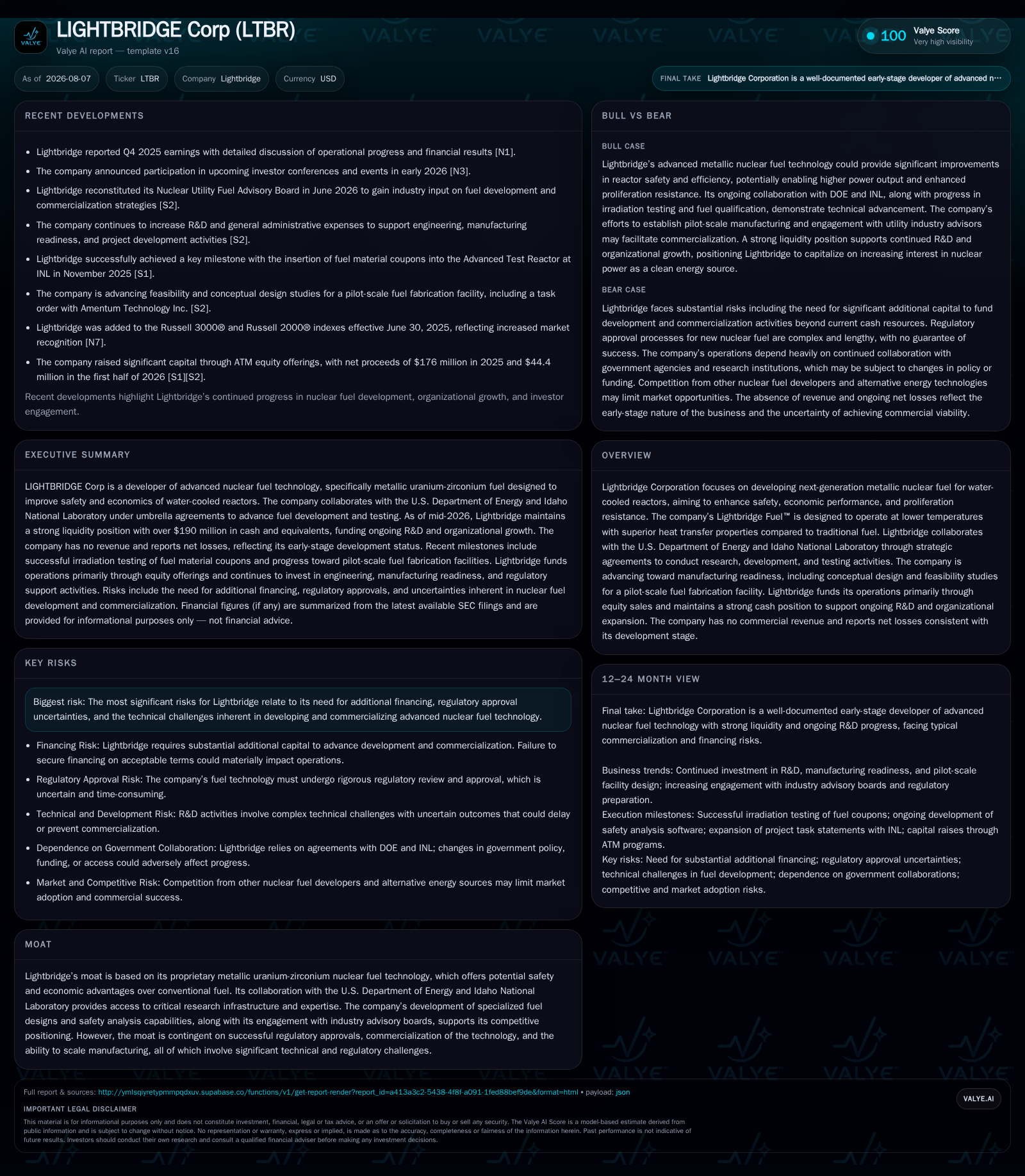
Lightbridge Corporation's latest quarterly filing highlights increased operating expenses supporting R&D and organizational growth as it moves closer to manufacturing readiness, including pilot-scale facility conceptual design. The company continues strategic collaborations with U.S. Department of Energy and national labs, also reconstituting a Nuclear Utility Fuel Advisory Board to align development with industry needs. While well-capitalized with over $192 million cash on hand, sustained funding via equity remains critical given the long development cycle and substantial future capital demands. Regulatory uncertainties and scaling fabrication capacity remain key challenges for eventual commercialization.
Recent Operating Update
Lightbridge Corporation’s latest quarterly report for the period ended June 30, 2026 reveals continued operational focus on advancing its Lightbridge Fuel™ metallic uranium-zirconium nuclear fuel technology. The company reports increased general and administrative (G&A) and research and development (R&D) expenses, reflecting expanded activities towards regulatory approval, pilot-scale manufacturing readiness, and development of organizational infrastructure [S2]. Notably, Lightbridge is evaluating potential sites and conceptual designs for a pilot-scale fuel fabrication facility known as the Lightbridge Expandable Fuel Facility (LEFF). This step aims to transition the company from mostly research-focused efforts toward manufacturing readiness, a critical phase that could de-risk later commercial scale-up [S2]. Construction could commence as early as 2027 contingent on regulatory approvals, financing availability, and strategic partnerships.
Further supporting this transition is Lightbridge’s submission of an application to the U.S. Department of Energy’s Nuclear Energy Launch Pad program seeking collaboration authorization. Such involvement offers regulatory flexibility and funding prospects that can expedite fabrication and testing of its lead test assemblies (LTAs), effectively shortening the time to potential commercialization [S2]. Additionally, the company reconstituted its Nuclear Utility Fuel Advisory Board in June 2026 to integrate insights from utility representatives regarding fuel licensing priorities, deployment strategies, and operational requirements; although the board operates without binding commitments from participants [S2].
Business Model Overview
Lightbridge operates in the advanced nuclear fuel technology sector by developing proprietary metallic nuclear fuels intended for water-cooled reactors. Its core product, Lightbridge Fuel™, is designed with a uranium-zirconium alloy that exhibits superior thermal conductivity compared to conventional oxide fuels, enabling lower operating temperatures within reactor cores. These features promise improved safety margins—such as reduced meltdown risk—and enhanced economic performance through better burnup rates and potentially longer fuel cycles.
Currently in pre-commercial stages, Lightbridge’s business model centers around extensive research and development funded primarily through public equity sales supplemented by strategic collaborations with government agencies—especially DOE—and national laboratories like Idaho National Laboratory (INL) [S1][S2]. The company lacks commercial revenue at this stage but invests heavily in R&D under contractual umbrella agreements such as Cooperative Research and Development Agreements (CRADA) and Strategic Partnership Project Agreements (SPPA) with INL operating contractor Battelle Energy Alliance (BEA). These collaborations provide access to vital testing infrastructure yet expose Lightbridge to cost reimbursements capped at around $14 million for ongoing project tasks [S1][S20].
The ultimate monetization strategy likely involves licensing intellectual property or supplying metallic fuel assemblies directly to nuclear utilities following successful commercialization. Manufacturing readiness initiatives—including pilot-scale fuel fabrication capability—are intended to bridge development progress with market-facing operations, though any large-scale fuel supply would require additional substantial capital investment beyond current funding levels.
Industry Structure and Competitive Positioning
Lightbridge occupies an upstream niche within the nuclear fuel value chain specializing in innovative fuel design rather than reactor operation or assembly manufacturing dominance. Key peers include established traditional nuclear fuel suppliers such as Framatome and Westinghouse Electric Company—entities that offer licensed oxide or mixed-oxide fuels manufactured at scale globally.
However, Lightbridge differentiates itself through metallic nuclear fuel technology leveraging higher thermal conductivity with potential for improved reactor safety profiles. The sector is characterized by lengthy R&D cycles involving rigorous testing, regulatory approvals from entities like the U.S. Nuclear Regulatory Commission (NRC), and substantial capital needed to scale manufacturing. Collaborations with DOE programs provide technical validation opportunities unavailable to smaller independent firms but achieving widespread market adoption poses challenges given entrenched incumbents.
The company’s current competitive moat derives from proprietary metallurgical expertise in producing uranium-zirconium alloys suitable for water-cooled reactors alongside ongoing advancements in safety analysis capabilities. This has been supplemented by assembling an advisory board comprising nuclear utility representatives, signaling an alignment effort toward licenseability and customer-centric design considerations despite no immediate purchase commitments.
Growth Drivers
Several structural growth drivers underpin Lightbridge’s opportunity:
- Government initiatives incentivizing advanced nuclear technologies boost available R&D funding channels while providing pathways for regulatory flexibility such as DOE's Nuclear Energy Launch Pad program [S2].
- Globally rising interest in clean energy enhances nuclear demand outlooks wherein safer, more economical fuels gain heightened importance.
- Technological innovation enabling higher burnup rates enhances thermal efficiency of reactor cores while contributing to utilities’ cost savings over lifetime operations.
- Collaborative agreements with national labs facilitate access to critical test data and establish credibility fundamental for licensing submissions.
- Modernization programs among existing global nuclear fleets encourage adoption of next-generation fuels that promise operational improvements.
Tracking operational KPIs such as R&D expenditure growth indicating investment intensity, progress on pilot-scale manufacturing site selection/design milestones, engagement levels via collaborative task statements with BEA/INL, advisory board activity magnitude, burnup performance tests underway or completed under government auspices constitute actionable markers for investor analysis going forward.
Risks and Constraints
Despite promising technological advances, notable risks persist:
- Regulatory approval timelines remain inherently uncertain due partly to stringent nuclear safety standards; delays materially impact commercialization pacing.
- Technical challenges associated with scaling metallic uranium-zirconium fuel fabrication beyond lab scale raise execution risks; pilot facility construction adds capital intensity.
- Dependence on future availability of economically viable high-assay low-enriched uranium (HALEU)—critical feedstock—is an ongoing supply chain vulnerability [S1][S12].
- Continuous equity financing reliance introduces dilution pressure; current cash runway extends approximately one year necessitating fresh capital raises or strategic investments for development continuity [S8][F1].
- Market acceptance by conservative nuclear utilities accustomed to conventional oxide fuels may require strong safety/economic case evidence post-regulatory approval before significant orders materialize.
- Competitive pressures from incumbent suppliers with established manufacturing infrastructure.
What To Watch Next
Key upcoming milestones include:
- Finalization of site location decision and conceptual design completion timelines for LEFF pilot-scale fabrication facility targeted possibly by late 2026 or early 2027 initiation [S2].
- Outcomes of DOE Nuclear Energy Launch Pad application process influencing pace of initial LTA fabrication/testing activities.
- Progression benchmarks within CRADA/SPPA task statements detailing experimental burnup performance results or licensing dossier preparations.
- Further activities or announcements from the Nuclear Utility Fuel Advisory Board that might shed light on priority shifts or early indications of industry receptivity.
- Quarterly reports tracking changes in operating expense patterns indicative of ramped commercial readiness activities versus pure R&D efforts.
- Equity financing rounds or alternative funding agreements filling capital requirements beyond mid-2027 horizon.
Financial Profile Discussion
At June 30, 2026, Lightbridge reported cash and cash equivalents totaling approximately $192 million against nominal current liabilities (~$2 million), resulting in a highly liquid balance sheet with a current ratio exceeding 116:1 [F1][S8]. The company carries minimal debt exposure based on last available metric from September 2017 ($600K), implying negligible leverage relative to its cash holdings [F1].
Operating cash outflows continue at about $8.3 million over six months ended June 30, 2026 reflecting sustained R&D ramp-up and G&A expansion consistent with strategic growth plans [S26]. All operating losses stem from these pre-commercial expenses without any associated revenues recorded historically [F1]. Funding principally derives from at-the-market common stock issuances generating net proceeds around $44 million in H1 2026 alone [S8][S26], reinforcing dependence on capital markets amid absence of operational cash flow generation.
While ample liquidity exists near term, management acknowledges need for future capital beyond one year timeframe barring revenue generation or significant grant inflows [S8][S11]. Any setbacks in regulatory approvals or technological milestones could pressure future funding needs further given high fixed-cost nature intrinsic to pilot facility build-out or other commercial prep investments.
This analysis synthesizes reported filings through August 2026 combined with sector knowledge applicable to advanced nuclear fuel developers focusing on metallic uranium alloys. No claims are made regarding specific commercialization dates or market penetration absent direct disclosure. Please note this report excludes investment research views or price predictions consistent with policy directives.
Disclaimer: This is research-only, informational analysis and not investment advice. It may include AI-generated interpretation and general industry context. Always verify important details using primary sources.

Comments