
NETGEAR Leverages Regulatory Edge to Sustain Innovation Amid Market Pressures
NETGEAR’s early FCC conditional approvals and cybersecurity governance underpin resilience despite near-term revenue decline and net losses.
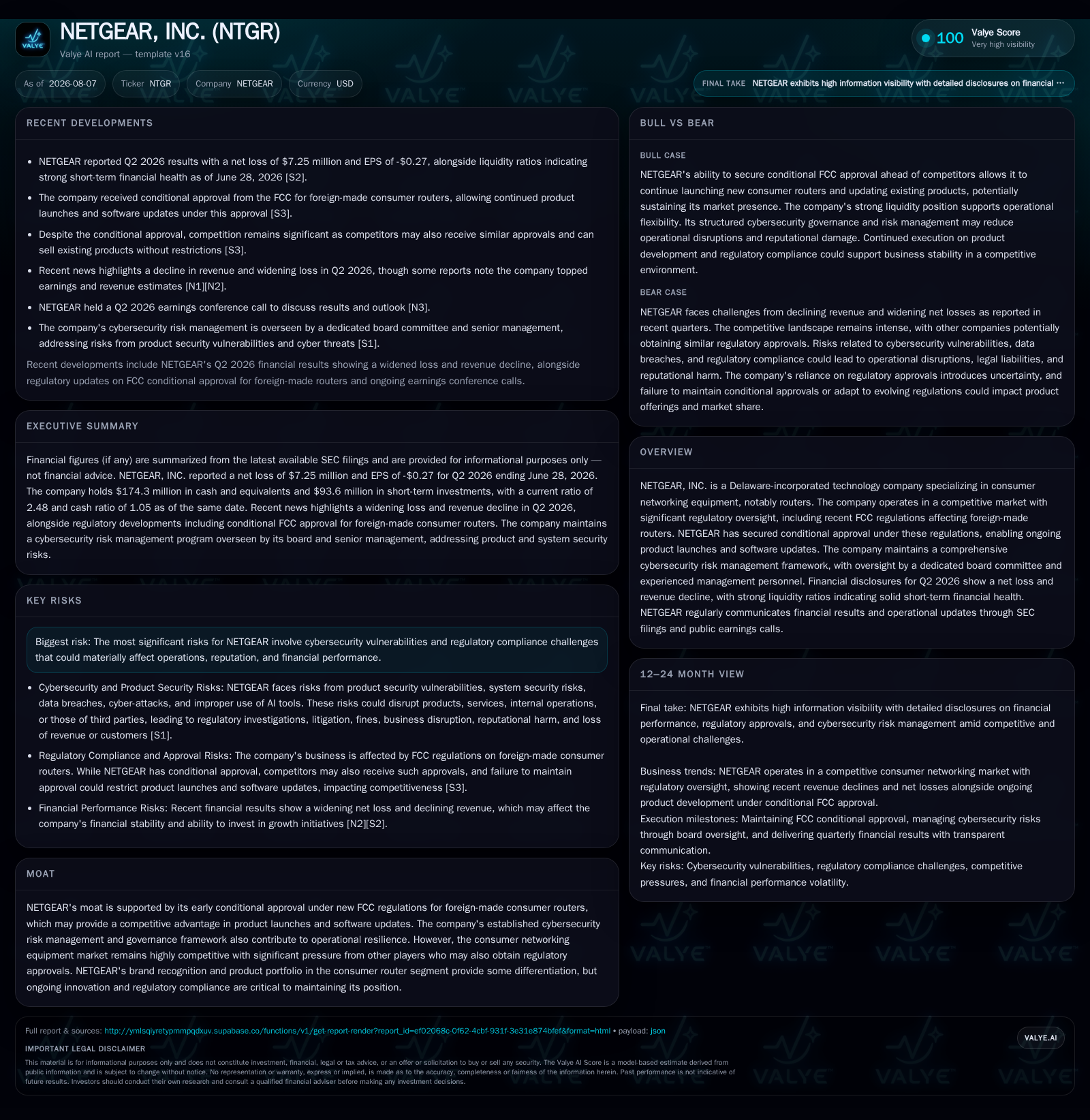
In Q2 2026, NETGEAR reported lower revenues alongside a net loss, reflecting ongoing competitive pressures in the consumer networking hardware sector. Critically, the company holds early conditional approval from the FCC for foreign-made routers under new regulations, enabling uninterrupted product launches and software updates, which constitute a significant strategic advantage. NETGEAR's structured cybersecurity risk management framework further reinforces its operational stability amid cybersecurity threats. While facing supply chain and market challenges common to the industry, NETGEAR’s regulatory positioning and product lifecycle management remain key differentiators.
Q2 2026 Operational Update Highlights Regulatory Leverage during Revenue Pressure
NETGEAR's latest quarterly report filed August 6, 2026, details a revenue decline coupled with a continued net loss, signaling persistent headwinds in the consumer networking hardware space [S2]. Despite this short-term financial softness, the company has secured an early conditional approval under the FCC's stringent new regulations targeting consumer routers produced abroad [S1][S15]. This approval critically allows NETGEAR to launch new router models and provide software updates uninterruptedly—functions essential in sustaining competitive relevance given the rapid product refresh cycles inherent to the industry. Such regulatory clearance goes beyond quarterly results in shaping long-term market access and innovation capabilities.
NETGEAR’s Product Ecosystem: Quality, Firmware Updates, and Compliance as Differentiators
At its core, NETGEAR generates revenue predominantly through designing and selling consumer-grade networking hardware — routers, modems, and wireless access points — primarily through retail and e-commerce channels targeting consumers and small businesses [S1]. Beyond upfront device sales, the company supplements revenue via firmware updates that extend product lifecycle durability and enhance security features. These updates rely on maintaining regulatory certification eligibility to avoid interruption.
The company's cybersecurity risk management is governed by a dedicated Cybersecurity Committee within the Board of Directors alongside seasoned management roles like the General Counsel & Chief Privacy Officer [S1]. This governance structure ensures proactive oversight of cyber threats inherent in connected consumer electronics. Regular incident response protocols and quarterly reporting to board-level committees enhance customer confidence by mitigating risks that could otherwise induce recalls or brand damage. This comprehensive approach positions NETGEAR to better manage the balance between service quality — as measured by software update frequency — and cost burdens linked with warranty claims.
Market Structure in Consumer Networking Hardware: Competitive Intensity Meets Regulatory Complexity
The industry is highly competitive with brands such as TP-Link, D-Link, and Linksys competing aggressively on price and technology features. OEM component commoditization constrains pricing power while regulatory certifications like FCC approval represent a significant bottleneck impacting time to market for U.S.-sold devices [S1]. Peer firms are navigating this complex landscape where product unit shipments can be volatile due to ongoing shifts in consumer preferences toward mesh networking solutions or integrated smart home support.
This intensifies pressure on manufacturing lead times and supply chain agility. In particular, component availability can affect inventory levels across retail channels – key drivers of quarter-to-quarter revenue fluctuations. NETGEAR's recognized brand portfolio supports some differentiation; however, sustaining ASPs amid price competition remains challenging.
Strategic Advantages from FCC Certification: Sustaining Product Launch Momentum
NETGEAR’s position as the first retail consumer router company granted conditional FCC approval under recent foreign-manufacture regulations creates a rare strategic vehicle [S16][S15]. This status not only enables continuous new product introductions but also secures the ability to issue vital firmware patches indefinitely — a crucial factor for network security maintenance given rising cyber threats.
Competitors lacking such clearance risk delayed software support or regulatory barriers restricting innovation timelines. While some rivals may eventually obtain similar approvals, NETGEAR currently enjoys an operational moat that supports customer retention via uninterrupted service experiences. This advantage is especially meaningful as regulatory frameworks tighten around national security concerns surrounding networking equipment origins.
Risks From Cybersecurity Exposure and Supply Chain Dependencies to Watch Closely
Despite robust oversight structures detailed in annual filings [S1], cybersecurity vulnerabilities remain an inherent risk for NETGEAR. Potential exploits could prompt product recalls or harm reputational capital severely affecting sales volumes [S22]. The company's multi-tiered governance—including specialized incident response teams—lower but do not eliminate these risks.
On supply chain fronts, global sourcing challenges persist pressure on OEM component availability vital for manufacturing continuity. Any significant disruption could constrain channel inventory levels or delay product launches—factors that directly impact operating margins given fluctuations in unit shipments. Additionally, aggressive price competition among peers compresses profit leverage.
Growth Catalysts: Smart Home Trends, Wi-Fi Standard Advances, and Replacement Cycles
Structural growth drivers underpinning NETGEAR’s market opportunity include accelerating demand for broadband connectivity fueled by remote work trends and smart home device proliferation requiring dependable mesh networking architectures. Adoption of emerging Wi-Fi standards such as Wi-Fi 6 and Wi-Fi 7 fuels capital expenditures into R&D to develop compatible products meeting evolving customer expectations.
The current ratio stands at approximately 2.48 with cash plus equivalents at $174 million [F1], indicating ample short-term asset coverage of liabilities. This financial flexibility permits sustained investment in research & development imperative to aligning with new Wi-Fi standards and extending product life cycles through software services.
While Q2 results reflect a net loss consistent with intensified market competition [N2][F1], sufficient liquidity buffers mitigate solvency risks allowing focus on long-term strategic initiatives centered on regulation-driven competitive advantages rather than near-term profitability alone.
This analysis reflects information directly supported by SEC filings through August 2026 alongside pertinent sector knowledge applicable to consumer networking hardware manufacturers engaging in U.S. markets constrained by evolving federal regulations. Commentary emphasizes cause-effect links between regulatory approvals, cybersecurity governance frameworks, competitive dynamics, growth catalysts, risks exposure, and financial health without speculative assumptions about exact future outcomes or competitor actions.
Disclaimer: This is research-only, informational analysis and not investment advice. It may include AI-generated interpretation and general industry context. Always verify important details using primary sources.

Comments