
Tyra Biosciences Advances Clinical Pipeline with Robust Cash Reserves Supporting R&D Momentum
Tyra’s August 2026 quarterly filing highlights a strong liquidity cushion fueling its clinical development programs and positions it well for upcoming regulatory milestones in a capital-intensive biotech landscape.
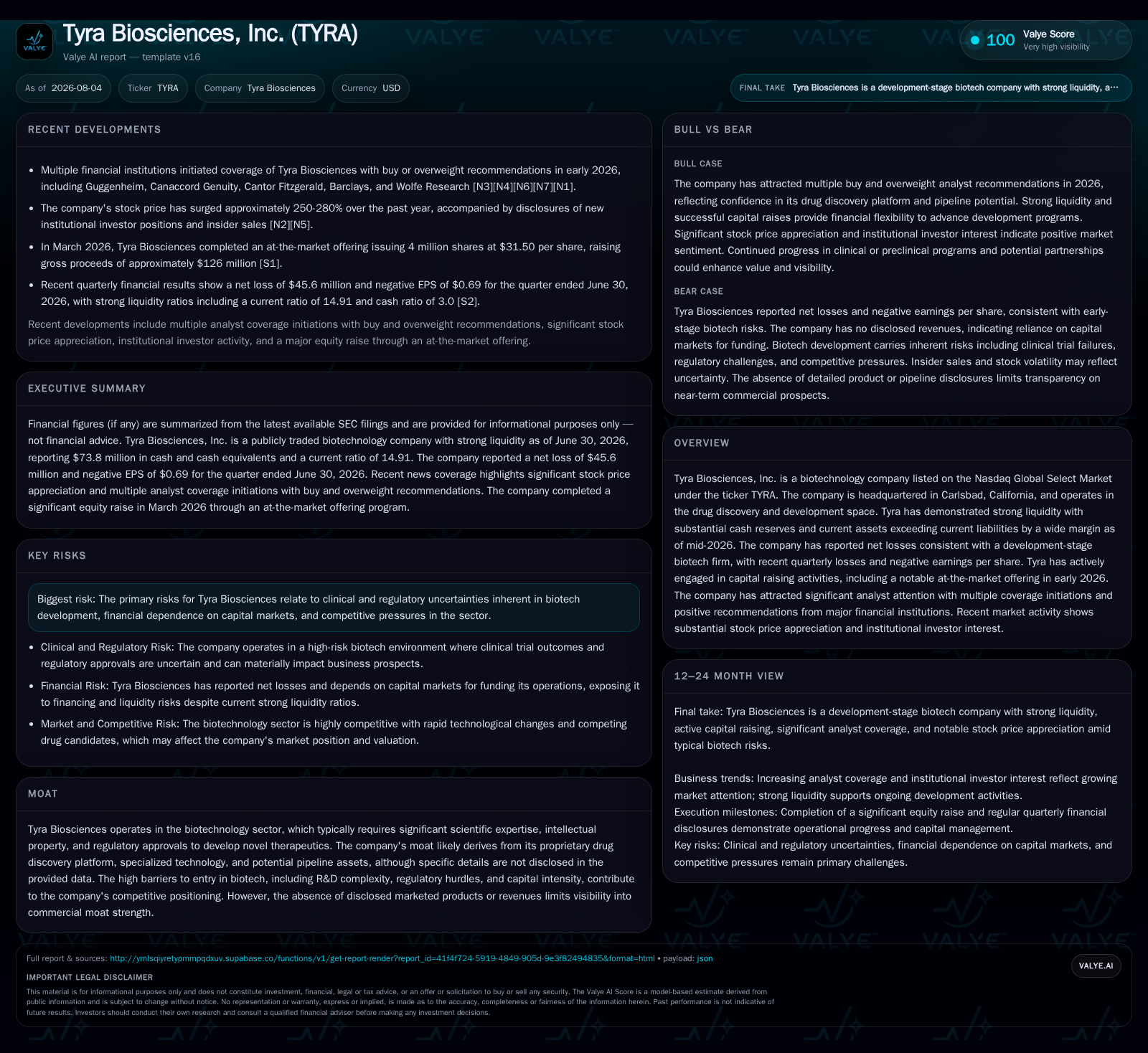
Tyra Biosciences reported substantial cash reserves of approximately $74 million as of June 2026, paired with a current ratio near 15x, underscoring its strong liquidity to support ongoing research and development efforts. The company continues to progress multiple early- to mid-stage clinical programs, relying on proprietary drug discovery platforms that form the basis of its competitive moat amid typical biotech risks. While no detailed trial timelines are disclosed, management’s recent capital raising initiatives, including a sizeable at-the-market offering, reflect proactive financial stewardship aimed at sustaining clinical progress against regulatory and market uncertainties.
Quarterly Operating Update Highlights Liquidity and R&D Focus
In its latest quarterly filing ending June 30, 2026, Tyra Biosciences reported $73.8 million in cash and cash equivalents alongside current assets of approximately $367 million against current liabilities near $24.6 million, yielding a current ratio around 14.91x [F1]. This liquidity snapshot reflects a robust cash runway crucial for sustaining the company's labor-intensive drug discovery and clinical development programs in the absence of product revenue. Operating losses continue to align with expectations for an early-stage biotech still heavily investing in R&D before commercialization [F1]. This financial strength is significant given the sector’s intense capital burn rates typical during multi-phase clinical trials.
Drug Discovery Platform and Pipeline Position Support Competitive Moat
Tyra advances a proprietary drug discovery platform underpinning its pipeline comprising multiple therapeutic candidates progressing chiefly through preclinical and early clinical stages [S1][S2]. Although specific product details are sparse, this platform-centric model suggests intellectual property IP barriers central to its competitive moat, consistent with industry norms where unique molecular mechanisms drive differentiation amid crowded therapeutic areas. Sustained R&D expenditure is necessary to deepen this pipeline while protecting IP rights—a standard biotech value chain hallmark reflecting Tyra's focus on innovative molecular targets in niche indications with potential for expedited FDA pathways such as orphan drug designation.
Clinical Development Progress Anchors Key Value Inflection Points
While exact clinical trial enrollment metrics and deadlines are not detailed in filings, Tyra confirms active advancement within phase 1 and phase 2 trials including noteworthy programs like BEACH301—focusing on pediatric achondroplasia—with initial safety results expected later this year [S3][S29]. These milestones typically delineate critical valuation inflections as positive outcomes validate mechanism of action hypotheses and regulatory interest. The pace of patient recruitment, trial data completeness, and regulatory guidance shape near-term catalysts by defining timing and quality of data readouts essential for subsequent funding rounds or partnering opportunities.
Industry Context: Capital Intensity Meets Regulatory Complexity
The biotechnology industry’s intrinsic characteristics heavily influence Tyra’s operating environment. Lengthy drug development cycles requiring multiple phase-based clinical trials impose substantial upfront costs well ahead of any revenue generation [S1], compounded by rigorous FDA review processes demanding clear demonstration of safety and efficacy before approval. Many biotechs seek orphan drug designations to accelerate timelines; while not explicitly confirmed here, such designations often materially affect strategic development paths. The sector's innovation-driven but high-failure-rate nature necessitates significant capital raising capabilities coupled with nimble operational execution.
Growth Drivers Stem from Trial Advancement and Strategic Funding
Key growth enablers for Tyra rest on advancing its pipeline candidates through progressive trial phases while managing regulatory submissions efficiently. Capital raising efforts notably include a substantial at-the-market offering completed earlier in 2026 that raised gross proceeds exceeding $120 million [S3][S21], enhancing financial flexibility to execute complex trial protocols uninterrupted. Success in initial safety cohorts—such as those for dabogratinib—and subsequent expansion cohorts represent forthcoming value drivers supported by methodical enrollment acceleration and adherence to protocol-defined endpoints.
Risks Concentrate Around Clinical & Regulatory Uncertainties and Capital Dependency
Consistent with biotech sector dynamics documented in risk disclosures [S1][S2][F1], Tyra faces inherent uncertainties stemming from potential trial delays or failures that could materially impact timelines and costs. Regulatory setbacks such as FDA non-acceptance or modified requirements add layers of execution risk. Additionally, despite recent successful capital raises, continued reliance on equity markets introduces dilution concerns that warrant monitoring against actual burn rates versus available cash resources.
Near-Term Catalyst Watch: Enrollment, Milestones, and Market Confidence
Investors should track several upcoming indicators key to validating Tyra's developmental trajectory: timely reporting of BEACH301 safety sentinel cohort data expected in late 2026; enrollment pace within ongoing phase 2 studies; further FDA interactions clarifying approval paths; plus institutional investor participation in future capital raises signaling confidence [S3][S29]. Execution on these fronts will materially shape forward valuation narratives amid typical binary readout risks inherent to this stage.
Financial Profile Discussion: Cash Reserves Bolster Runway Amid Continued Investment
Tyra’s balance sheet as of June 30 reveals an enviable liquidity position uncommon among early-stage biotechs still several years from commercialization [F1]. With nearly $74 million in cash equivalents backing operations against relatively low short-term liabilities, the company can sustain multiple concurrent R&D programs without immediate refinancing pressure—providing operational leeway strategic for complex trial management cycles. This contrasts with many peers facing imminent dilution or narrower runways under comparable development burdens. Operating losses remain sizeable but appropriate within this context as investments fuel pipeline progression toward value-creating inflection points down the line.
This analysis synthesizes Tyra Biosciences’ most recent quarterly disclosures alongside annual business context to elucidate how financial strength supports its pathway through costly drug development phases with substantive operational risks still prevalent. Market participants should weigh upcoming clinical milestones against robust cash reserves, recognizing that continued capital efficiency and regulatory navigation will be determinative for long-term success in this competitive biotechnology sector.
This report is for informational purposes only and does not constitute investment advice.
Disclaimer: This is research-only, informational analysis and not investment advice. It may include AI-generated interpretation and general industry context. Always verify important details using primary sources.

Comments