
Travere Therapeutics Advances FDA-Approved Rare Kidney Disease Treatments While Managing Commercial and Regulatory Challenges
Travere’s recent quarterly results underscore commercialization hurdles for FILSPARI amid regulatory, reimbursement, and competitive pressures in rare nephrology indications.
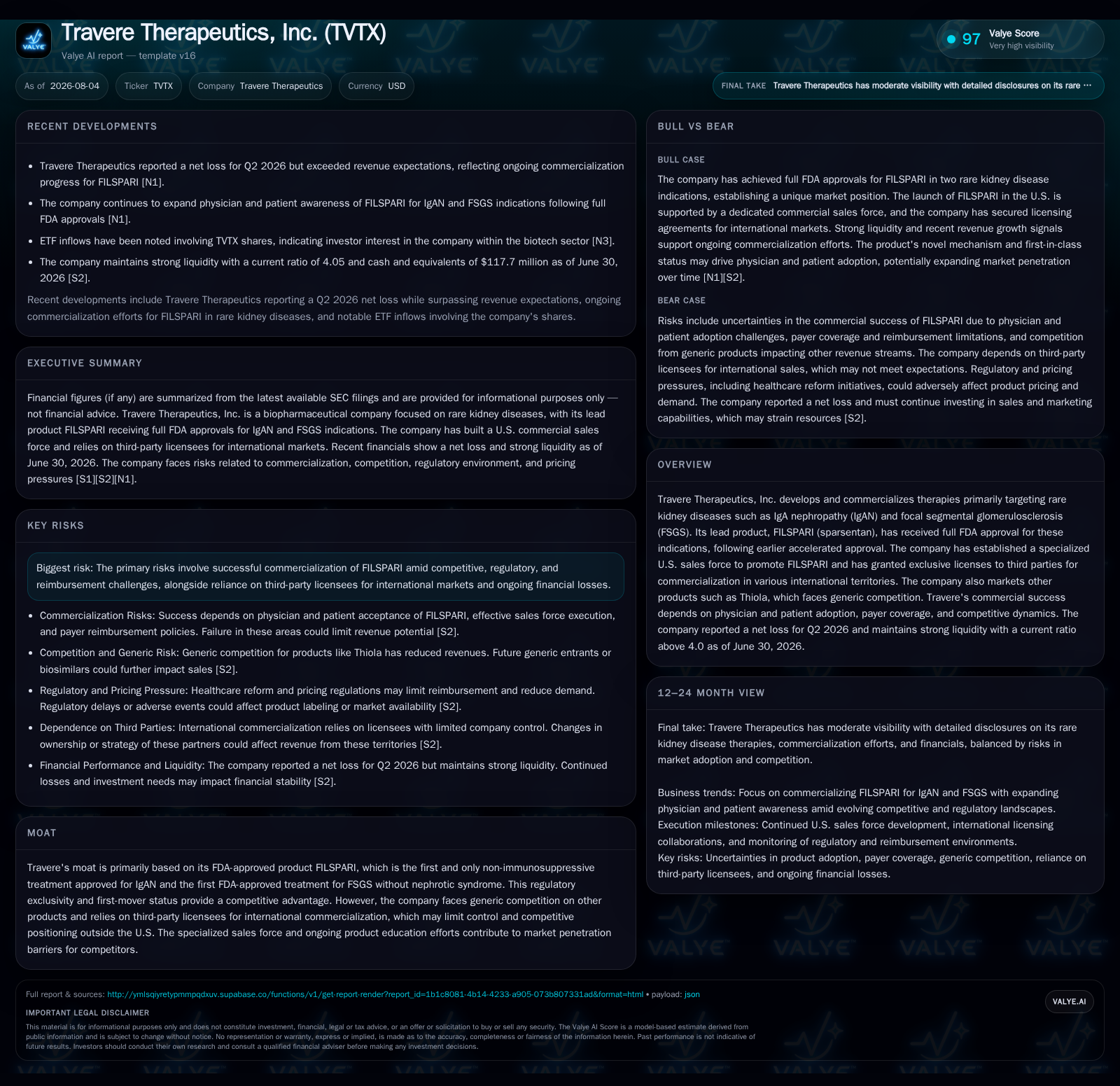
Travere Therapeutics is focused on commercializing FILSPARI, a non-immunosuppressive therapy fully approved for treatment of IgA nephropathy and focal segmental glomerulosclerosis (FSGS). The company reported continued operating losses in Q2 2026 but maintains strong liquidity. Commercial execution in the U.S. remains critical as FILSPARI competes in a complex market with payer reimbursement challenges and generic competition to other products. Internationally, reliance on licensing partners limits direct control of growth outside the U.S. Regulatory compliance and litigation risks are persistent hurdles. Upcoming milestones include further market penetration of FILSPARI in FSGS and payer coverage expansion.
Recent Operating Update
In its latest quarterly filing dated August 4, 2026, Travere Therapeutics reported continuing efforts to commercialize FILSPARI (sparsentan), its lead product targeting rare kidney diseases such as IgA nephropathy (IgAN) and focal segmental glomerulosclerosis (FSGS) [S2],[S3]. Notably, FILSPARI gained full FDA approvals—September 2024 for IgAN and April 2026 for FSGS without nephrotic syndrome—advancing beyond prior accelerated approvals that relied on surrogate markers like proteinuria reduction [S2]. Despite these regulatory milestones enabling traditional commercialization efforts, Travere reported a net loss for Q2 2026 with no positive operating income visible yet [F1]. However, cash balances remain robust at approximately $118 million by June 30, 2026, with current assets comfortably exceeding liabilities to yield a current ratio above 4.0 [F1], signifying ample liquidity for near-term operations and investment.
The company continues to invest in building out its specialist U.S. sales force dedicated to educating nephrologists about FILSPARI’s novel non-immunosuppressive profile—a critical factor as clinicians adopt treatment paradigms that differ significantly from established immunosuppressants or supportive care alone [S2]. Nevertheless, Travere emphasizes that optimizing launch success requires sustained training and team development amid evolving competitive dynamics.
Business Model Analysis
Travere’s business model hinges predominantly on generating prescription drug revenue within the orphan disease niche of rare kidney disorders. Product sales stem primarily from FILSPARI’s two FDA-approved indications: slowing kidney function decline in adults with primary IgAN at risk of progression, and reducing proteinuria in patients aged eight years or older with FSGS absent nephrotic syndrome [S2]. Payments flow through insurance payers—including Medicare/Medicaid—and commercial payors whose formulary decisions influence patient access and physician prescribing behavior.
Revenue growth is sensitive to physician adoption rates supported by a dedicated specialty sales force targeting nephrologists familiar with complex diagnostic criteria around proteinuria and biopsy-confirmed diagnoses. Pricing power benefits from orphan drug designations conferring regulatory exclusivity windows; yet real-world uptake often faces barriers from payers requiring evidence of medical necessity or cost-effectiveness over standard treatments.
Complementing direct U.S. sales, Travere leverages exclusive licensing agreements to promote FILSPARI internationally via third-party partners. While this strategy limits Travere’s operational overhead and capital deployment abroad, it also constrains control over marketing execution and revenue recognition outside the U.S.—a classic tradeoff seen in specialty biopharma firms managing small global patient populations [S1]. Legacy assets like Thiola face generic competition that has eroded their commercial contributions; hence current profit pools concentrate increasingly on FILSPARI’s market performance.
Industry Structure and Competitive Position
Travere operates within the biotechnology specialty pharmaceuticals industry focused on rare diseases—specifically rare kidney disorders lacking extensive approved therapies except supportive care historically. FILSPARI’s differentiation is anchored by its status as the first non-immunosuppressive therapy approved by the FDA for IgAN and FSGS without nephrotic syndrome [S2]. This regulatory exclusivity provides a moat relative to immunosuppressive agents constrained by side effects or limited efficacy data.
The commercial niche necessitates targeted educational sales approaches due to complex disease awareness among nephrologists concentrated in academic centers or specialty clinics rather than broad primary care adoption. Peer companies in this space include others focused on orphan renal conditions or similar chronic autoimmune diseases requiring specialized engagement strategies.
Competition includes emerging therapeutic candidates such as Novartis’ Fabhalta (ipafricept), which seeks to bolster its nephrology franchise with drugs addressing complement-mediated pathways relevant to IgAN [N3]. While not yet displacing FILSPARI's pioneering status outright, these entrants reflect intensifying R&D competition that may pressure pricing or payer willingness moving forward.
Regulatory scrutiny extends beyond initial approvals into ongoing safety surveillance and promotion oversight. Revisiting labeled indications entails extensive clinical trial data generation—a costly endeavor central to extending market reach or enhancing payer negotiations [S4],[S7]. Compliance complexity is further illustrated by risks related to alleged off-label promotion or price reporting challenges common across pharmaceutical firms operating under the Anti-Kickback Statute and False Claims Act frameworks [S9],[S14].
Growth Drivers
Key pillars supporting Travere’s growth trajectory include further penetration of the approved FILSPARI indications. Successfully expanding patient adoption depends on increasing physician comfort with this novel non-immunosuppressive mechanism, backed by ongoing clinical trial endpoints correlating proteinuria reduction with long-term renal function preservation [S2],[N1]. Gains in payer coverage translating into formulary inclusion will materially affect utilization rates given the specialty drug cost profile typically associated with orphan-designated medicines.
Geographically, international licensing deals offer optionality for incremental revenue streams without substantial capital intensity but hinge on performance execution by partners—highlighting the importance of strong alliances capable of navigating local reimbursement policies [S1]. New indication approvals or label expansions could accelerate uptake if supported by robust pivotal data sets.
Further education initiatives aimed at increasing patient awareness about rare kidney disease management could translate into improved diagnosis rates—often an under-recognized barrier—and subsequently enlarge addressable markets. Regulatory incentives such as extended orphan exclusivity or priority review vouchers also serve as strategic catalysts underscoring sustainable competitive advantages.
Risks and Constraints
Despite apparent strengths, Travere faces intrinsic risks typical within rare disease biotech. Commercial risks loom large: failure to achieve adequate payer reimbursements could sharply limit prescribing momentum even when clinical differentiation exists [S2],[S7]. Complex healthcare laws governing marketing promotion raise possibility of costly enforcement actions potentially diverting management focus amid litigation uncertainties [S6],[S22].
Reliance on third-party licensees internationally dilutes direct influence over global revenue streams while exposing Travere to counterparty execution risk—potentially impacting scale acceleration outside the U.S. Generic competition against legacy products reduces profit diversification capacity.
Financially, persistent net losses reflect heavy investment required to sustain commercialization infrastructure alongside clinical development programs. Although liquidity remains healthy currently—with cash far exceeding near-term liabilities—the company must eventually demonstrate durable earnings leverage or clear paths toward profitability to optimize capital efficiency [F1],[S27].
Competitive threats from novel therapeutics entering the nephrology arena could exert pricing pressure or fragment patient pools if alternative modes of action gain traction faster than anticipated [N3]. Moreover, manufacturing or supply chain disruptions pose operational hazards given complex biologic production processes inherent to biotechnology firms.
What to Watch Next
Investors and stakeholders should monitor several key indicators over coming quarters:
- Physician prescribing rates of FILSPARI across both IgAN and FSGS indications will directly reflect traction alongside specialty sales force effectiveness.
- Payer coverage announcements including preferred formulary placements can materially modify patient access landscapes.
- Clinical trial updates supporting label expansions or demonstrating correlation between biomarker changes (proteinuria) and meaningful clinical outcomes may unlock further market segments.
- Execution progress from international licensees regarding launches or regulatory filings abroad will shape non-U.S. revenue prospects.
- Regulatory communications especially those linked to post-marketing surveillance or compliance audits will be important risk barometers.
- Competitive developments especially around pipeline therapies from peers entering the rare nephrology domain warrant close tracking.
Financial Profile Discussion
As of June 30, 2026, Travere Therapeutics shows a stable liquidity position with $117.7 million in cash & equivalents paired against current liabilities totaling approximately $152 million—yielding a strong current ratio near 4.05 which provides cushion for near-term operational funding needs without immediate refinancing pressure [F1],[S2],[S27]. The company recorded operating losses reflective of ongoing commercial scale-up investments balanced against nascent product revenues; actual product sales figures were not individually disclosed but implied indirect through narrative disclosures concerning launch phases [F1],[N2].
Total debt levels appear modest relative to liquidity though detailed recent debt figures are not explicitly restated since last known totals date back several years; nonetheless net debt estimates suggest excess cash after accounting for outstanding obligations [F1]. This conservative leverage stance aligns with typical specialty biotech profiles reliant primarily on equity-based funding complemented by manageable long-term borrowings.
Capital allocation prioritizes R&D funding essential for supporting pipeline progress alongside commercial expansion expenditures particularly around enhancing field force capabilities targeted at niche specialist prescribers [F1],[S1],[N2]. Vigilance around expense discipline versus revenue scaling is critical given continued negative net income reported most recently at year-end 2025 [-$25 million] indicating profitability remains a medium-to-long term milestone rather than immediate objective [F1].
Overall fiscal stewardship appears prudent with emphasis on maintaining sufficient liquidity buffers amidst complex regulatory environments and uncertain payor dynamics characteristic of orphan drug commercialization cycles.
This analysis aims to provide an informed overview of Travere Therapeutics’ operational status grounded strictly in publicly filed data without making investment research views nor speculating beyond available evidence.
Disclaimer: This is research-only, informational analysis and not investment advice. It may include AI-generated interpretation and general industry context. Always verify important details using primary sources.

Comments