
Pacific Health Care Organization’s Strong Liquidity Supports Its Niche Workers’ Compensation Services Model
The company’s August 2026 quarterly filing highlights robust financial health and licensing advantages that underpin its California-focused managed care services.
Pacific Health Care Organization Inc. reported solid liquidity metrics and modest profitability for the quarter ending June 30, 2026, reflecting operational stability within its niche sector of managed workers’ compensation healthcare services. The company leverages regulatory licensing dominance in California with two of three state-issued Health Care Organization and Medical Provider Network licenses, enabling it to deliver integrated cost containment services. While revenue details remain limited, its business model emphasizes bundled managed care and ancillary offerings designed to reduce medical claim costs. Key risks include customer concentration and regulatory complexity, balanced by growth drivers such as rising outsourcing demand and technological integration.
Liquidity Strength Amplifies Operational Stability Amid Regulatory Complexity
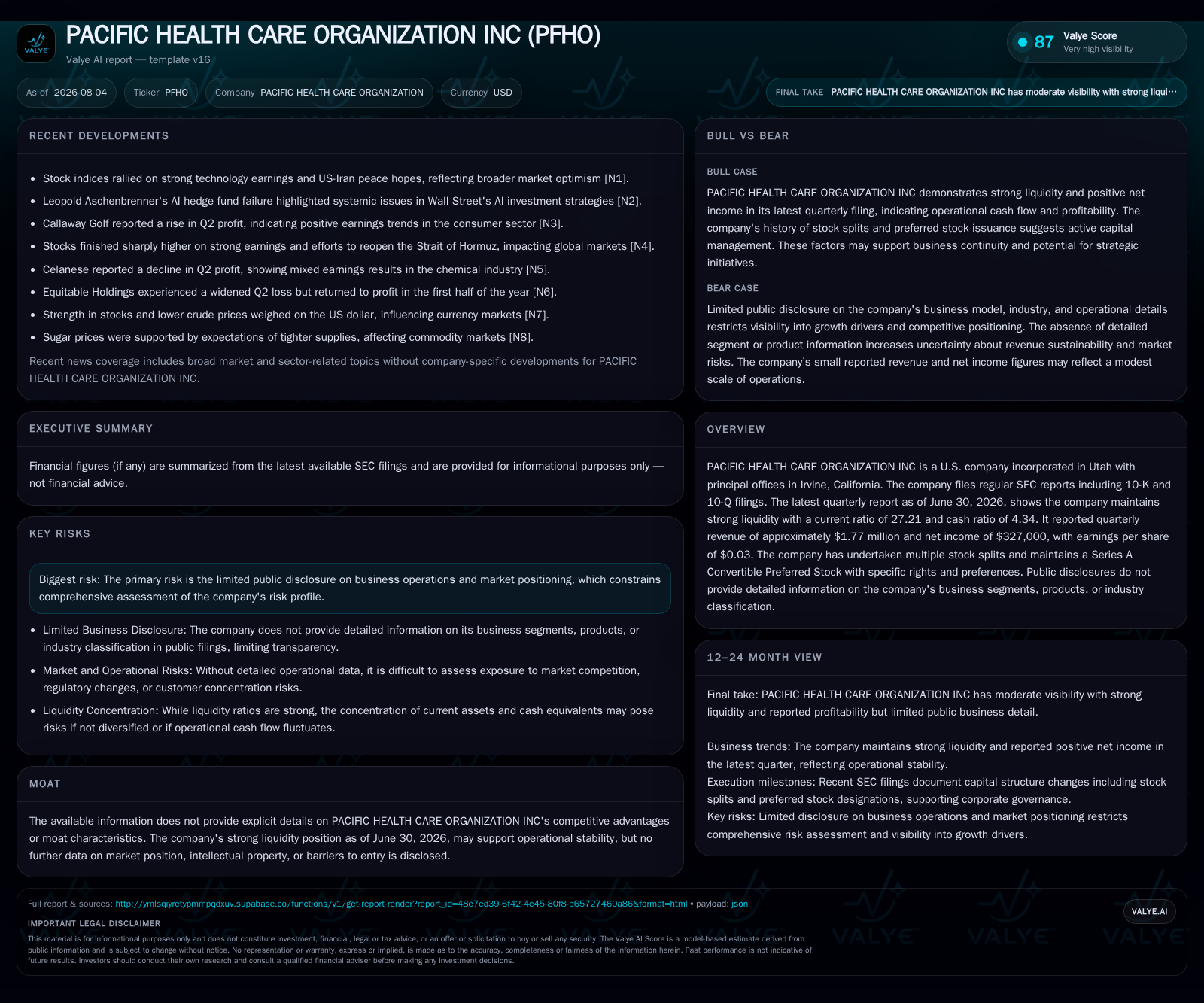
The latest quarterly report for the period ended June 30, 2026 reveals that Pacific Health Care Organization Inc. maintains a remarkably strong liquidity position with a current ratio of roughly 27.21 and a cash ratio near 4.34 [S2][F1]. This unusually high level of liquid assets relative to short-term liabilities is notable in the managed workers’ compensation healthcare sector where regulatory compliance costs and claim volatility can strain operational flexibility. Such liquidity allows Pacific Health Care to sustain consistent service delivery amid potential fluctuations in claims frequency or regulatory policy shifts affecting managed care operations.
Moreover, the company’s stock structure has undergone multiple splits historically without any recent insiders modifying Rule 10b5-1 trading plans during Q2 2026 [S2], signaling steady governance practices aligned with operational confidence. This capital structure conservatism supports resilience without overleveraging—a critical consideration given the narrow regulatory licensing environment constraining revenue diversification.
Integrated Managed Care Offering Anchored by Strategic Licensing Positions
Pacific Health Care’s business is deeply integrated into California's workers' compensation system through its licensed Health Care Organizations (HCOs) and Medical Provider Networks (MPNs) [S1]. It controls two out of three state-issued HCO/MPN licenses — a rare regulatory scarcity that grants operational control over network participation and pricing leverage domestically. This licensing dominance enables it to offer bundled managed care solutions combining oversight functions such as utilization review, medical bill reviews, case management services, employee advocacy, carve-out programs for specialized tests or treatments, alongside Medicare set-aside services.
This gamut of complementary services reflects a strategic positioning designed to reduce overall medical treatment costs while improving timely access to appropriate care for injured workers [S1]. The company also operates through subsidiaries Medex and MMC that oversee HCO/MPN management and bill/utilization review functions respectively. Notably, lien representation services were discontinued in late 2023 due to diminished market demand indicating active portfolio rationalization [S1].
By integrating licensed network operation with ancillary service units under one umbrella contractual framework, Pacific Health Care strives to balance quality outcomes and economic efficiency—key metrics for client retention.
(Re)Shaping Competitive Positioning: Licensing Scale vs Industry Peer References
Within the managed workers’ compensation services industry characterized by firms such as CorVel Corporation, Sedgwick Claims Management Services, and other third-party administrators (TPAs), Pacific Health Care’s niche focus on California licensing presents both strengths and limits. While peers often operate nationally with diversified revenue streams across multiple states and service lines, Pacific holds a uniquely defensible position thanks to state-level licensing barriers.
This localized licensing scale tends to insulate Pacific’s core HCO/MPN operations from direct price competition found in more fragmented jurisdictions but simultaneously restricts geographic expansion possibilities absent new licenses or acquisitions. Pricing power is further supported by its investment in proprietary or licensed IT systems that streamline claims data management and enable more effective cost containment—an advantage over less-integrated peer providers relying on standalone utilization review or bill audit services [S1]
Licensing Anchorage Accelerates Growth Drivers Amid Heightened Work Comp Medical Trends
Macro trends favor companies like Pacific Health Care as the complexity of workers’ compensation regulation in California escalates along with rising medical treatment costs. Employers and insurance payors increasingly seek outsourced managed care solutions to control claim durations—the primary cost driver noted by auditing bodies aligned with California Division of Workers' Compensation studies [S1].
Furthermore, technological advancements embedding analytics into utilization review improve decision-making accuracy around treatment necessity and duration—bolstering client value propositions when integrated effectively alongside licensed networks.
Pacific's strategy of expanding ancillary service suites organically or through acquisitions mirrors these growth drivers by addressing diverse customer needs within the same managed care ecosystem [S1]. Enhanced regulatory compliance demands also create higher switching costs among clients reliant on established licensed providers.
Risk Vectors: Customer Concentration, Regulatory Ambiguity, and Technology Staleness
Despite operational strengths, risk factors remain material. Foremost is the company's reliance on a concentrated group of customers who represent significant portions of accounts receivable—three to four customers accounted for over 10% each at recent fiscal year-ends [S1]. Such concentration elevates renewal dependency risks impacting revenue predictability.
Legal exposures have also surfaced via lawsuits against former executives alleging breach of contract and misappropriation claims tied to trade secrets—matters that impose both reputational and operational risk if unresolved [S18].
Regulatory evolution in California's stringent certification requirements poses ongoing compliance complexity potentially impacting license renewal or operational scope [S1]. Furthermore, technology platforms supporting claims processing must continuously evolve to prevent obsolescence amid sector digital transformation. Failure here could erode competitive pricing advantages vis-à-vis peers employing more advanced systems.
What Investors Should Monitor Next: Renewal Trends, License Extensions, Claims Metrics
Key near-term milestones revolve around successful renewal or expansion of the two primary California licenses held along with client contract renewals critical for sustaining stable cash flows given concentrated customer exposure [S2][S1]. Monitoring published metrics on claims volume managed or average claim duration would provide insight into operational scalability aligned with cost-containment effectiveness.
Announcements regarding new ancillary service offerings incorporating technology tools like AI-based utilization review or predictive analytics may signal acceleration in growth initiatives consistent with broader industry adoption patterns.
Enhanced disclosures around medical bill savings achieved or network provider participation rates would further illuminate Pacific’s competitive positioning within California’s managed care landscape.
Financial Profile Discussion: Elegant Liquidity Underscores Operational Resilience
From a financial perspective at quarter-end June 30, 2026, Pacific Health Care reported cash & equivalents totaling approximately $2.24 million against current liabilities under $520 thousand yielding an exceptional current ratio above 27 times—a level signaling ample short-term solvency beyond typical industry norms where ratios commonly fall below five [F1]
Total debt remains negligible at around $35 thousand last reported end-2024 with no indications of major financing leveraged since then [F1]. Quarterly earnings show net income nearing $327 thousand (EPS $0.03), underscoring modest profitability consistent with highly regulated fee-for-service models prioritizing stability over aggressive growth [S2].[F1]
This sturdy balance sheet enables sustained investment in compliance measures as well as technology upgrades without dependence on external capital markets—an advantageous position amidst cyclical fluctuations common in worker comp claims administration demand.
Disclaimer: This analysis is based solely on publicly available regulatory filings as of August 4, 2026. It does not constitute investment advice nor does it incorporate non-public information about Pacific Health Care Organization Inc. Readers should exercise independent judgment before making any business decisions related to this company.
Disclaimer: This is research-only, informational analysis and not investment advice. It may include AI-generated interpretation and general industry context. Always verify important details using primary sources.

Comments