
Sierra Bancorp’s Q2 Earnings Reflect Credit Stability and Margin Pressure
Q2 results highlight stable credit quality amid net interest margin compression driven by interest rate dynamics.
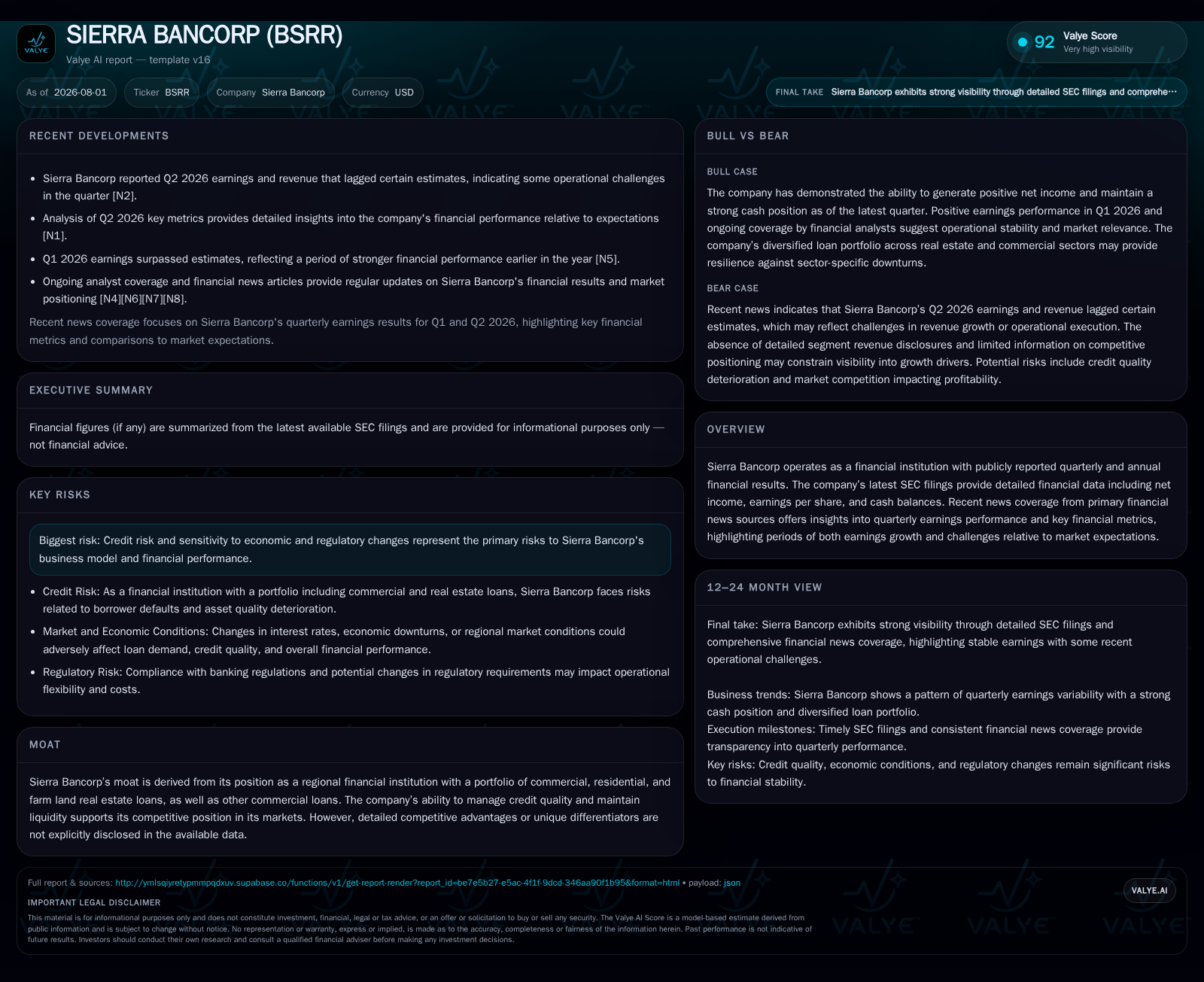
Sierra Bancorp’s Q2 2026 earnings reflect solid credit risk management amid a flat loan growth environment and pressure on net interest margin due to prevailing interest rate conditions. The bank’s diverse loan portfolio—focused on commercial, residential, and farmland real estate loans—continues to underpin steady net interest income with manageable asset quality metrics. Deposit growth and noninterest income from fees and securities gains provide supplemental support, although margin headwinds pose near-term challenges. Regulatory capital levels and liquidity profiles remain robust, supporting operational stability while monitoring rate sensitivity and portfolio concentration risks remains critical.
Quarterly Momentum: Credit Quality Anchors Operating Results Amid Margin Pressures
ures that tend to affect commercial and real estate-linked exposures disproportionately. The provision for loan losses remained controlled without material hikes signaling no immediate credit stress detected in portfolio performance [S2]. This operating profile suggests Sierra’s near-term profitability will hinge on managing margin headwinds while maintaining discipline over loan quality—a balancing act reflected across similarly positioned regional peers such as Cathay General Bancorp and Bank of the Sierra.
Loan Portfolio Composition: Balancing Commercial and Real Estate Exposure in Regional Markets
cal employment levels. Meanwhile, farm land loans diversify geographic and sectoral risk albeit are closely linked to commodity prices and agricultural sector health.
Continued balance between these segments is essential as it underpins net interest income generation while presenting manageable credit risk when monitored effectively. Peer institutions such as Western Alliance Bancorporation also emphasize commercial lending but often supplement with broader product lines; Sierra appears more regionally concentrated which could limit scale but supports deep market knowledge.
Industry Forces: Competitive Dynamics and Regulatory Capital Environment Shape Strategy
Within the competitive regional banking landscape, Sierra Bancorp’s pricing power is moderated by comparable offerings from community banks and larger institutions vying for similar borrower categories. This has led management to sustain focus on core lending disciplines rather than aggressive volume expansion or risk taking as seen in larger national banks [S1]. Regulatory capital requirements remain a major determinant shaping risk appetite; Sierra maintains solid capital ratios per its filings which equip it against unexpected losses while ensuring compliance with evolving regulatory standards [S1],[S2]. Such capital adequacy affords strategic flexibility to navigate market headwinds without compromising balance sheet integrity.
Liquidity management remains integral amid deposit base dynamics; deposits grew moderately during the quarter, buttressing funding stability necessary for consistent loan origination and investing activities [S2]. Balancing deposit growth against loan demands influences the loan-to-deposit ratio—a key KPI—affecting both earnings potential through efficient asset utilization and risk profile regarding reliance on wholesale funding or volatile liabilities.
Emerging Growth Vectors: Deposit Expansion and Fee Income Diversification Opportunities
Besides core lending income, Sierra benefits from noninterest income streams primarily sourced from fees on deposit accounts and service charges alongside net gains recorded from sales of investment securities available-for-sale during Q2 2026 [S2]. While these contributions are not yet large enough to fully offset net interest margin pressure stemming from wider rate spreads contraction, they enhance earnings resilience by providing revenue diversification.
Incremental deposit growth observed in recent quarters offers potential fuel for future loan growth—which is currently muted—but also reflects successful customer acquisition or retention strategies characteristic of regional banks optimizing local market presence. Additionally, fee-based income aligned with payment processing or trust services could present ongoing value-add avenues given Sierra's established footprint. Nonetheless, scaling these revenue segments requires sustained execution alongside technology investments to compete with evolving fintech alternatives.
Risks Evident: Interest Rate Sensitivity and Concentration Pocket Watchpoints
The primary risks highlighted in the annual filings emphasize sensitivity of net interest margin to fluctuating interest rates—a central challenge given market volatility post-Fed monetary tightening cycles [S1]. Rising rates can theoretically boost yields but also impact borrower capacity and lead to re-pricing mismatches between assets and liabilities impacting margins adversely in short term.
Credit risk persists as borrowers within concentrated commercial real estate or farm land portfolios face sector-specific cyclical downturns that could elevate loan loss provisions suddenly if economic conditions deteriorate locally. Although recent quarters showed stable nonperforming assets ratios and contained provision expenses, early signs such as upticks in past-due loans or increasing charge-offs warrant close surveillance moving forward [S2],[S3]. Regulatory changes or compliance costs add an incremental layer of complexity potentially constraining operational agility if new capital buffers or reporting mandates intensify.
Next Checkpoints: Key Indicators to Monitor into Rest of Fiscal Year
Investors should prioritize tracking quarterly shifts in loan growth rates particularly within real estate segments alongside deposit momentum indicators which directly influence funding costs and liquidity metrics per successive SEC filings [S2],[S3]. Changes in nonperforming assets ratios or net charge-offs serve as bellwethers for emerging asset quality trends that could materially affect profitability.
Furthermore, monitoring adjustments to provision expense will provide insight into credit outlook revisions by management—confirmation would entail stable or declining provisions while adverse surprises may manifest through rapid build-ups indicating stress. Regulatory disclosures concerning capital adequacy updates remain essential given their impact on strategic decisions around dividend payments or share repurchases.
Financial Profile Discussion: Current Balance Sheet Strength and Earnings Snapshot
Capital ratios detailed in annual filings exhibit comfortable buffers above regulatory minima reinforcing resilience against downturn scenarios while underpinning ability to pursue disciplined growth initiatives without elevating financial leverage excessively [S1]. This financial profile aligns with prudent balance-sheet management expected among regional banks focusing on sustainable franchise development rather than speculative expansions.
This analysis emphasizes Sierra Bancorp's steady credit quality underway through mid-2026 combined with the challenges posed by a narrowing interest spread environment impacting its core earnings metric—the net interest margin. The company maintains a strategically balanced loan book anchored in commercial real estate alongside residential mortgages and farmland lending segments typical of regional banking franchises serving defined local markets. Deposit expansion fuels liquidity safeguarding while noninterest income sources partly mitigate pressure on margins. Persistent vigilance over credit trends tied to underlying economic cycles paired with disciplined capital stewardship remains critical to sustaining this regional bank’s operating stability amid industry-wide shifts affecting comparable peers across this space.
This report is prepared for informational purposes only without investment research views.
Disclaimer: This is research-only, informational analysis and not investment advice. It may include AI-generated interpretation and general industry context. Always verify important details using primary sources.

Comments