
First Financial Bankshares Navigates Rising Funding Costs with Expanded Capital Return Strategy
FFIN’s Q2 2026 filing highlights increased interest expense pressure alongside a strategic boost to its share repurchase authorization, balancing margin challenges with shareholder returns.
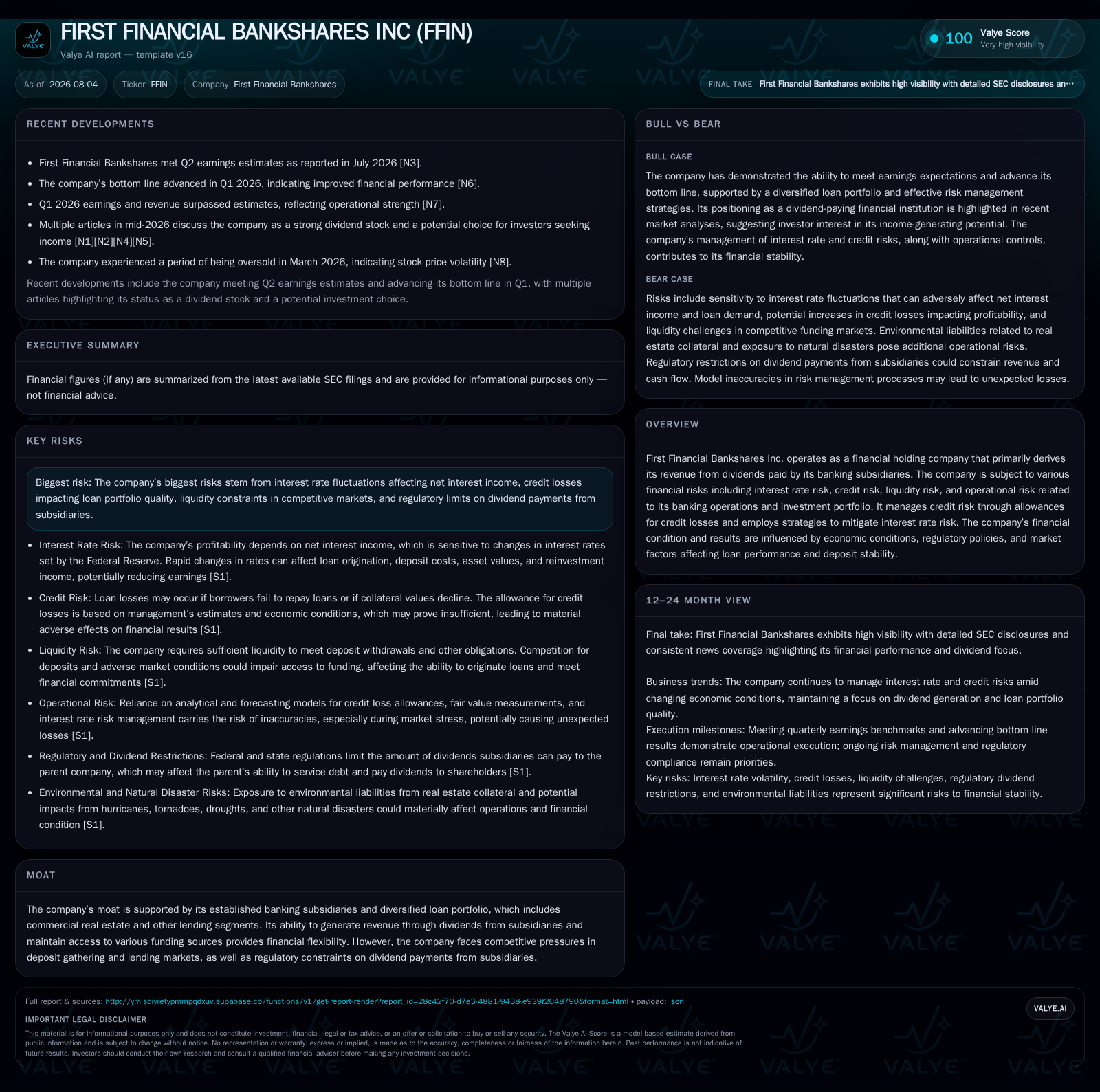
First Financial Bankshares Inc. reported a notable rise in total interest expense in Q2 2026, reflecting elevated funding costs that compress net interest margin amid a still-uncertain interest rate environment. The company’s revenue depends heavily on dividends from regulated banking subsidiaries, whose payments are constrained by capital requirements, limiting cash flow flexibility. The loan portfolio includes significant commercial real estate exposure, with stable credit quality metrics for now. Management’s decision to increase the share repurchase plan signals confidence in capital deployment despite margin headwinds. Key risks include evolving regulatory dividend restrictions, deposit repricing dynamics, and potential credit stress under changing economic conditions.
Elevated Funding Costs Pressure Net Interest Income in Q2 2026
First Financial Bankshares’ latest quarterly filing reveals a substantial increase in total interest expense to roughly $97.2 million during Q2 2026 [S2]. This uptick reflects rising funding costs driven by the Federal Reserve’s monetary policy evolution, which directly pressures net interest margin (NIM), a critical profitability lever for regional banking holding companies like FFIN. The company’s funding structure—primarily deposits supplemented by borrowings—is subject to deposit beta effects where rising market rates necessitate faster repricing of liabilities than asset yields can achieve. Without offsetting loan repricing or deposit cost management, these dynamics compress net interest income and earnings.
Dividend Dependence and Regulatory Capital Constraints Limit Holding Company Cash Flow
FFIN’s business model relies predominantly on dividends paid by its wholly owned subsidiary banks [S1]. These dividends are regulated to ensure subsidiaries maintain adequate capital buffers per Federal Reserve Board and FDIC requirements, constraining the holding company’s available cash flow for shareholder returns or reinvestment [S1,S3]. The recent expansion of the share repurchase program—authorizing up to 7.2 million shares through July 2027 from a prior limit of 5 million—indicates management’s confidence in excess capital at the holding company level despite these regulatory frictions [S3]. This move balances returning capital with maintaining subsidiary capital adequacy.
Diversified Loan Portfolio with Significant Commercial Real Estate Exposure
Disclosures confirm that FFIN’s loan portfolio includes meaningful commercial real estate (CRE) segments—both owner-occupied and non-owner-occupied—as well as construction and development loans [S1,S2]. CRE loans are particularly sensitive to interest rate volatility due to their collateral-dependent nature and borrower debt service capacity under adjustable rates. The distinction between owner-occupied CRE (potentially more stable) versus investment property loans implies varied credit risk profiles within the portfolio. Close monitoring of non-performing loans (NPLs) in these sectors will be crucial as economic conditions evolve.
Stable Credit Performance Amid Interest Rate Risks
Despite rising macroeconomic uncertainty and funding cost pressures, FFIN reports steady credit quality metrics through Q2 2026 [S1,S2]. Non-performing loan ratios have not shown material deterioration, nor has there been a significant increase in provisions for credit losses relative to prior periods. However, vigilance remains warranted as prolonged economic headwinds or CRE collateral value declines could quickly impact asset quality.
Strategic Capital Deployment: Enhanced Share Repurchase Authorization Signals Confidence
The Board’s decision to increase the share repurchase authorization by over 40% reflects management’s belief that the stock is attractively valued and that sufficient capital exists beyond dividend payout capacity and reinvestment needs [S3]. Deposit growth composition also plays a pivotal role in funding cost management; retention of low-cost core deposits mitigates deposit beta risks amid competitive rate markets. However, ongoing Federal Reserve policy adjustments and regional economic variability present uncertainties to this outlook.
Key Risks and Monitoring Points Ahead
Investors should watch for regulatory changes affecting dividend restrictions at subsidiary banks that directly influence holding company cash flows [S1]. Additionally, evolving non-performing asset levels and provision coverage will indicate emerging credit stress consistent with economic cycles. Finally, Federal Reserve guidance on future interest rates will be critical given their impact on asset-liability repricing mismatches affecting net interest margins.
Financial Profile Discussion — Leverage and Liquidity Context
As of June 30, 2026, First Financial Bankshares reported total debt of approximately $21.8 million on its balance sheet [F1], indicative of modest leverage relative to similarly sized regional banking peers. Net debt aligns closely given limited offsetting cash balances reported [F1]. This conservative leverage supports the expanded share repurchase program while providing resilience against liquidity pressures arising from elevated funding costs observed in Q2 [S2,F1]. Capital ratios remain within regulatory thresholds ensuring ongoing operational stability amidst macroeconomic uncertainties [S1]. This balance between prudent leverage management and active capital return strategy underscores management's measured approach toward optimizing shareholder value without compromising financial health.
This analysis synthesizes information from First Financial Bankshares Inc.’s latest SEC filings through August 4, 2026 [S1,S2,S3], supported by current financial data as of mid-2026 [F1] and corroborated news sources where relevant [N1]. It offers an evidence-based assessment emphasizing key operational drivers, risk factors, and strategic initiatives without speculative extrapolation.
Disclaimer: This is research-only, informational analysis and not investment advice. It may include AI-generated interpretation and general industry context. Always verify important details using primary sources.

Comments