
South Plains Financial Expands Regional Footprint While Managing Interest Rate and Credit Risks
The bank holding company's Q2 2026 report highlights growth through acquisitions, disciplined underwriting, and stable asset quality amid rising interest rate challenges.
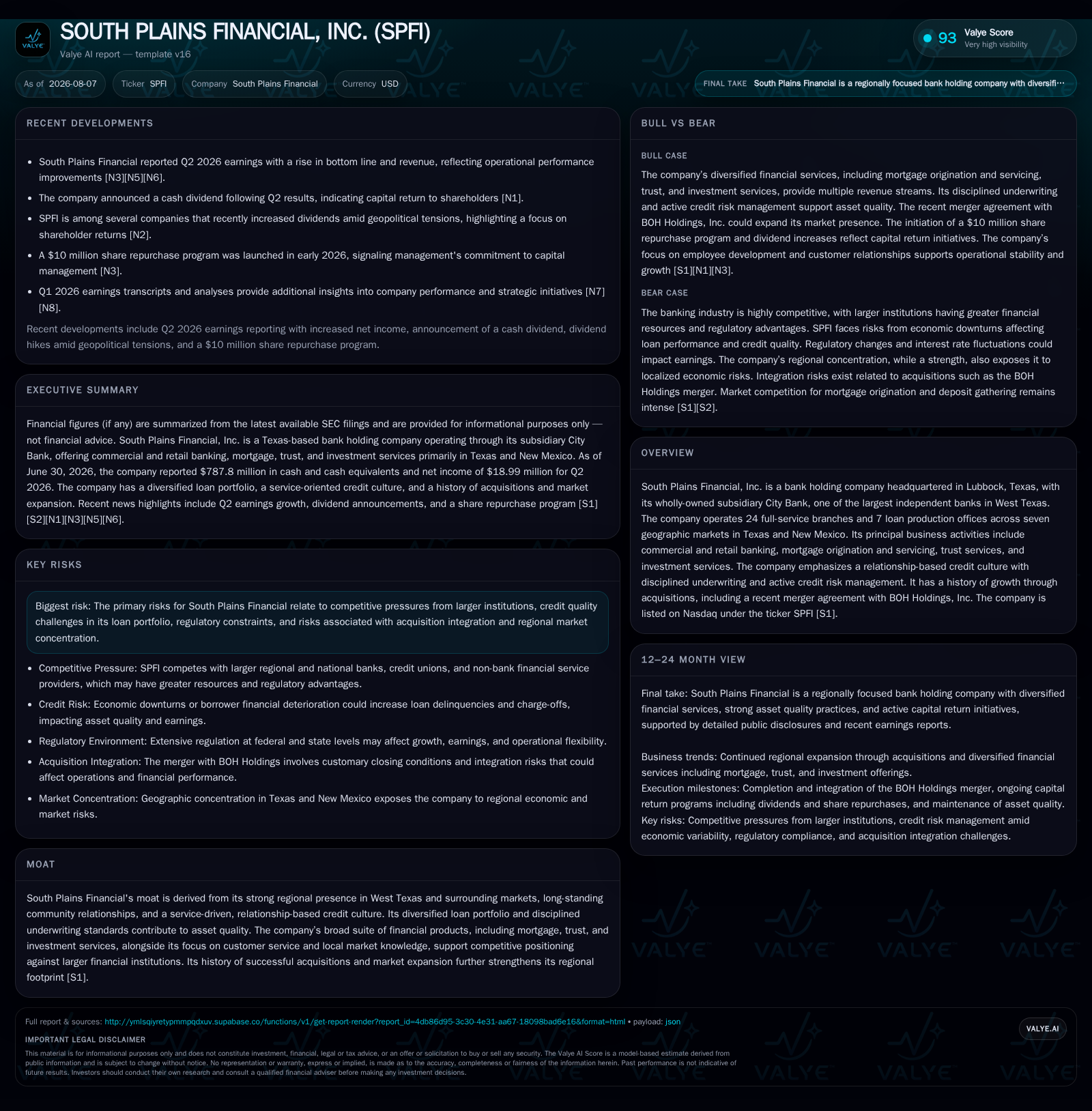
South Plains Financial, Inc. (SPFI) reported robust second-quarter results in 2026 reflecting continued strategic expansion primarily via the merger with BOH Holdings, Inc., alongside steady operational execution across its regional banking platform. The company maintains a diversified loan portfolio with strong asset quality supported by conservative credit risk management in its West Texas and New Mexico markets. However, rising interest rates impose pressure on net interest margin dynamics and loan demand, while competitive and regulatory factors remain important considerations. Future performance will hinge on integration success of acquisitions, local economic conditions, and effective capital management.
Recent Operating Update
South Plains Financial, Inc. reported its latest quarterly results on August 6, 2026 [S2], confirming the closing of its strategic acquisition of BOH Holdings completed in Q2. This transaction notably expanded SPFI’s geographic footprint by merging Bank of Houston into its wholly owned subsidiary City Bank, further strengthening its presence in Texas’s competitive regional banking market [S11]. Concurrently, the company announced a quarterly cash dividend of $0.18 per share payable in August, signaling confidence in earnings stability amid ongoing macroeconomic challenges [S3][N1]. These developments underscore SPFI’s focus on growth through acquisition while maintaining shareholder returns.
Business Model Overview
SPFI operates as a regional bank holding company headquartered in Lubbock, Texas, controlling City Bank which is among the largest independent banks in West Texas [S1]. Its branch network consists of 24 full-service locations supplemented by seven loan production offices primarily focused on mortgage origination across Texas and New Mexico [S1][S25]. The business model centers around generating core revenue through net interest income derived from lending activities focused on commercial and retail customers within its regional markets.
Revenue streams include traditional deposit-taking products—checking, savings, certificates of deposit—and diversified loan offerings such as commercial real estate, agricultural loans, consumer mortgages, along with trust and investment service fees [S1][S26]. Fee income from mortgage servicing and trust operations complements net interest margins providing a more resilient revenue mix especially during periods of fluctuating loan demand or interest rate environments. Monetization is largely relationship-driven; the bank emphasizes long-term customer engagements rather than transactional volume alone to foster retention and cross-selling opportunities [S1]. This relationship-based credit culture supports disciplined underwriting standards tailored to local market dynamics.
Industry Structure and Competitive Position
Within the broader U.S. regional banking sector characterized by competition from national banks, fintech platforms, and community banks alike, SPFI occupies a niche emphasizing local expertise in West Texas and nearby regions. Its scale—total assets nearing $4.5 billion with about $3.1 billion in gross loans—places it above many smaller community banks but below some larger regional peers such as Frost Bank or Zions Bancorporation [S1]
SPFI’s competitive moat derives from longstanding community relationships, deep knowledge of local industries (notably energy/agriculture sectors), and comprehensive financial offerings including mortgage origination, wealth management via trust services ($435 million assets under management as of year-end 2025), and third-party investment services ($684 million AUM) [S1][S26]. These capabilities help differentiate it from fintech disruptors that may lack local personalization as well as large banks that often struggle with regional tailoring. However, SPFI faces intensifying competitive pressures as larger institutions expand locally and digital-first entrants capture new customer segments.
Growth Drivers
Key growth catalysts for SPFI involve both organic expansion within existing markets leveraging digital underwriting tools to improve loan production efficiency and inorganic scaling through acquisitions like the BOH merger completed in early 2026 [S1][S11]. Expansion into new geographic areas depends heavily on hiring experienced loan originators to maintain underwriting discipline while scaling operations without diluting credit quality [S1].
Higher prevailing interest rates theoretically increase net interest margins by widening spreads but also tend to suppress loan demand—particularly refinancing activity—which has direct impact on mortgage-related revenues. SPFI noted this dynamic could pressure mortgage noninterest income if origination volumes slow meaningfully [S1]. Meanwhile, demographic trends favoring community banking relationships in underserved or mid-sized markets support continued deposit inflows enhancing funding stability.
Cross-selling trust and investment products remains an ancillary contributor to fee income growth while providing customer stickiness [S1][S17]. SPFI’s reported asset-quality vigilance through active credit risk management practices serves as a guardrail supporting sustainable growth amidst cyclical fluctuations
Risks and Watchpoints
Several risks warrant continued monitoring. The elevated interest rate environment challenges net interest margin stability; rapid increases can lead to mismatches where funding costs reprice faster than earning assets affecting profitability [S1]. Additionally, tightening credit conditions may yield greater borrower stress especially in energy-exposed regions.
Credit concentration risks exist given the company’s geographic focus primarily on West Texas economic centers, compounded by deposit concentration where top 20 depositors constitute over 22% of total deposits—a significant liquidity sensitivity if large accounts withdraw funds unexpectedly [S23]. Regulatory compliance burdens continue rising with enhanced scrutiny on fair lending laws, capital adequacy under Basel III frameworks (Tier 1 leverage ratio minimums), and incentive compensation policies designed to prevent excessive risk-taking [S13][S16][S24]. Integration risks associated with acquisition activity such as BOH also pose execution hazards that could dilute expected benefits if not carefully managed post-close.
The company’s dividend policy is contingent on earnings availability per regulatory guidance; future changes could influence capital allocation flexibility particularly if unexpected credit losses emerge or regulatory constraints tighten further [S21]. Lastly technological adoption pace will influence underwriting efficiency gains critical for competing against more digitally enabled peers.
What to Watch Next
Operationally, key metrics including sequential loan growth rates post-merger will illuminate the success of geographic expansion efforts alongside mortgage origination volumes which serve as a barometer for fee income trends amid changing rate climates [N2][N4]. Monitoring the non-performing loans ratio's stability will be crucial for gauging credit quality resilience amidst modest economic headwinds.
Equally important are capital adequacy ratios compliance reflecting ability to sustain dividends or fund organic growth without dilutive equity issuance. Progress reports on BOH integration milestones—including system harmonization and staff retention—will be vital indications of long-term synergy realization [S11]. Additionally, any material shifts in deposit base composition or concentration risk should be carefully assessed given their potential liquidity ramifications.
Finally, broader macroeconomic developments impacting the Texas region’s key industries such as oil & gas prices or agricultural cycles will indirectly influence lending demand patterns central to SPFI’s franchise.
Financial Profile Discussion
As of June 30, 2026, South Plains Financial reported $787.8 million in cash and equivalents highlighting substantial liquidity buffers available to support operational needs including lending initiatives or unexpected funding demands [F1]. The company's reported total debt was relatively modest at approximately $1.35 million as of mid-2025 indicating low leverage on the balance sheet with a strongly negative net debt position reflective of significant cash holdings exceeding debt obligations [F1].
This capital strength provides flexibility for continued acquisition activity under prudent regulatory oversight mandating maintenance of well-capitalized status per Federal Reserve guidance [S5][S24]. Moreover, tangible book equity near $494 million (as of end-2025) supports healthy return on equity targets alongside allowing absorption of potential credit loss shocks without compromising solvency [S1][F1].
Operating expenses remain tightly managed benefiting from digital process enhancements referenced in filings aimed at improving underwriting efficiency while containing cost growth essential for favorable efficiency ratios over time [S1]. Dividend declarations consistent with earnings support balanced stakeholder value creation while ensuring reinvestment capacity stays intact [S3][N1].
Overall financial stewardship appears aligned with industry best practices balancing growth ambitions against risk management imperatives amidst a challenging but opportunity-rich regional banking landscape.
Disclaimer: This analysis is for informational purposes only and does not constitute investment advice or research views.
Disclaimer: This is research-only, informational analysis and not investment advice. It may include AI-generated interpretation and general industry context. Always verify important details using primary sources.

Comments