
Octave Specialty Group Expands Niche Insurance Footprint While Managing Leverage and Mixed Profitability in Q2 2026
Q2 results reflect growing specialty commercial and health insurance segments with ongoing capital management under credit facility constraints.
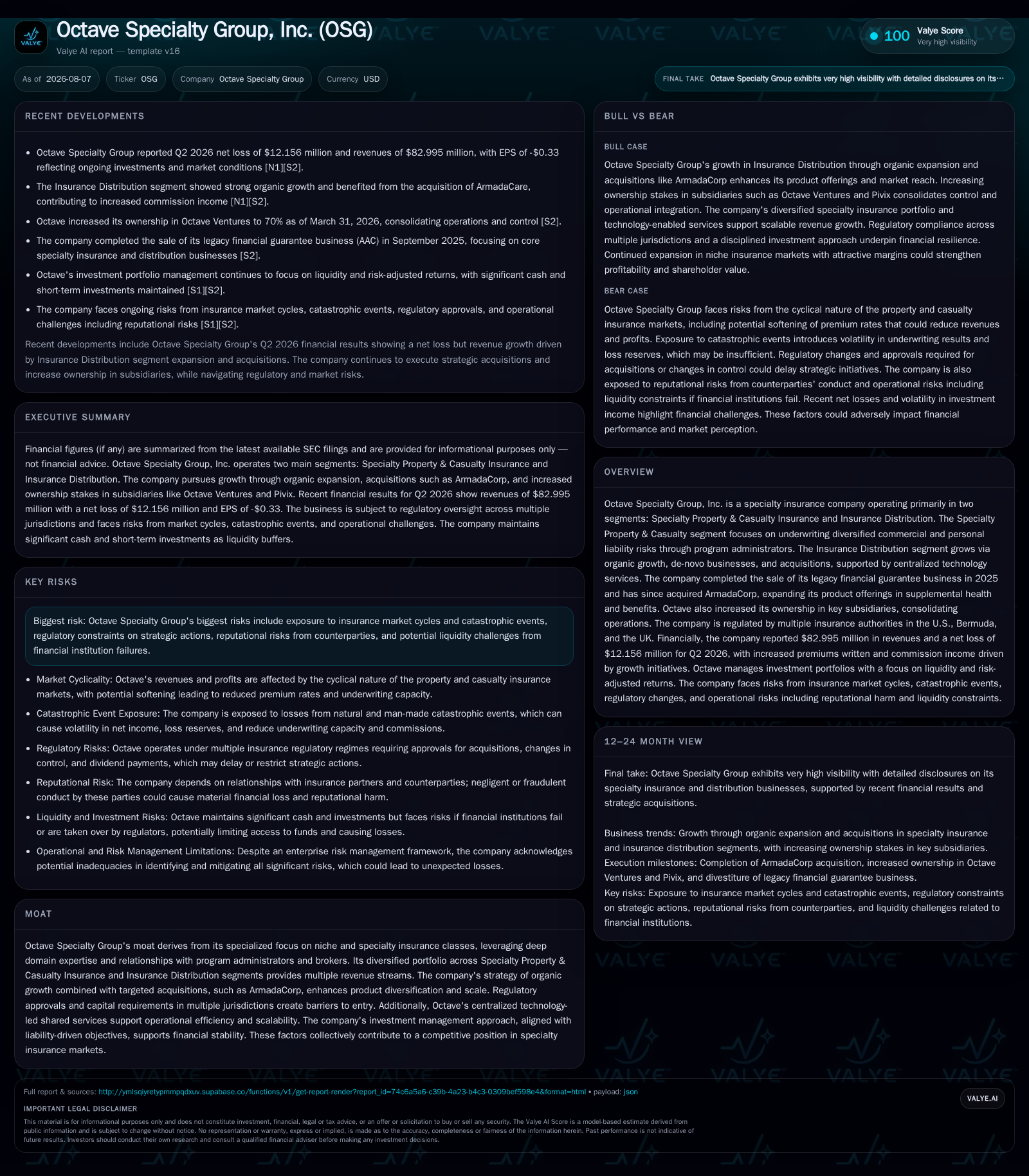
Octave Specialty Group reported a net loss for Q2 2026 despite revenue growth driven by expanded underwriting through program administrators and the ArmadaCorp acquisition. The company’s dual-segment model blends specialty property & casualty insurance with a growing insurance distribution business supported by technology-led services. While underwriting expansion in new and existing programs boosted premium volumes, combined ratios remain pressured, resulting in continued operating losses. Leverage from the ArmadaCorp acquisition debt and material put/call obligations present liquidity considerations amid regulatory capital constraints. Monitoring premium retention, underwriting performance, and put/call funding will be critical to long-term value creation.
Recent Operating Update
This quarter’s operating results mirror Octave's distinct business architecture balancing two complementary but operationally demanding segments: Specialty Property & Casualty Insurance and Insurance Distribution.
Business Model Overview
OSG's Specialty Property & Casualty (P&C) segment functions primarily as an underwriter of diversified commercial and personal liability risks using program administrators and managing general agents (MGAs) as distribution conduits. This segment relies on generating underwriting profits through disciplined pricing, effective claims management, reinsurance arrangements, and maintaining favorable loss and combined ratios. Growth is measured by gross/net premiums written/earned, retention rates on policy renewals, claim frequency/severity metrics, and participation levels in assumed reinsurance treaties [S1][S16]. The underwriting footprint emphasizes niche classes often underserved by broader market participants.
The Insurance Distribution segment contributes revenues via commissions (base plus profit commissions), fees from brokering or administering insurance products, anchored by both organic expansion—adding policies-in-force—and strategic acquisitions like ArmadaCorp that diversify product offerings into less correlated lines such as supplemental health and executive benefits. Distribution is supported by centralized technology platforms enabling scale efficiencies across administrative functions like policy servicing, claims handling support, accounting services, compliance monitoring, and data analytics [S2][S15].
OSG monetizes these activities mainly through premium collections from insureds paying insurers underwritten via program administrators; the insurer pays claims less expenses yielding underwriting profits or losses influenced by combined ratio components (loss plus expense ratios). Distribution revenues add commission/fee income tied directly to premium volumes or profitability thresholds within specific programs.
Industry Structure & Competitive Position
Operating at the intersection of specialty P&C insurance underwriting and technology-enabled insurance distribution situates Octave within a moderately consolidated landscape alongside specialized insurers such as Markel Corporation or RLI Corp—recognized for disciplined underwriting in niche segments—and distribution-focused players like Brown & Brown or Hub International that excel at commission-based revenue models scaling via broker network acquisitions.
Octave's moat derives from its diversified product portfolio spanning commercial liability exposures accessed mainly through affiliated/non-affiliated program administrators plus burgeoning supplemental health lines introduced via ArmadaCorp. Licensing across multiple jurisdictions—including U.S. states (Arizona domiciled Everspan subsidiaries), Bermuda (Alcor Underwriting Bermuda), the UK (Lloyd’s Managing Agency Statera)—introduces regulatory barriers deterring easy market entry while complicating capital deployment optimization [S1]. The centralized technology-led services platform for its ID segment acts as a scalable infrastructure layer enhancing operational leverage versus pure-play brokers or MGAs who may lack integrated service capabilities.
Risk mitigation features embedded in certain Specialty P&C programs include sliding scale commission arrangements adjusting brokers’ remuneration based on loss experience favorable to Octave’s underwriting loss volatility limits [S16]. However, volatile claim severity trends alongside pricing competition maintain pressure on OSG’s combined ratio dynamics relative to peer benchmarks
Growth Drivers
Organic expansion remains core to driving incremental gross written premiums by onboarding new commercial liability risks and personal lines through program administrators who value Octave’s underwriting expertise and capital base. Retention rates are pivotal; elevated policy renewals underpin stable earned premium bases supporting revenue visibility.
Acquisition-led growth complements this via targeted deals such as ArmadaCorp's October 2025 purchase adding access to supplemental health/business benefit markets focused on C-suite executives—a specialty niche with differentiated product offerings including third-party administration services that create recurring fee income streams less correlated with traditional casualty risk cycles [S15][S17]. These moves diversify revenue sources beyond cyclical P&C exposures enhancing overall portfolio resilience.
The company also invests strategically in technology enabling scalable back-office operations reducing per-policy servicing costs while facilitating standardized reporting vital for compliance across dispersed jurisdictions. This supports nimble onboarding of de-novo businesses while deepening integration of acquired entities.
Regulatory approvals—such as the December 2025 authorization for Statera Managing Agency Ltd to operate at Lloyd's—offer gateways into capital-rich specialty markets traditionally dominated by entrenched syndicates offering potential for syndicate management income streams serving niche risks [S1]
Risks / Watchpoints / Growth Constraints
Significant risks loom from persistent combined ratio pressures within Specialty P&C underwriting—driven by claim cost inflation or unexpected catastrophic event frequency—that could erode underwriting profits if not offset by rate increases or risk selection improvements.
Regulatory complexity arising from multiple domiciles requires careful navigation—compliance with solvency requirements, licensing mandates constraints on dividend flow restrict inter-company fund movements impacting liquidity available for strategic investments or deleveraging efforts.
Market cycles affect pricing power; downturns may compress margins unless countered by tightening underwriting standards or broader diversification including supplemental health products which historically exhibit lower correlation to casualty cycles.
Reputational risks tied to counterparties’ integrity represent latent threats given dependency on brokers/MGAs/program administrators for access to niche insured pools; any misconduct could impair renewals or trigger litigation exposures impacting reserves beyond estimates [S7][S22].
Finally, foreign exchange fluctuations principally between GBP (significant Insurance Distribution operation currency) and USD could materially impact consolidated results despite hedging strategies deployed given revenue concentration in USD vs operational costs often denominated in GBP [S1]
What To Watch Next
Analysts should monitor successive quarters for improvement or deterioration in underwriting indicators such as loss ratio trends and combined ratios within Specialty P&C revealing progress toward sustainable profit margins displacing legacy structural losses.
Growth in net earned premiums stabilized or accelerating indicates effectiveness of organic initiatives plus acquisitions feeding into base revenue durability.
Tracking commission income growth pace informs Insurance Distribution health validating conversion of policy count expansion into fee realization leveraged by centralized tech services.
Regulatory announcements around new product approvals or expanded licenses notably at Lloyd’s syndicate level provide signals for longer-term scaling opportunities beyond incumbent platforms.
Corporate expense control progress post office relocation should contribute incrementally toward lowering overhead drag supporting improved adjusted EBITDA margins highlighted during cost reduction initiatives noted earlier this year [S10][S23].
Ultimately sustained improvement in adjusted net income attributable to shareholders aligned with positive free cash flow generation would mark inflection towards unlocking shareholder value vis-à-vis portfolio diversification efforts balanced against inherent underwriting cycle volatility.
Financial Profile Discussion
Operating companies within Everspan manage liquidity mainly through premium inflows supplemented by investment income conservatively allocated per liability-driven investment guidelines supporting claims reserving capacity. However, Everspan did not pay dividends in 2025 nor anticipated doing so during 2026 reflecting prioritization of balance sheet strength over upstream capital distributions given underlying cycle sensitivity [S8][S26]. Insurance Distribution subsidiaries enjoy fewer regulatory restrictions allowing more regular dividend flows supporting parent liquidity needs subject to timing variability impacted by seasonal working capital cycles.
Disclaimer: This is research-only, informational analysis and not investment advice. It may include AI-generated interpretation and general industry context. Always verify important details using primary sources.

Comments