
Globus Medical Drives Growth Through Enabling Technologies Despite Supply Chain Strains
Q2 2026 results highlight robust revenue growth fueled by enabling technologies and implant sales, balanced against supply chain and pricing pressures.
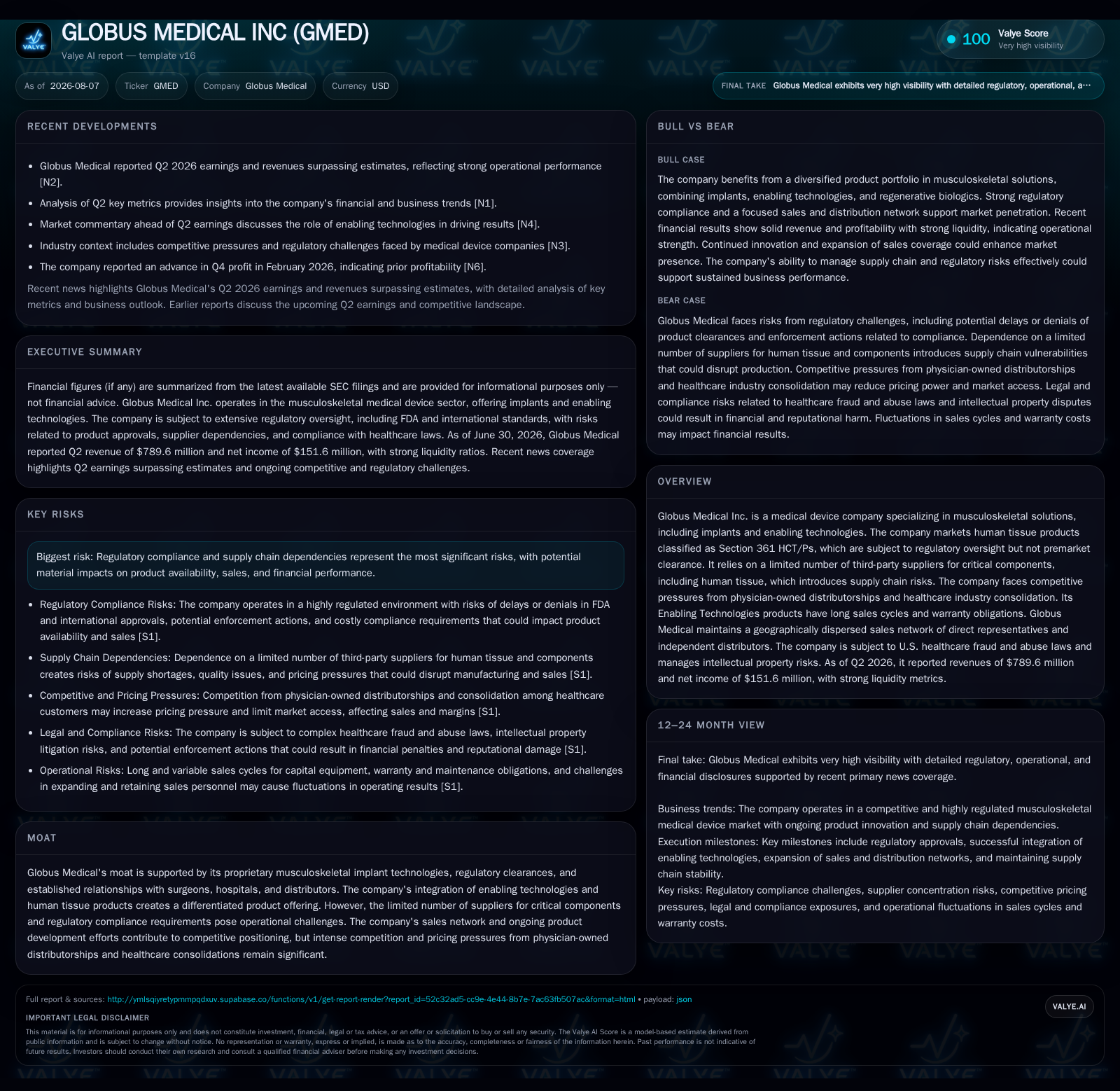
Globus Medical reported Q2 2026 revenues exceeding expectations, driven primarily by its Enabling Technologies segment alongside steady implant sales. While supply chain constraints related to limited human tissue suppliers pose operational risks, the company’s geographically diverse sales network and product innovation underpin solid growth momentum. Competitive pricing pressures from physician-owned distributorships and healthcare consolidation continue to challenge margin expansion and operating leverage. Key metrics such as sales force coverage and supplier lead times remain critical indicators for near-term performance.
Q2 Drivers: Enabling Technologies Propel Revenue Gains Despite Supply Constraints
Globus Medical’s Q2 2026 filing revealed revenues surpassing consensus estimates at approximately $789.6 million, with notable strength coming from the Enabling Technologies segment alongside steady performance in musculoskeletal implants [S2][N2]. This is significant because while enabling technologies tend to have longer sales cycles—reflecting the complex decision-making processes around integrated surgical solutions—the segment continues to gain traction despite persistent supply-side limitations. The company’s reliance on a limited number of third-party suppliers for human tissue products introduces bottlenecks, yet Globus appears to have managed these constraints without derailing top-line momentum. These dynamics reflect skillful inventory management and suggest demand resilience, though continued monitoring of supplier lead times remains critical.
Product Mix and Innovation: The Integration of Implants, Tissue, and Technologies
At its core, Globus Medical operates in the musculoskeletal solutions space offering proprietary orthopedic implants supplemented by enabling surgical technologies and biologic products classified as Section 361 Human Cells, Tissues, or Cellular and Tissue-Based Products (HCT/Ps) [S1]. This classification exempts certain human tissue products from premarket clearance but necessitates stringent regulatory oversight for safety and manufacturing quality. Globus leverages its proprietary implant technology alongside innovative enabling technologies—such as intraoperative monitoring systems—which differentiates its portfolio in a highly competitive medical devices industry. However, these enabling technologies carry longer development timelines due to regulatory approval requisites (e.g., 510(k) clearance or Premarket Approval (PMA)) and require building clinical evidence to support adoption. Consequently, development cadence directly impacts pipeline visibility and revenue recognition patterns.
Competitive Pressures: Navigating Pricing Headwinds from PODs and Consolidation
Pricing power remains a strategic concern as Globus Medical contends with competitive pressures stemming from physician-owned distributorships (PODs) which often offer price advantages due to their ownership structure [S1]. Further compounding this are broader healthcare sector consolidations enhancing purchasing leverage among hospital systems. These trends contribute to downward price pressure and compel Globus to differentiate on innovation, service quality, and integrated solutions rather than cost alone. Such market forces limit margin expansion potential despite organic sales growth. This environment aligns broadly with challenges faced by orthopedic peers such as Stryker Corporation and Zimmer Biomet Holdings that similarly navigate POD competition while pursuing product innovation for differentiation.
Channel Strategy: Balancing Direct Sales Force Coverage with Distributor Networks
Globus employs a hybrid go-to-market model consisting of a geographically dispersed direct sales force complemented by independent distributors in select regions [S1][S2]. This approach facilitates broader market coverage while controlling fixed selling expenses. Direct reps enable tailored surgeon engagement necessary for complex implant systems requiring training and support; distributors extend reach into secondary markets or international geographies where local knowledge is essential. The balance between direct versus distributor channels influences operating leverage: expanding direct sales typically entails higher upfront SG&A investment but can generate stronger customer relationships and pricing control; distributor reliance offers variable cost benefits but less direct influence on end-user adoption. Monitoring shifts in channel mix alongside sales force productivity metrics provides insight into future scalability.
Supply Chain Risks: Third-party Supplier Constraints Impacting Production
A prominent vulnerability remains Globus’ dependence on a small number of third-party suppliers for critical biologic components underpinning its human tissue products [S1][N1]. Given the regulatory complexities governing tissue sourcing—including adherence to FDA good manufacturing practices—disruptions or capacity constraints can affect product availability. Limited alternate sources amplify this risk, potentially leading to inventory shortages or elevated procurement costs that compress gross margins. While the company has not disclosed significant recent supply failures, such dependencies require careful oversight as they impact fulfillment capability amid growing demand.
Growth Catalysts: Regulatory Approvals, Market Expansion, and New Product Adoption
Regulatory clearance timelines remain pivotal growth gating factors due to FDA-required premarket reviews (510(k), PMA) for new or modified products [S1][S2]. Successful navigation enables new product introductions that serve unmet clinical needs or improve surgical outcomes — key levers in an aging global population driving orthopedic procedure volumes. Additionally, geographic expansion efforts target emerging markets where rising healthcare infrastructure investments broaden addressable patient pools. Complementing organic innovation are strategic partnerships and potential acquisitions broadening technology portfolios or distribution footprints. Collectively these drivers support sustainable topline expansion contingent on timely regulatory milestones.
Risks Ahead: Warranty Costs, Regulatory Compliance, and Price Competition
Warranty obligations linked to enabling technology products represent an operational cost pressure source capable of inducing margin volatility if claims escalate beyond historical norms [S1][S2]. Coupled with this are intensifying regulatory compliance complexities across jurisdictions that raise administrative burdens and risk penalties if adherence lapses occur. Furthermore, ongoing pricing pressure exacerbated by POD activity and healthcare consolidation limit pricing flexibility — all contributing to a challenging margin outlook despite revenue gains. Intellectual property litigation also poses ongoing uncertainty given the dense patent landscape in musculoskeletal device innovation.
Monitoring Milestones: What Investors Should Watch Next
Key upcoming milestones include tracking FDA approval announcements for pipeline products that will validate R&D investments and underpin new sales growth vectors [S2][N3]. Additionally, changes in average sales cycle length particularly within enabling technologies will provide signals about market acceptance pace — a critical factor impacting revenue timing forecasts. Attention should also be given to updates on supplier status or any indications of inventory build due to anticipated regulatory or demand changes. Finally, warranty claim trending data will be important ahead of quarterly filings for assessing profitability trajectory.
Financial Profile Discussion: Strong Liquidity Supports Operational Flexibility
As of June 30, 2026, Globus Medical held approximately $508 million in cash and equivalents paired with current assets totaling $2.22 billion against current liabilities near $479 million—yielding a robust current ratio of about 4.62 indicating ample short-term liquidity [F1]. This financial position affords the company flexibility to invest selectively in commercial expansion while mitigating working capital pressures from supply chain variability. It also supports capacity to manage warranty claims without undue strain on cash flows amid volatile expense dynamics typical in medtech sectors reliant on new product launches.
Disclaimer: This analysis is based on publicly available SEC filings dated through August 6, 2026, supplemented by authoritative industry context from medical device sector practices. It does not constitute investment advice but aims to provide an informed perspective on Globus Medical's business fundamentals, operating environment, risks, and growth outlook.
Disclaimer: This is research-only, informational analysis and not investment advice. It may include AI-generated interpretation and general industry context. Always verify important details using primary sources.

Comments