
Banner Corp Advances Share Repurchases Amid Stable Loan and Deposit Growth
Banner Corp's latest filings reveal steady loan portfolio diversification, solid asset quality, and a new stock repurchase program supporting shareholder returns.
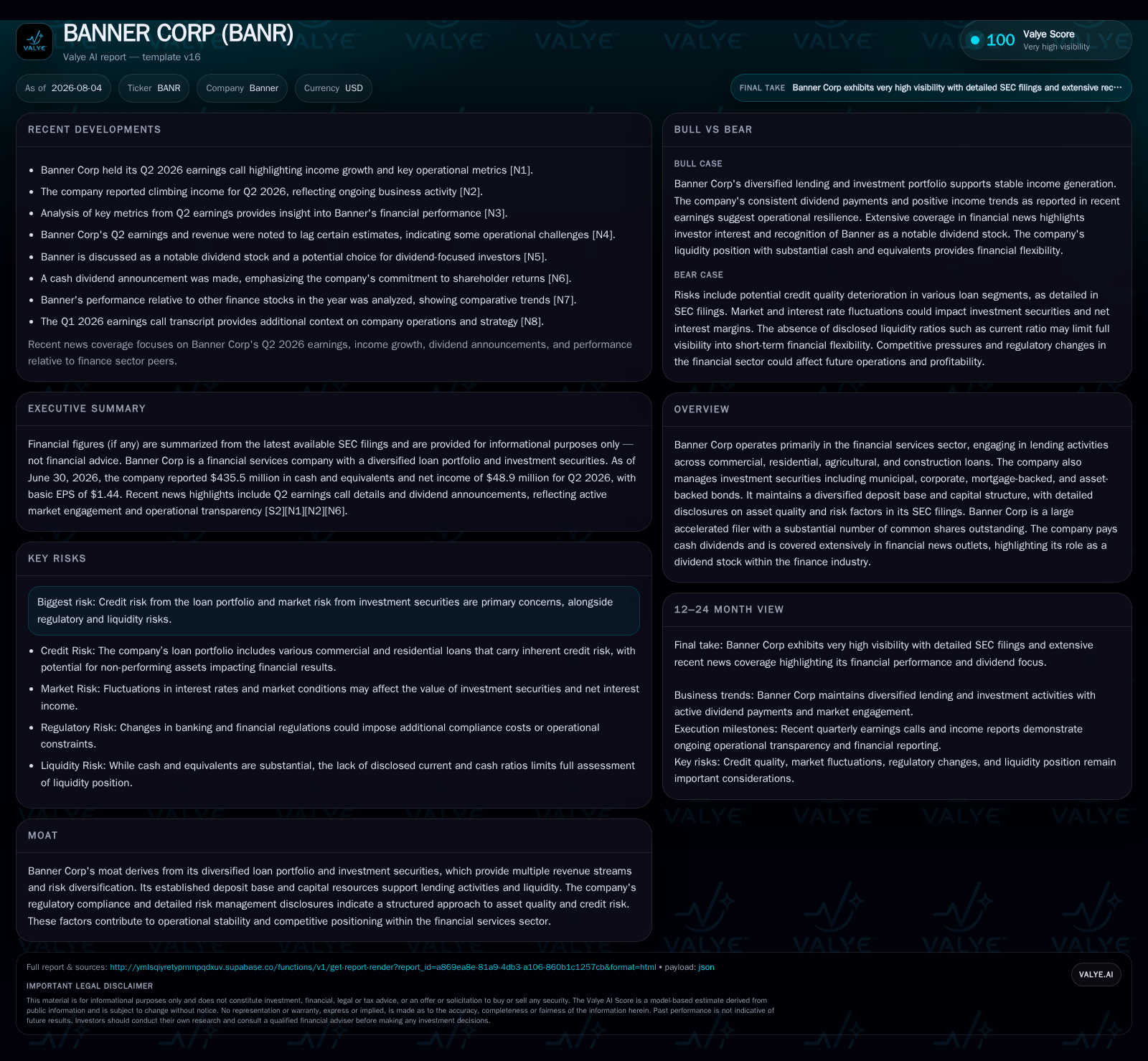
Banner Corp’s Q2 2026 report shows balanced growth in commercial, residential, agricultural, and construction loans alongside conservative investment securities management. The company maintains disciplined credit risk controls with stable non-performing loan ratios and adequate provision levels. Notably, Banner initiated a share repurchase program for up to 5% of its common stock, signaling confidence amid moderate net interest margin pressure typical for regional banks. Capital and liquidity remain sound, positioning Banner well within regulatory standards while continuing to pay dividends.
Recent Operating Update
Banner Corporation’s Q2 2026 filing highlights incremental yet important developments supporting its core banking operation stability. Loan balances across commercial business, residential mortgages (one-to-four-family homes), agricultural loans, and construction lending segments held relatively steady compared to December 31, 2025 levels [S2]. This steadiness points to cautious credit extension during prevailing macroeconomic uncertainties. Crucially, non-performing loans ratios remained contained without spikes in delinquencies or charge-offs relative to prior quarters. The provisioning for loan losses aligns with historic patterns reflecting prudent risk management in underwriting [S1][S2].
Additionally, Banner expanded shareholder value initiatives by announcing a board-approved stock repurchase plan effective August 3, 2026. The program permits buying back up to approximately 5% of the company’s issued shares (roughly 1.7 million shares), suggesting management confidence in intrinsic valuation and financial flexibility [S3]. This move complements Banner’s longstanding dividend payment tradition noted in prior investor communications [N4][N7].
Business Model Mechanics
Banner Corp operates primarily as a regional bank intermediary connecting depositors with borrowers in its regional footprint. Its key revenue driver is net interest income—earned by lending deposits at higher interest rates than funding costs—augmented modestly by fee income from deposit services and investment securities management [S1]. The loan portfolio strategy emphasizes diversification: commercial loans range from owner-occupied real estate to small business lines; residential mortgages cover direct home purchases plus home equity products; agricultural exposures cater to the Pacific Northwest's farming base; and construction loans align with local real estate development cycles.
On the funding side, Banner maintains a diversified deposit base encompassing both non-interest-bearing accounts (accounting for about one-third of total deposits) and various classes of interest-bearing accounts including savings and certificates of deposit [S2][S13]. This mix supports lower cost-of-funds compared to wholesale borrowing reliance typical in larger banks. Investment securities holdings provide secondary revenue streams and liquidity buffers; these include high-quality municipal bonds along with corporate, mortgage-backed (MBS), and asset-backed securities (ABS), a composition that balances yield objectives against credit risk exposure [S2].
Revenue expands when Banner prudently grows the loan book or captures wider net interest margins (NIM). NIM can fluctuate due to market interest rate changes impacting asset yields or funding costs; Banner employs some hedge strategies via interest rate swaps as disclosed historically though specific hedge effectiveness updates weren’t detailed this quarter [S1]. Loan fees contribute nominally but provide some operating leverage benefit.
Industry Positioning and Competitive Landscape
Banner fits squarely in the regional banking peer set typified by names such as Regions Financial Corporation, Zions Bancorporation, FNB Corporation, KeyCorp, and Comerica Incorporated. These institutions combine local market banking products with selective investment securities roles while balancing regulatory capital requirements tightly due to their regional scale.
Competing effectively hinges on maintaining asset quality through underwriting discipline amidst economic cycles affecting sectors like real estate development and agriculture prevalent in Banner’s markets. Deposit gathering efficiency also directly impacts funding costs—a key competitive edge as aggregated deposit base size correlates with pricing power over borrowers.
Compared to peers, Banner’s emphasis on conservative investment-grade bond portfolios affords more stable securities income but limits upside during yield curve steepening [N8][N9]. Its mixed loan portfolio mitigates concentration risks often seen in monoline lenders. Market commentary suggests this balance positions Banner toward the middle of its peer group's profitability band
Growth Drivers
Banner’s growth prospects revolve around organic expansion of loan volumes aligned with regional economic health. Economic expansions that boost commercial activities or housing demand create tangible loan origination opportunities especially in owner-occupied real estate lending.
Further support may come from rising interest rates which could enhance net interest margins if managed well despite potential pressure on borrower creditworthiness. Fee generation from wealth management or advisory services remains an ancillary growth leeway but likely less material given current disclosures.
Technological adoption aimed at improving customer acquisition efficiencies may gradually increase deposit retention or generate cross-sell enhancements although incremental impact is typically slow-paced in regional banking outfits [S1]. Regulatory environment evolutions permitting new product offerings could incrementally broaden Banner’s competitive set over longer horizons.
Risks and Constraints
Primary risks stem from potential deterioration in credit quality should economic conditions weaken abruptly—especially exposure concentrations within construction loans or agriculture where cyclical swings are pronounced [S1][N3]. Monitoring delinquencies beyond current non-performing levels will be critical.
Interest rate environment volatility remains a double-edged sword: while increasing rates tend to widen net interest margins initially, excessive rate fluctuations can depress loan demand or increase funding pressure if deposit betas accelerate unexpectedly.
Liquidity risk is contained presently given disciplined deposit funding but external shocks that diminish customer confidence could alter this balance rapidly requiring contingency actions.
Regulatory compliance burden intensifies capital adequacy checks potentially constraining rapid balance sheet growth without accretive internal earnings retention.
Competition from larger national banks or fintech platforms poses ongoing threat particularly for tech-savvy younger customers seeking digital-first banking experiences.
What To Watch Next
Key forthcoming indicators include quarterly updates on:
- Loan growth rates by segment (commercial vs residential vs agricultural)
- Non-performing loan ratio trends relative to provision coverage changes
- Deposit growth composition shifts impacting cost of funds trajectory
- Net interest margin fluctuations tied to benchmark rate movements
- Execution pace and impact of share buyback programs announced August 2026
- Changes in regulatory capital ratios amid retained earnings or risk-weighted asset adjustments
- Management commentary on competitive pressures including technology adoption progress
These data points combined will signal whether Banner sustains current operational stability or faces emerging headwinds warranting closer scrutiny.
Financial Profile Discussion
As of June 30, 2026, Banner held cash and equivalents totaling approximately $435 million providing ample liquidity for operational needs and capital deployments [F1]. The initiation of a sizable share repurchase program complements an efficient capital return strategy reinforcing shareholder value without compromising balance sheet solidity given existing liquidity reserves and modest leverage profile [S3].
Overall financial metrics affirm Banner’s fundamental strength among mid-sized regionals executing cautious asset/liability management within regulatory frameworks while navigating competitive market conditions.
This analysis integrates SEC filings through August 4, 2026 ([S1], [S2], [S3]) augmented by recent market commentary ([N1]–[N9]) contextualized against known dynamics of the regional banking industry sector. It focuses on operational specifics supported explicitly by cited disclosures without speculative projections or investment research views.
Disclaimer: This is research-only, informational analysis and not investment advice. It may include AI-generated interpretation and general industry context. Always verify important details using primary sources.

Comments