
Global Industrial Co’s Multi-Channel Expansion Paves a Path to Sustainable Growth
Q2 2026 highlights reveal progress in acquisition integration, sales force realignment, and private label expansion underpinning growth.
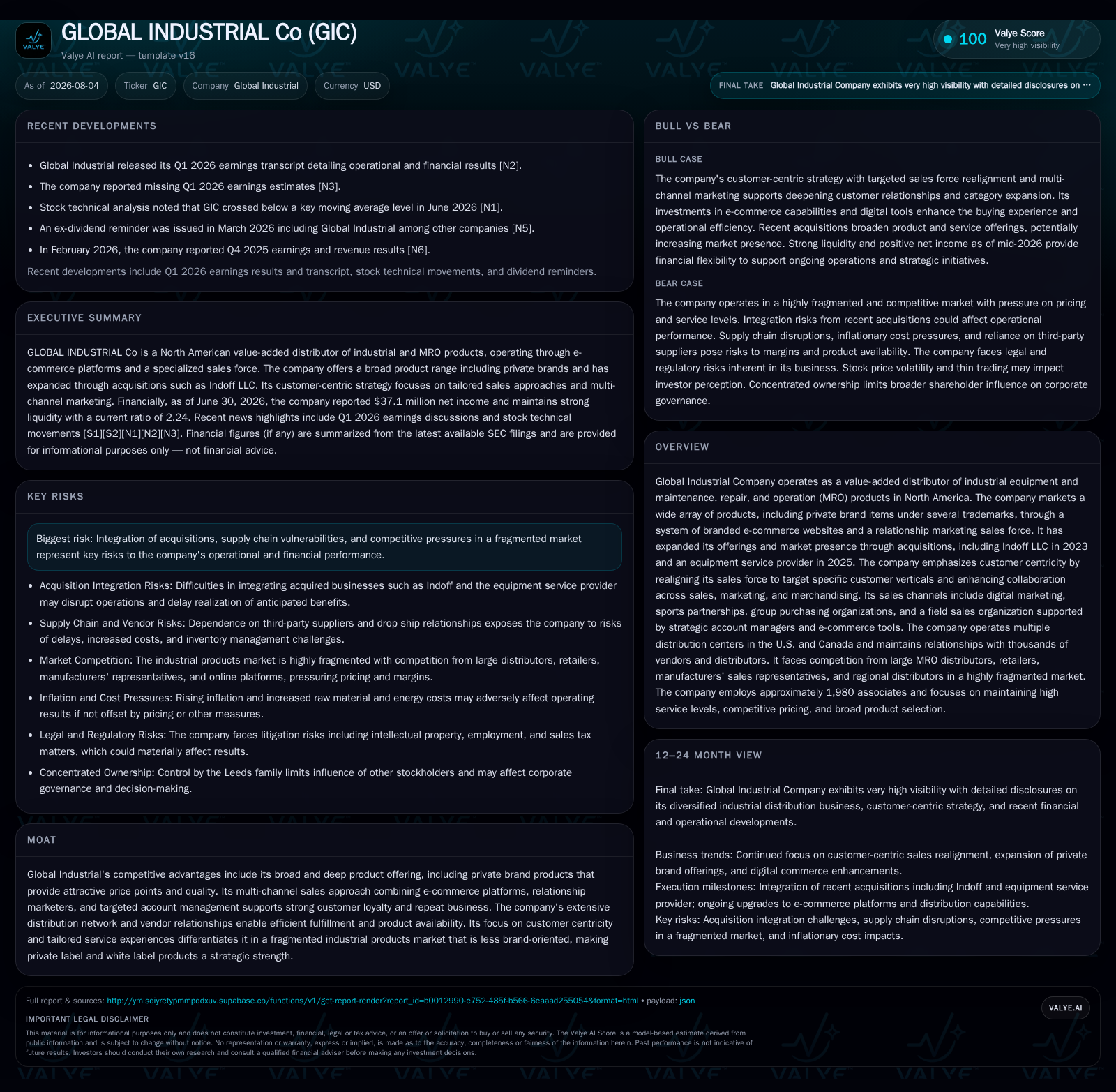
Global Industrial Company’s latest quarterly filing confirms its strategic focus on building customer loyalty through a multi-channel distribution model that combines e-commerce platforms with relationship marketing and targeted vertical sales teams. Recent acquisitions, notably Indoff LLC and an equipment service provider, have expanded its product offering and value-added services, contributing to category expansion particularly in MRO consumables. The company’s emphasis on private label products supports margin resilience amid inflationary pressures. While supply chain risks and integration challenges remain, the firm's strong liquidity and low leverage provide operational flexibility for continued investment.
Recent Quarterly Developments Reflecting Strategic Realignment
The second quarter ended June 30, 2026 filing and concurrent event disclosures confirm Global Industrial Company’s sustained focus on operational realignment post its significant acquisitions — Indoff LLC in May 2023 and an equipment service provider in April 2025. These acquisitions have broadened the company’s industrial equipment catalog and enhanced value-added service capabilities. The latest filings indicate the company has made meaningful strides in integrating these entities into its operating model via IT systems harmonization and personnel assimilation despite inherent geographic dispersions [S2],[S3],[S9].
A critical strategic shift highlighted is the proactive realignment of the sales force along customer end-market verticals. This reorganization fosters tighter cross-functional collaboration among sales, marketing, and merchandising teams tasked with delivering differentiated service experiences tailored to unique vertical-specific needs. This approach contrasts with a traditional product-line sales method by emphasizing account-level intimacy that encourages higher customer retention rates and increased wallet share through category expansion initiatives—especially within maintenance, repair, and consumable product lines where repeat ordering drives stable volume growth [S1],[S16]. Early indications suggest this alignment supports improved average order sizes and stronger pipeline development.
Private Label Innovation Enhancing Margin Stability and Pricing Power
Global Industrial markets a suite of proprietary private brand products under trademarks such as Global™, Nexel™, Paramount™, Interion™, Absocold™, among others. These private label offerings are central to the company's strategy for margin enhancement amid competitive pricing pressures endemic to the fragmented industrial distribution sector. By controlling private brand lines — some designed in-house or white-labeled via outsourced manufacturing — the company leverages both exclusivity in pricing flexibility and perceived quality differentiation that cushions gross margin erosion due to commodity cost fluctuations or supplier-driven price hikes [S1],[S5].
In an industry where many distributors compete primarily on price for branded goods, private labels allow for better margin control while simultaneously offering customers cost-effective alternatives without sacrificing reliability or specification standards. This dynamic is especially valuable against peers like Fastenal which also deploy extensive private label portfolios but often combine these with a local branch network emphasizing immediacy over digital reach.
Multi-Channel Sales Enablement: E-Commerce Meets Relationship Marketing
Global Industrial operates multiple synergistic sales channels comprising branded e-commerce sites alongside relationship marketers who utilize personalized selling tactics supported by technical expertise embedded within their sales representatives. This combination amplifies customer acquisition effectiveness by providing flexible access points — self-service digital platforms meet consultative relationship management — catering to varied buyer preferences across industries.
Further sophistication comes from segmented account teams aligned with vertical-specific insight enabling customized propositions supported by coordinated efforts from marketing campaigns through merchandising assortments. The integration of digital tools aiming to increase e-commerce conversion rates complements this relational engagement by facilitating streamlined purchasing workflows while providing data feedback loops for continuous service optimization [S1].
Such multi-channel integration is analogous to strategies employed by MSC Industrial Direct but may lack MSC’s scale advantage; nonetheless, Global Industrial's focus on combining digital ease with high-touch service interactions underpins solid customer loyalty formation critical in MRO markets characterized by infrequent yet volumetric buying patterns.
Growth Opportunities Rooted in Category Expansion and Acquisitions Integration
Expansion of product categories remains a key driver for growth as the company rigorously vets opportunities within existing accounts to identify unmet needs suitable for new or deeper category penetration. Maintenance materials, consumables, business products linked via Indoff LLC acquisition alongside commercial interior solutions represent high-repeat demand sectors aligning with recurring purchase models favoring predictable revenue streams.
Despite benefits gained from boundary-spanning acquisitions bringing new customers and upsell prospects, risks tied to managing dispersed operations persist. Geographic distance complicates operational assimilation impacting timing of synergy realization including IT system consolidation delays or cultural alignment hurdles amongst acquired personnel [S5],[S21]. Further evidence of successful integration would come from measurable revenue retention stability or improvement plus controlled incremental fulfillment costs despite enlarged inventory management complexity.
Competitive Position within the Fragmented Industrial Distribution Landscape
Global Industrial occupies a value-added distributor role intermediary between manufacturers (including its own private label arm) and end-users demanding industrial equipment or MRO supplies primarily across North America. Its peer set includes giants like W.W. Grainger leveraging scale-enabled multi-channel reach; Fastenal emphasizing local presence coupled with comprehensive private labels; MSC Industrial Direct noted for digital strength; HD Supply focusing on diversified MRO offerings; Motion Industries providing highly localized parts distribution.
While lacking direct competitor financial data for comparative analysis herein, generalized sector insight suggests Global Industrial's hybrid model encompassing digital commerce fused with relationship-based selling targets middle ground between purely branch-heavy or purely digital-native distributors. The company's strengthened private label portfolio differentiates it on pricing leverage while restructured field teams tailored by customer vertical further enhances customer retention metrics which are pivotal given pricing turbulence typical in this fragmented marketplace.
Risks Related to Supply Chains, Integration, and Economic Sensitivities
Material risk factors detailed in annual disclosures emphasize sustained vulnerabilities related to global supply chains predominantly sourcing from China and broader Asia for both private label finished goods as well as components used by domestic producers supplying Global Industrial’s product lines [S1]. Though recent operational adjustments aim to maintain adequate stock levels mitigating lost sales risk due to impeded imports, no assurances exist preventing future disruptions triggered by geopolitical tensions, pandemics or logistic bottlenecks.
Moreover, acquisition integrations inherently carry execution uncertainties including potential loss of key associates/customers at acquired businesses or unforeseen operational disruptions detracting from anticipated earnings or cash flow contributions [S5],[S21]. Inflationary pressures affecting raw material costs transport charges also threaten margins unless successfully passed along via price adjustments.
Economic downturns impair industrial capital spending reducing MRO demand intensity while seasonality introduces quarter-to-quarter variability notably benefiting second/third quarters aligned with heightened commercial activity but elevating parcel shipping costs during peak periods impacting fulfillment expenses disproportionately [S8].
What To Monitor: Milestones That Will Demonstrate Execution Success or Challenge Thesis
Key performance indicators warrant close tracking going forward include: - Product category penetration rates reflecting success in expanding footprints within existing accounts post salesforce segmentation. - E-commerce conversion rate improvements validating effectiveness of digital investments complementing relationship marketing. - Sales per representative increases indicating productivity yields related to vertical-centric account management. - Smooth integration evidenced by synergy capture measured through incremental revenue contribution from acquired operations combined with controlled incremental costs. - Inventory turnover trends signaling logistics efficiency amidst enlarged supply scope. - Indicators of supply chain stability evidenced via lead time consistency against prior disruption history [S3]. Monitoring subsequent quarterly filings for explicit management guidance commentary during earnings calls will be essential to assess whether these execution levers materialize as anticipated
Financial Profile Discussion: Balance Sheet Strength Supports Strategic Flexibility
As of June 30, 2026, Global Industrial maintains substantial liquidity highlighted by $86.7 million in cash equivalents paired with negligible long-term debt of $1.7 million yielding a robust current ratio of approximately 2.24 [F1]. This conservative balance sheet affords strategic optionality enabling continued investments necessary for technology infrastructure upgrades supporting digital platform enhancements along with working capital provisioning essential given inventory-intense business operations typical within industrial distribution.
It prioritizes evidence-based interpretation emphasizing operational shifts manifest in recent quarters substantiating strategic directions targeting sustainable growth through enhanced multi-channel distribution models combined with proprietary private brand deployment amidst ongoing external risks typical of the sector.
Disclaimer: This is research-only, informational analysis and not investment advice. It may include AI-generated interpretation and general industry context. Always verify important details using primary sources.

Comments