
Neurocrine Biosciences Advances Specialty Pipeline and Commercial Expansion Driving 2026 Momentum
Strong Q2 performance reflects INGREZZA growth, CRENESSITY launch traction, and Soleno acquisition integration.
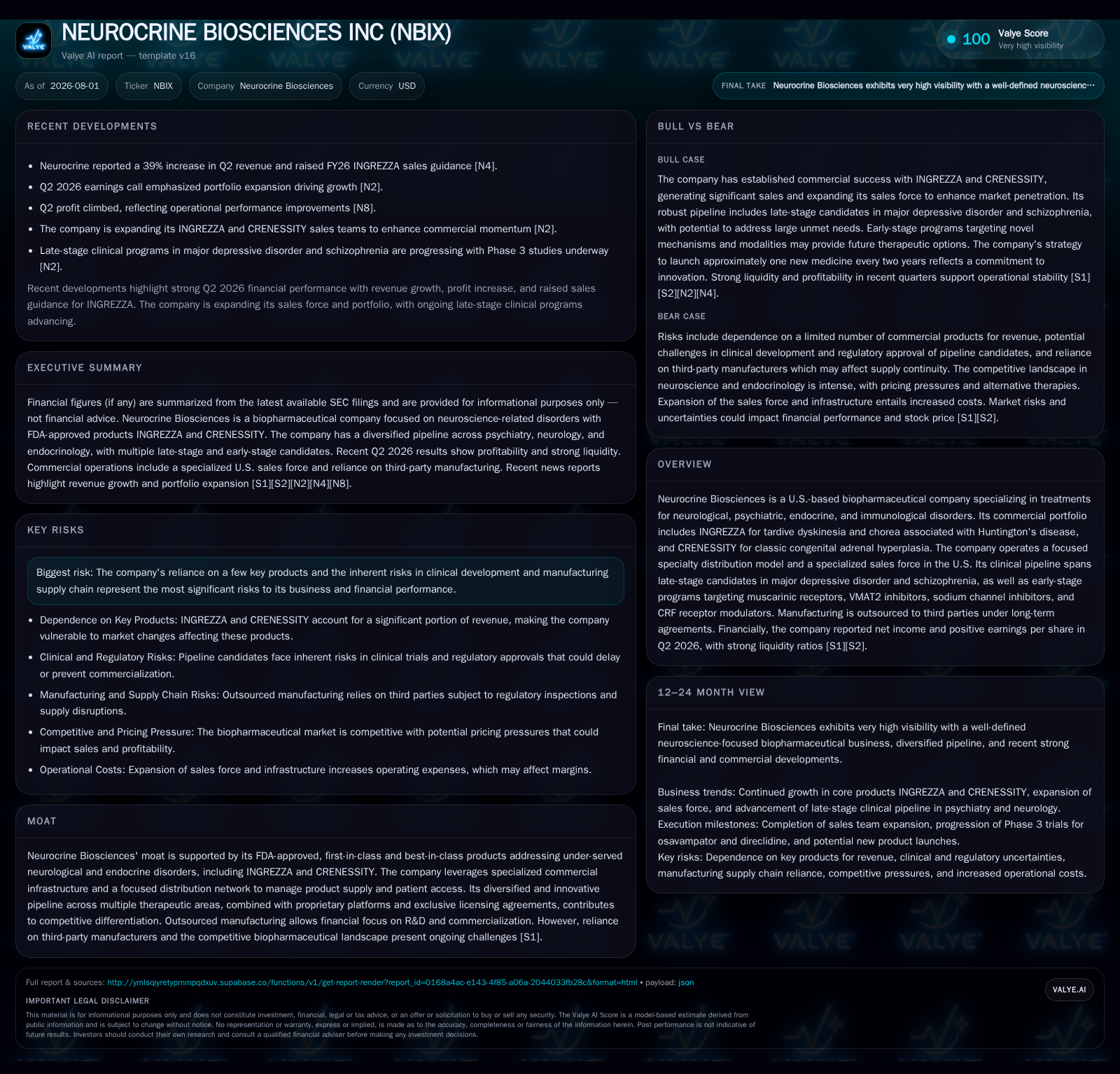
Neurocrine Biosciences reported robust second-quarter 2026 results anchored by expanded net product sales of INGREZZA and CRENESSITY amid strategic commercial team growth and specialty distribution optimization. The recent acquisition of Soleno Therapeutics broadens Neurocrine's endocrine-focused portfolio with late-stage assets targeting orphan diseases. Outsourced manufacturing and a focused specialty sales force underpin scalable commercialization while advancing a diversified clinical pipeline in neurologic, psychiatric, and endocrinological disorders. Key risks include dependency on a limited number of marketed products and third-party manufacturing continuity. Upcoming milestones involve execution of integration plans and clinical progress within VMAT2 inhibitor candidates.
Recent Operating Update
Neurocrine Biosciences' second quarter ended June 30, 2026, reported continued strong commercial momentum with significant revenue increases primarily driven by the core asset INGREZZA (valbenazine) and the relatively recent launch of CRENESSITY (crinecerfont). The company also completed its transformative acquisition of Soleno Therapeutics in May 2026, adding VYKAT™ XR (diazoxide choline) to its portfolio [S2][S3]. This acquisition broadens Neurocrine’s reach into rare endocrine disorders, bringing an established commercial product alongside development-stage assets which aligns well with its specialty focus.
Net product sales gains in the quarter were notable with INGREZZA achieving record total prescriptions supported by expanded formulary coverage—now reaching approximately 70% of Medicare beneficiaries affected by tardive dyskinesia (TD) and Huntington's chorea—signifying payer endorsement critical for sustained uptake [S1]. CRENESSITY continues to build traction after its U.S. launch in late 2024 as a first-in-class treatment for classic congenital adrenal hyperplasia (CAH), a rare disease with estimated 20,000 affected patients in the U.S., underscoring the company’s strategy to address under-served neurological and endocrine indications [S1][S26].
Business Model Overview
Neurocrine operates within the biotechnology value chain focusing exclusively on research-driven discovery through development to commercialization of neuroscience- and endocrine-targeted therapeutics. Its commercial revenues derive almost entirely from proprietary pharmaceutical products serving narrow but high-unmet medical need populations predominantly within the U.S. market [S1].
INGREZZA and CRENESSITY represent first-in-class or best-in-class therapies approved by the FDA that command premium pricing leveraged through strict formulary negotiations with payers. Revenues are realized via prescription volume growth balanced against net pricing assumptions reflecting negotiated rebates or access-related concessions [S26]. Products are sold exclusively through limited specialty pharmacy providers complemented by wholesale distributors under a specialty distribution model designed to tightly control supply chain quality, patient adherence support services, and reimbursement complexities [S26]. This controlled channel approach allows for focused sales effort deployment alongside enhanced patient engagement programs crucial for chronic or rare disease drugs.
The company outsources all manufacturing activities under long-term contracts with contract manufacturing organizations (CMOs), optimizing capital allocation towards R&D and marketing activities while accepting operational dependency risks inherent to third-party relationships [S1]. This asset-light model is common amongst mid-size biopharmaceutical firms but requires vigilant supply chain risk management particularly given potential capacity constraints or regulatory inspections impacting partner CMOs.
Pipeline assets currently span late-stage clinical candidates targeting major depressive disorder, schizophrenia, next-generation vesicular monoamine transporter 2 (VMAT2) inhibitors which build on foundational neurobiological mechanisms validated by INGREZZA’s success, sodium channel inhibitors, cholinergic muscarinic receptor modulators, and corticotropin-releasing factor (CRF) receptor agents [S1]. This breadth provides multi-therapeutic area exposure balancing neurological, psychiatric, endocrine, and immunological domains.
Industry Structure & Competitive Position
Within the biotechnology space specializing in neurological and endocrine therapeutics, Neurocrine competes against peer biopharmaceutical developers like Biogen (neurological focus), Alkermes (psychiatric indications), Sage Therapeutics (neuropsychiatric disorders), and ACADIA Pharmaceuticals (specialty neurology). Compared to these peers, Neurocrine's differentiation lies in its solidified market leadership with FDA-approved VMAT2 inhibitors addressing TD and Huntington's chorea—a space with few effective alternatives—and its recent strategic expansion into rare endocrine diseases via CRENESSITY and Soleno acquisition.
The company’s tightly managed specialty sales force is relatively lean compared to broad primary care commercial models but optimized for high-touch engagement required for orphan/rare disease prescribing environments where both physicians and payers demand extensive education [S1][S26]. Formulary access remains a critical battleground across peer companies; Neurocrine has shown capability expanding coverage notably among Medicare formularies reinforcing durable pricing power.
Outsourcing manufacturing aligns with industry practices among similar-sized biotechs desiring cost efficiency; some competitors operate partial internal production capabilities but at higher fixed cost burdens. Maintaining robust third-party relationships while mitigating supply risk is a competitive necessity that influences operating margins over time.
Growth Drivers
Key growth drivers revolve around sustainable volume expansion for INGREZZA supported by prescribing physician adoption primarily in neurology specialist practices treating movement disorders [S1]. Expanding labeled indications or patient subpopulations remains an opportunity—Neurocrine has indicated efforts to develop valbenazine as a best-in-class agent targeting emerging patient segments beyond current labels
CRENESSITY provides near-term diversification prospects leveraging growing awareness among endocrinologists of congenital adrenal hyperplasia management improvements offered by this first-in-class therapy. Patient diagnosis rates and payer reimbursement acceptance will be critical monitoring points.
The integration of Soleno adds VYKAT™ XR transitioning from small-scale orphan indication dependency toward broader pipeline-driven growth if clinical candidates advance successfully.
Research productivity is driven by a disciplined discovery engine focused on genetically validated mechanisms improving clinical success probabilities—a differentiator versus less targeted pipelines. With goals to advance four new programs into Phase 1 trials annually plus two into Phase 2, Neurocrine maintains robust mid-to-late stage pipeline replenishment sustaining long-term innovation capacity [S1]
Formulary access expansion focusing on payers including Medicare manifests through targeted negotiations ensuring continued product usage amidst evolving reimbursement landscapes.
Risks / Watchpoints / Growth Constraints
The company remains materially dependent on a limited number of commercial products generating the majority of revenues—primarily INGREZZA which contributed $2.51 billion in net product sales during calendar year 2025 representing the bulk of total revenues [S1]. Such dependence elevates risk from competitive entry or generic erosion once market exclusivity periods lapse.
Manufacturing outsourcing concentrates operational risk externally; any interruptions could materially impact product availability given reliance on third-party CMOs without immediate internal backup capacity.
Regulatory approval uncertainties persist particularly around pipeline compounds where trial failures or delayed approvals could impair expected future growth contributions.
Pricing pressures linked to evolving healthcare policy reforms including Medicare Drug Price Negotiation programs could compress net realized prices despite currently granted exceptions for small biotech innovators [S1]
Additionally, successful integration of Soleno's assets entails execution risk including harmonizing commercial functions and scaling new product launches in rare disease markets.
What to Watch Next
Upcoming milestones include quarterly updates on net prescription volumes across key products INGREZZA and CRENESSITY signaling sustained demand momentum. Expansion or confirmation of payer formulary status will be key indicators for durable pricing power.
Clinical advancement announcements especially relating to next-gen VMAT2 inhibitors such as NBI-1065890 expected to enter pivotal studies will critically influence risk-adjusted pipeline valuation.
Operational readouts concerning Soleno integration progress covering sales force alignment, marketing initiatives rollout for VYKAT™ XR, and capital allocation shifts will provide insight into synergies realization timeline.
Financial metrics such as R&D spending ratios contextualized against multiple active clinical programs gauge ongoing innovation efficiency; similarly monitoring SG&A expense trends alongside revenue growth reflects scalability of commercialization efforts.
Financial Profile Discussion
As of June 30, 2026, Neurocrine held $332 million in cash and equivalents with current assets totaling approximately $1.64 billion versus current liabilities around $874 million yielding a healthy current ratio near 1.87—indicative of solid short-term liquidity supporting operational needs including advancement of clinical trials and commercial operations [F1]
Capital allocation includes ongoing investments in R&D aligned with strategic pipeline expansion goals alongside disciplined share repurchase programs demonstrating confidence in long-term free-cash-flow generation potential from core franchises [S19]
Maintaining financial flexibility is augmented by a senior secured revolving credit facility providing up to $1 billion supporting potential future acquisitions or unexpected liquidity needs while preserving favorable covenant structures [S4]
This analysis is based solely on publicly available information as provided by SEC filings including latest quarterly report dated July 31, 2026, recent event disclosures throughout H1 2026 covering merger activities and earnings releases supplemented by well-established biotech industry framework. It does not constitute investment advice or research views but aims at an informed understanding of Neurocrine Biosciences’ operating profile within its sector context.
Disclaimer: This is research-only, informational analysis and not investment advice. It may include AI-generated interpretation and general industry context. Always verify important details using primary sources.

Comments