
InterDigital Strengthens Licensing Revenue Through Diversification and Enforcement Amid Patent Industry Dynamics
InterDigital’s Q2 2026 results highlight resilience in its patent licensing business driven by growth beyond smartphones and disciplined capital allocation.
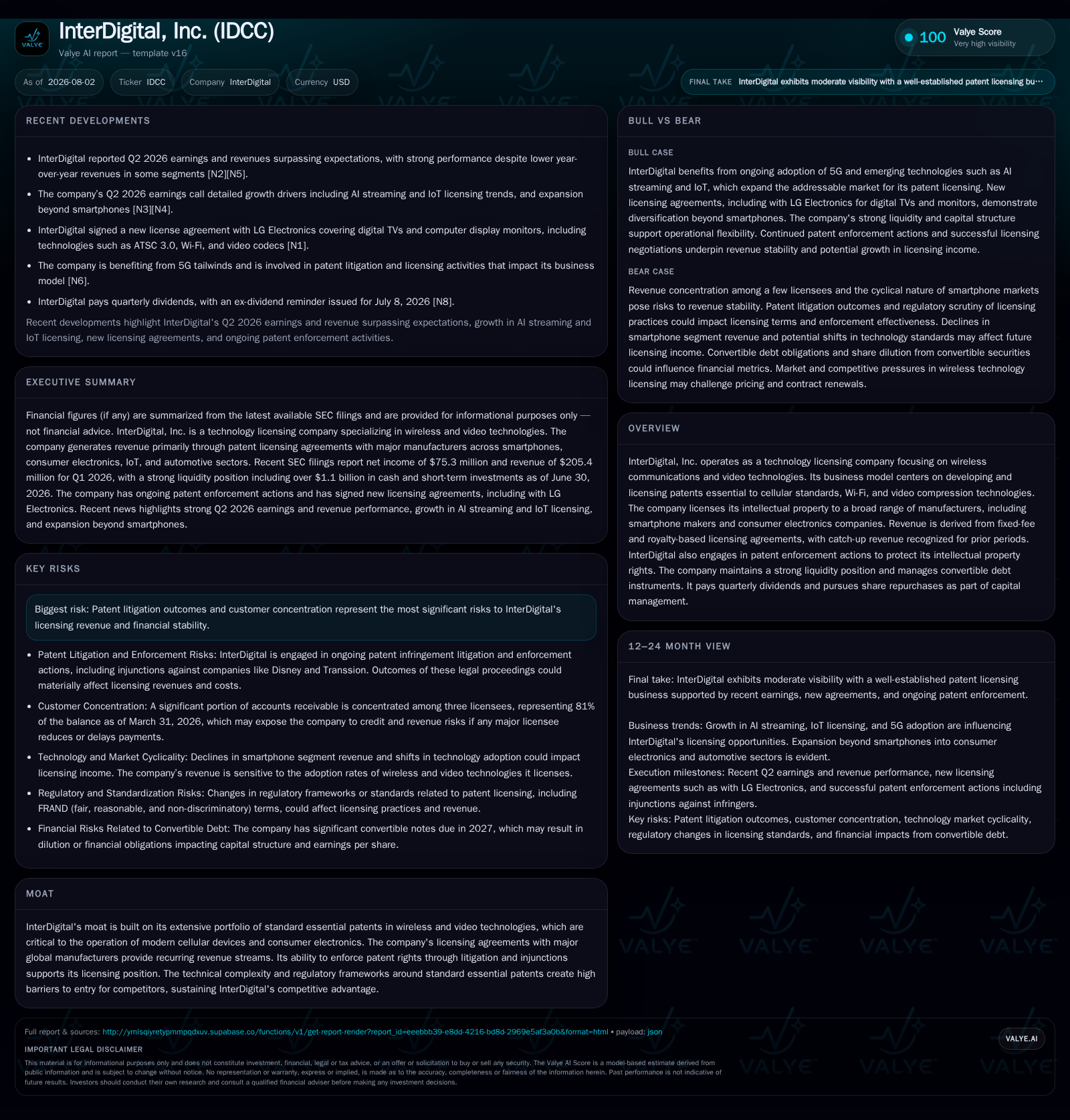
InterDigital, Inc. reported steady Q2 2026 performance with sustained licensing revenues underpinned by its robust portfolio of standard essential patents in wireless communications and video technologies. The company’s diversified licensing agreements now extend well into emerging IoT, automotive, and streaming sectors, partially offsetting softer smartphone royalties. Its strategic patent enforcement actions continue to protect licensing revenue streams amid industry-wide legal complexities. Financially, InterDigital maintains strong liquidity with a solid current ratio and manageable debt, supporting ongoing shareholder returns via dividends and share repurchases.
Recent Operating Update: Q2 2026 Performance Anchors Near-Term Narrative
Notably, catch-up revenues—which represent accrued income for past periods post-license execution—declined by approximately 25% relative to last year’s comparable quarter, reflecting normalization after previously front-loaded recognition triggers [S1]. This is typical in the licensing lifecycle where agreements often involve retroactive settlements; thus monitoring catch-up trend trajectories offers clues on contract renewal cadence and timing of enforcement resolutions.
Moreover, accounts receivable balances surged compared to prior periods, consistent with payment terms from key multinational licensees including major wireless OEMs and consumer electronics producers who form InterDigital’s core customer base. This rise aligns with seasonally adjusted billing cycles rather than credit deterioration risk as management flags ongoing credit evaluations ensuring collection integrity under complex global agreements [S2][S8].
Business Model Analysis: Licensing Core with Expanding Technology Footprint
InterDigital operates as a pure-play technology IP licensing firm with an emphasis on standard essential patents (SEPs) in wireless communications—covering cellular standards like 4G through emerging 6G protocols—as well as video compression technologies integral to modern multimedia devices. The company monetizes these patents predominantly through two revenue streams: fixed-fee licenses and royalty-based agreements pegged to the volume or value of licensed products sold globally by OEMs and technology integrators [S1]
The fixed-fee arrangements often embed prescribed payment schedules that lead to timing mismatches between cash collection and revenue recognition; accordingly, deferred revenue management is essential for smooth earnings delivery. Royalties provide recurring income proportional to end-device shipments embedding InterDigital’s patented technologies.
Importantly, recent quarters underscore growing revenue contributions from non-smartphone end markets such as connected automotive platforms, IoT devices including smart home products, and video streaming/cloud service providers leveraging advanced compression codecs developed under InterDigital’s IP umbrella [N6][N7]. These segments have exhibited double-digit percentage growth rates year-over-year even as smartphone licensing faced softness—a trend validating management's pivot toward multi-industry IP monetization to hedge cyclical consumer demand variability
The company also actively engages in patent enforcement and litigation efforts to uphold its licensing position consistent with legal frameworks mandating fair, reasonable, and non-discriminatory (FRAND) terms. Enforcement actions serve both protective and strategic roles: deterring/licensees’ non-compliance while preserving license renewal momentum across global jurisdictions where patent laws differ considerably [S1][N6].
Industry Structure and Competitive Positioning
As an upstream intellectual property owner without manufacturing operations, InterDigital sits atop the technology value chain providing critical enabling components in cellular standards (4G/5G/6G), Wi-Fi protocols, and video codec innovations used ubiquitously across mobile devices, consumer electronics equipment, automotive telematics systems, and enterprise/cloud infrastructures.
This positioning entails navigating complex cross-licensing environments with other SEP holders such as Qualcomm, Nokia's technology segment, Ericsson’s patent portfolio group, Broadcom’s wireless/video licensing business, and Marvell Technology's semiconductor-related patents. Unlike larger peers who may bundle broader system-level innovations or chipset solutions alongside IP licensing (e.g., Qualcomm), InterDigital primarily focuses on fundamental wireless connectivity plus video compression patents creating a niche but defensible moat supported by technical complexity barriers and regulatory protection around SEPs.
Regulatory scrutiny over FRAND pricing practices continues globally—driven by antitrust authorities requiring SEP holders to offer licenses on transparent terms—mandating disciplined negotiation capabilities from InterDigital to maintain royalty rates without triggering protracted disputes. Such conditions favor well-resourced firms with robust patent portfolios capable of sustained enforcement while diversifying their customer bases beyond dominant handset OEMs into growing adjacent end markets.
Growth Drivers
Structural industry drivers underpinning InterDigital's growth include:
- Adoption of New Wireless Standards: Expansion of 5G device shipments progressing worldwide alongside early-stage development toward 6G standards fuels demand for associated patented technologies embedded within billions of connected devices.
- Connected Devices / IoT Proliferation: As Internet-of-Things ecosystems mature—from smart homes to industrial telemetry platforms—licensing needs broaden significantly beyond smartphones.
- Video Streaming & Compression: Surging bandwidth-intensive video consumption drives uptake of advanced codecs where InterDigital holds essential innovations underpinning next-generation video quality improvements.
- Emergence of AI & Edge Computing: Intelligent edge devices require specialized licensed IP enabling low-latency wireless communication and efficient multimedia processing.
- Renewal & Expansion of Existing Agreements: Long-term entrenched relationships with leading global manufacturers provide stable royalty backbones augmented periodically through contract renewals or scope expansions.
- Strategic Patent Acquisitions: Supplementing organic R&D with targeted buyouts enables portfolio breadth enhancement to sustain competitive positioning.
- Geographical Market Growth: Rising smartphone penetration in emerging economies expands total addressable market for standardized wireless technologies.
These drivers collectively support resilient recurring revenue streams while mitigating cyclicality inherent in consumer device lifecycles.
Risks and Watchpoints
Critical risks remain that could impair InterDigital's business model:
- Patent Litigation Outcomes: Adverse rulings or invalidation of core SEPs could materially erode royalty income. Ongoing enforcement requires careful legal resource investment against well-capitalized counterparties.
- Customer Concentration: A substantial portion of revenues stems from a few large multinational licensees; shifts in their sourcing strategies or settlement behaviors could impact cash flow consistency.
- FRAND Regulatory Changes: Evolving mandates affecting permissible royalty calculations may reduce negotiated license fees or delay contract execution timelines.
- Technological Obsolescence: Rapid innovation cycles might circumvent existing patents; continuous R&D investment is necessary but costly.
- International Enforcement Challenges: Divergent global patent regimes complicate uniform rights protection; geopolitical factors add uncertainty.
- Cyclical End-Market Demand: Economic downturns impacting device sales volumes translate into diminished royalty bases temporarily.
- Currency Fluctuations: Global exposure subjects revenues and expenses to exchange rate variability affecting reported financial results.
Close monitoring of litigation status updates, renewal pipelines, licensee relationships, and regulatory developments remains imperative for stakeholders.
What To Watch Next
Key upcoming milestones investors should track include:
- Quarterly revenue mix breakdowns spotlighting growth trends outside smartphones (CE/IoT/auto/streaming segments).
- Outcomes from any significant patent enforcement or arbitration proceedings announced officially or inferred from SEC disclosures.
- Updates on catch-up revenue trajectory indicating timing shifts in license recognition patterns.
- Management commentary on future contract signing pace reflecting market confidence under FRAND regimes.
- Capital deployment activity including dividend increases or share repurchase pace demonstrating financial flexibility utilization.
- Broader industry adoption curves for emerging wireless standards (notably 6G developments) which impact future royalty pool expansion potential.
Monitoring these markers will help validate the sustainability of InterDigital’s intellectual property monetization model amid a maturing yet evolving wireless ecosystem.
Financial Profile Discussion
As of June 30, 2026, InterDigital reported $615.6 million in cash and equivalents along with short-term investments near $496.8 million contributing to robust liquidity reserves sufficient to navigate legal costs or opportunistic portfolio investments [F1][S2]. The company held current assets totaling approximately $1.4 billion against current liabilities near $801 million yielding a healthy current ratio around 1.74—signaling good short-term creditworthiness [F1].
Total debt mainly comprises convertible instruments linked to the senior notes due in 2027; these feature conversion provisions allowing partial settlement via stock issuance which management actively exercises based on market conditions improving capital structure efficiency [S2]. Net debt positioning remains negative when comparing debt obligations against cash buffers underscoring strong balance sheet health [F1].
Return-of-capital mechanisms saw meaningful activity in early 2026 including a 17% dividend rise to $0.70 per share per quarter alongside ongoing share buybacks financed from operating cash flows underscoring commitment to shareholder value creation amidst capital allocation discipline [S19]. Sustained operating margins bolstered by licensing revenue stability help fund these distributions.
This financial flexibility affords InterDigital capacity to invest selectively into new patent assets or litigation defense without jeopardizing operational stability—a critical advantage against less capitalized or single-market licensors frequently challenged by aggressive market entrants or shifting tech paradigms.
This analysis leverages the latest SEC filings combined with sector knowledge about technology intellectual property licensing dynamics. It does not constitute investment advice but aims to provide an informed perspective on InterDigital's business evolution within its competitive context.
Disclaimer: This is research-only, informational analysis and not investment advice. It may include AI-generated interpretation and general industry context. Always verify important details using primary sources.

Comments