
Horizon Technology Finance Navigates Sector Concentration and Capital Strategy Amid Market Volatility
The latest quarter reveals Horizon’s careful management of portfolio risk and capital structure within its specialized tech debt niche.
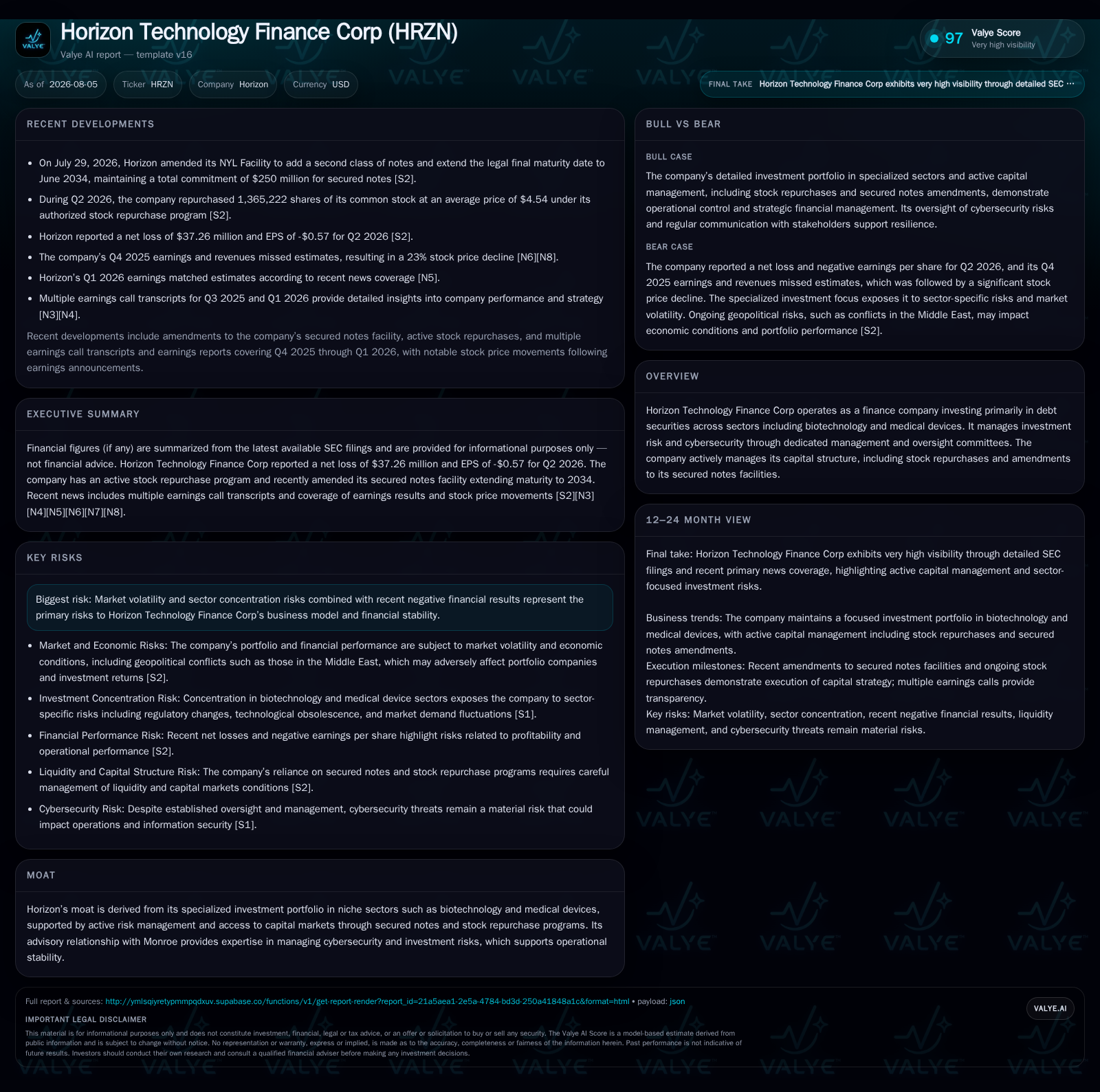
Horizon Technology Finance Corp reported Q2 results reflecting challenges in net income against the backdrop of market volatility affecting its tech and life sciences debt portfolio. The company continues to focus on active portfolio management in biotechnology, medical devices, and software sectors, leveraging secured notes and a targeted stock repurchase program to optimize capital structure. Cybersecurity risk oversight remains integral, supporting operational resilience. Horizon faces inherent sector concentration risks compounded by recent earnings pressures, with growth hinging on demand for non-bank debt financing in innovation-driven industries.
Recent Operating Update
Horizon Technology Finance Corp’s latest quarterly filing for Q2 2026 reveals net income lagging estimates during a challenging environment for specialty finance firms focused on technology and life sciences debt [N1][S2]. This shortfall reflects pressures on investment income driven by sector-specific credit challenges and broader market volatility influenced by geopolitical conflicts in the Middle East affecting global economic conditions [S2].
Concurrent with its operating update, Horizon announced the extension of its stock repurchase program through mid-2027 with authorization to repurchase up to $10 million of common stock below reported net asset value (NAV) per share [S2][S3]. Recent activity included repurchasing over 1.3 million shares at an average price of $4.54 per share in Q2, reflecting a tactical approach to capital allocation intended to enhance shareholder value given prevailing NAV discounts
Business Model Analysis
Horizon operates as a non-bank lender specializing in debt securities targeting growth-stage companies primarily in the technology-enabled life sciences sectors. Its revenue is predominantly derived from interest income on secured term loans, convertible notes, and asset-backed securities deployed within niche segments such as biotechnology research firms and medical device manufacturers [S1]. The firm’s business model prioritizes active credit risk management through rigorous underwriting standards, diversification across sub-sectors within the tech-lifesciences spectrum, and proactive monitoring enabled by advisory relationships.
Cybersecurity risk management is deeply integrated into operational oversight. Leveraging expertise from Monroe's Information Technology leadership team allows Horizon to address material risks associated with cyber threats — critical given its entrusted management of sensitive financial data within a highly regulated investment environment [S1]. This governance facet reduces operational risk exposure that specialty finance firms typically face when servicing innovative yet vulnerable portfolio companies.
Industry Structure and Competitive Position
Compared to broader BDCs like Ares Capital (ARCC) or New Mountain Finance (NMFC), Horizon displays greater sector concentration risk but benefits from domain-specific expertise allowing nuanced underwriting in complex innovation-driven industries [N2][N3].
Growth Drivers
Demand drivers for Horizon’s offerings are structurally supported by the persistent capital needs of burgeoning technology firms and innovators in biotechnology and medical devices where traditional bank lending remains constrained due to risk profiles or regulatory limits. The firm's ability to address these gaps via bespoke loan structures like term loans indexed to prime rates or convertible securities ensures relevance even as market interest rates fluctuate.
Additionally, advances in life sciences innovation alongside expansions in medtech create consistent opportunities for credit deployment. Horizon's focus on disciplined portfolio diversification within these promising sub-sectors helps mitigate idiosyncratic risk while capturing above-average yields compared with conventional fixed income alternatives.
Recent stock repurchases signal intent to sustain shareholder returns amid potential near-term earnings drag caused by elevated credit loss provisions or valuation adjustments driven by external macroeconomic shocks. Furthermore, ongoing access to capital markets facilitates refinancings or incremental leverage that can underwrite additional investments when favorable conditions emerge.
Risks and Watchpoints
Key risks confronting Horizon stem from sector-specific concentration encompassing biotechnology startups susceptible to clinical trial failures or regulatory setbacks impacting cash flows necessary for loan repayments. Moreover, recent geopolitical tensions amplify broader market volatility risk which may depress valuations affecting net asset value (NAV) stability.
Interest rate risk attached to the company's secured notes portfolio also represents a sensitivity point: rising borrowing costs could compress net interest spreads unless offset by commensurate increases in portfolio yield derived from variable-rate loan structures or repricing strategies. Credit loss experience must be closely monitored—consistently high or escalating loss rates would erode earnings predictability.
Stock price volatility introduces execution risk around the repurchase program; adverse trading conditions could limit effective share buybacks at accretive levels hence diluting intended capital return benefits.
Operationally, while cybersecurity governance is robust currently, emerging threats necessitate vigilance since breaches could disrupt business operations or expose sensitive information undermining investor confidence.
What to Watch Next
Upcoming quarters will be telling for Horizon’s capacity to navigate volatile credit markets while preserving NAV integrity amid sector headwinds. Key metrics include trends in portfolio yield — signaling pricing power or margin compression risks — alongside credit loss rates which provide leading insight into underlying asset quality.
Additionally, monitoring stock repurchase volumes relative to NAV discounts will elucidate management’s confidence level regarding share valuation fairness and capital allocation discipline. Announcements regarding adjustments in distribution payout ratios or changes in secured note terms should also be noted as indicators of financial flexibility.
Management commentary around geopolitical impacts and macroeconomic outlook on borrower prospects will provide qualitative context essential for gauging horizon over medium term.
Financial Profile Discussion
Overall liquidity appears sufficient with active engagement in stock buybacks signaling confidence in balance sheet resilience despite episodic investment cycle fluctuations.
This analysis draws upon publicly disclosed regulatory filings through August 4, 2026, news reports contemporaneous with reporting periods, and recognized industry frameworks relevant for specialty finance firms engaged in technology-driven life sciences lending. It aims solely at contextual company assessment without offering any investment research view or financial advice.
Disclaimer: This is research-only, informational analysis and not investment advice. It may include AI-generated interpretation and general industry context. Always verify important details using primary sources.

Comments