
OneIM Acquisition Corp. Advances SPAC IPO with Strong Trust Account and Sponsor Backing
OneIM Acquisition Corp. completed its January 2026 IPO, raising $287.5 million to pursue a target merger in the next 24-27 months.
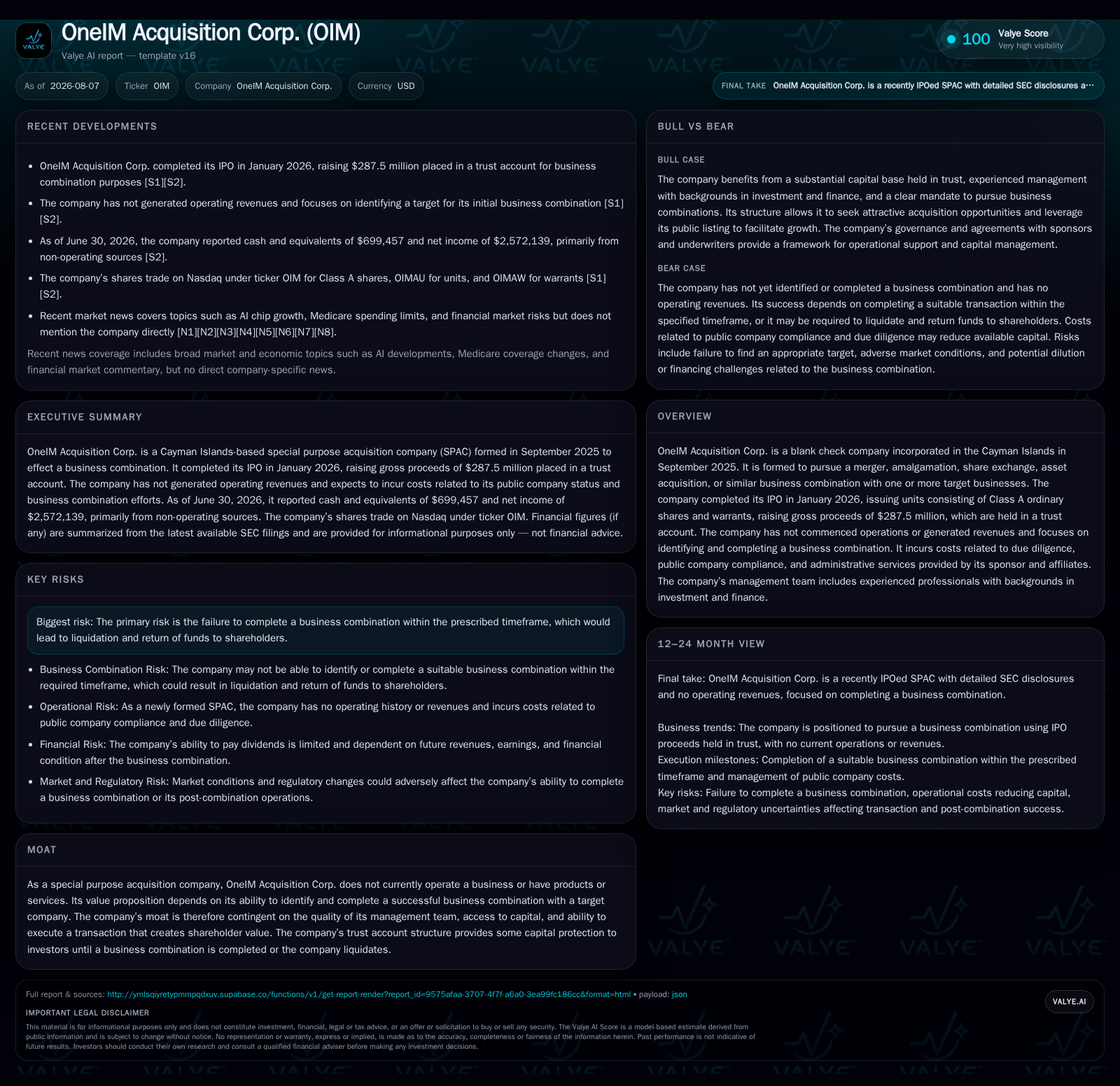
OneIM Acquisition Corp., a Cayman Islands-based blank check company, launched its initial public offering (IPO) in January 2026, generating gross proceeds of $287.5 million that are held in trust pending a business combination. Its sponsor’s private placement aligns incentives with shareholders, and the company is well-capitalized for the typical SPAC lifecycle. The key near-term catalyst remains the identification and consummation of an initial business combination within the mandated timeframe or extended deadline, after which shareholder liquidation rights activate. Operating expenses and early-stage losses are modest as expected given no current operations. Investors should monitor management’s deal sourcing effectiveness, shareholder redemption trends, and evolving regulatory factors shaping SPAC deal execution.
Recent Operating Update: Capital Base Set but No Business Combination Yet
OneIM Acquisition Corp. held its initial public offering (IPO) in mid-January 2026, successfully raising approximately $287.5 million gross proceeds through an issuance of 28.75 million units priced at $10 each [S1][S7]. Alongside this public offering, the SPAC’s sponsor executed a private placement contributing $2 million under matching terms, reflecting alignment between sponsor and public investors through skin in the game [S1][S15]. Importantly, all funds raised from these transactions were deposited into a structured U.S.-based trust account controlled by Continental Stock Transfer & Trust Company that restricts access to principal except under specified circumstances such as a completed business combination or liquidation scenario [S7][S6]. This trust structure is foundational to SPAC investor protections as it preserves capital while due diligence and negotiations proceed.
As disclosed in the Q2 2026 quarterly filing dated August 6, there have been no business operations beyond administrative expenses related to maintaining public company status and searching for suitable acquisition candidates [S2][F1]. This limited financial outflow underscores typical early-stage SG&A burn before pipeline development and deal announcement.
The company maintains a strong liquidity profile heading into the critical transaction window with reported cash and equivalents standing at roughly $699,457 and current assets exceeding current liabilities by more than fourfold (current ratio of approximately 4.55) as of June 30, 2026 [F1]. These figures suggest sufficient buffer to fund ongoing search costs without jeopardizing capital preservation within the trust account.
Business Model: A Pure-Play Blank Check Vehicle With Sponsor-Led Acquisition Incentives
OneIM Acquisition Corp. operates exclusively as a special purpose acquisition company (SPAC), or "blank check company," formed in September 2025 under Cayman Islands law expressly for effectuating one or more mergers or acquisitions with private entities seeking accelerated access to public markets [S1]. It holds no operating assets beyond cash proceeds from its January 2026 IPO and related private placement held in trust pending an initial qualifying combination.
Revenue mechanics differ fundamentally from traditional operating companies: OneIM monetizes value creation indirectly through structuring an attractive acquisition pipeline enabled by its sponsor’s network and expertise while leveraging capital raised from public investors who buy units composed of Class A shares plus redeemable warrants exercisable post-business combination at predetermined strike prices ($11.50 per share here) [S4][S5]. Success depends primarily on identifying target companies whose post-transaction valuation justifies warrant dilution and satisfies shareholder expectations.
The sponsor acquired founder shares at minimal cost ($0.003 per share), subsequently transferring some shares to independent directors to ensure governance oversight but retaining control over key votes tied to the approval of any business combination proposal [S1]. This arrangement increases potential conflicts between public shareholders’ interests—who hold redemption rights if they disapprove deals—and sponsor incentives that may prioritize deal completion within contractual timelines and sponsor promote triggers.
Industry Structure and Competitive Position: Positioning Within the Evolving SPAC Ecosystem
As part of a highly active but increasingly scrutinized SPAC sector navigating regulatory changes and investor skepticism around valuations and disclosures, OneIM follows a standard two-year lifecycle framework common across US-listed SPACs [S6]. With approximately two dozen prominent peers such as Pershing Square Tontine Holdings or Churchill Capital Corp having already completed de-SPAC transactions or continuing searches, differentiation arises mainly from sponsor pedigree, deal sourcing capabilities, size relative to target segments, and capital structure flexibility.
Unlike many legacy SPACs targeting large-scale tech unicorns or consolidation plays in fragmented industries like consumer goods or energy infrastructure, OneIM’s publicly available filings do not specify focus sectors nor disclosed target opportunities yet [N# none; S# none]. This early-stage status aligns it with the majority of recently listed blank check companies still cultivating acquisition pipelines amid challenging market conditions for new IPO-like deals.
Growth Drivers: Accessory Capital Vehicle Backed by Sponsor Experience Amid Market Demand for Alternate Public Routes
OneIM benefits from several macro-driven tailwinds underpinning continued SPAC issuance despite periodic headwinds:
- Private companies' increasing desire for flexible alternatives to costly traditional IPO processes favors SPAC mergers as expedited public listing pathways.
- Investor appetite remains considerable among retail segments attracted by units’ embedded warrants offering leveraged upside.
- Experienced sponsors with established financing relationships augment potential for competitive bidding on quality targets.
- Regulatory frameworks still permit extensions beyond initial 24 months (here up to 27 months) contingent on definitive merger agreement execution promoting timeline flexibility.
- Prospective PIPE investments can supplement trust account capital enhancing transaction size feasibility post-shareholder vote approvals.
The ability of OneIM’s management team—the CEO Ioannis Pipilis and CFO Grigorios Kapenis appointed alongside independent directors—to leverage their expertise in deal sourcing and negotiation will be critical to translating raw capital into operational value creation through successful acquisitions [S15][S9].
Risks and Watchpoints: Transaction Execution Risk Dominates Early Lifecycle
Foremost among OneIM’s risks is failure to consummate an initial business combination within prescribed windows—24 months post-IPO with possible extension up to 27 months—leading unavoidably to liquidation wherein IPO shareholders receive only their pro-rata trust account distributions without warrant value retention [S1][S6]. This binary outcome underscores urgency in securing credible targets versus passive time decay.
Additionally, shareholder redemption rights present financing complexities since high redemption levels erode available cash pool constraining negotiation leverage or requiring supplemental PIPE commitments that can dilute pre-deal investors [S1]. Furthermore, dilution effects from warrant exercises post-merger often depress net economic value realized by common shareholders complicating returns forecasting.
Market volatility combined with heightened regulatory oversight poses further uncertainty around valuation thresholds achievable during de-SPAC negotiations relative to public debut valuations—a challenge exacerbated for less differentiated sponsors without clear thematic sector angles or disclosed proprietary pipelines compared with larger cohorts boasting marquee deals already announced.
What To Watch Next: Deal Pipeline Development and Shareholder Engagement Marks Critical Milestones
Key upcoming milestones integral to monitoring OneIM’s progression toward shareholder value realization include:
- Public announcement of definitive agreements specifying target companies subject to shareholder voting will initiate critical evaluation phase inclusive of redemption elections.
- Proxy statement disclosures detailing use-of-proceeds assumptions post-deal closure will shed light on structural economics notably warrant dilution magnitude and PIPE participation if any.
- Tracking redemption rates following meeting notices provides real-time gauge of investor confidence or dissent towards chosen transactions impacting viability.
- Sponsor activity levels in sourcing multiple pipeline candidates could mitigate single-target concentration risk increasing transaction optionality.
- Observing any amendments filed extending deadlines or altering governance frameworks signals adaptive strategic responses shaping eventual outcomes.
Overall execution transparency throughout these phases combined with clear communication regarding alignment mechanisms will influence market reception ahead of OneIM transitioning into an operational entity via business combination completion.
Financial Profile Discussion
Reflecting its status as a pre-combination entity with no revenue-generating operations yet unveiled publicly, OneIM Acquisition Corp.’s financial statements present expected features characterized by negligible operating income ($4,023 in Q2 2026) offset by net losses attributable primarily to G&A expenses totaling approximately $59k in FY25 [F1]. The company reported cash & equivalents totaling nearly $700k outside the trust arrangement supporting administrative undertakings while total current assets stood at $832,804 against modest liabilities ($183,220), yielding a robust current ratio near 4.55 reflecting strong short-term liquidity absent capital deployment activities outside planned transactional uses [F1].
Importantly, principal funds remain fully secured within the trust account pursuant to SEC rules governing blank check companies maintaining investor protections prior to completing qualifying business combinations or triggering liquidations triggered by lapse of statutory deadlines or unsuccessful deals [S7][S6]. No debt instruments or other significant liabilities currently exist on balance sheet reinforcing clean capital structure awaiting deployment aligned with forthcoming strategic decisions by management and sponsor teams.
This analysis synthesizes official SEC disclosures alongside industry-standard understanding of SPAC dynamics without projecting specific merger candidates or forecasting outcomes beyond documented parameters. Readers should regard inherent uncertainties related to sponsorship quality, market conditions at deal execution timeframes, shareholder behaviors on redemption rights exercises, regulatory developments influencing transaction structures, and warrant dilutive effects when assessing subsequent performance prospects.
Disclaimer: This is research-only, informational analysis and not investment advice. It may include AI-generated interpretation and general industry context. Always verify important details using primary sources.

Comments