
AEye Inc’s Tier 1 Partnerships and Modular Lidar Platform Navigate Industry Challenges
AEye’s latest quarterly filing emphasizes the strategic importance of Tier 1 automotive partnerships and its software-definable active lidar technology amid ongoing commercialization challenges.
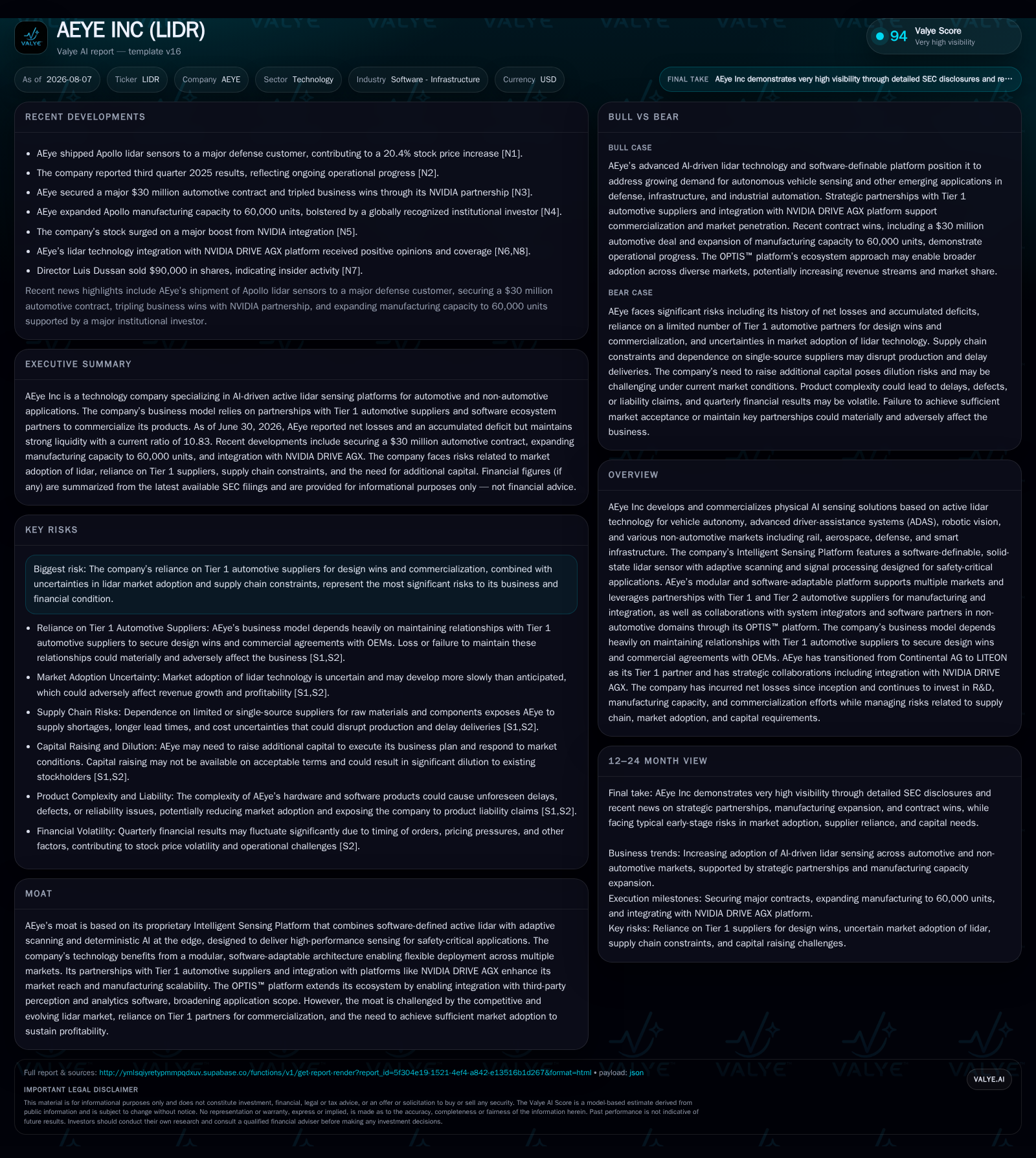
AEye Inc continues advancing its Intelligent Sensing Platform, integrating adaptive active lidar with deterministic AI for safety-critical automotive and select non-automotive applications. The recent quarterly update highlights persistent challenges in translating Tier 1 design wins into production contracts, supply chain constraints due to single-source components, and sustained losses typical of early-stage lidar providers. AEYE’s modular platform and ecosystem partnerships like OPTIS™ broaden market opportunities but revenue growth remains contingent on industry adoption, supplier relations, and capital availability to support ongoing commercialization.
Recent Operating Update
AEye Inc's August 6, 2026 quarterly filings reaffirm its strategic reliance on Tier 1 automotive suppliers as the primary conduit for securing design wins pivotal to future revenue streams in ADAS and autonomous vehicle markets [S2], [S3], [S27]. The company’s pivot from Continental AG to LITEON as a key Tier 1 partner following Continental’s program discontinuation reflects AEYE's capital-light approach that leverages partners’ manufacturing scale and supply chains rather than direct volume production. This partnership model reduces capital intensity but heightens execution risk tied to third-party performance and relationship management [S1], [S27].
Supply chain vulnerabilities persist due to dependence on limited or single-source suppliers for critical raw materials and components, exposing AEYE to cost fluctuations and delivery delays that could impede customer shipments and slow product adoption — a challenge mirrored across the lidar sector amid global component shortages [S2], [S8].
Sales cycles remain extended across both automotive and non-automotive segments [S1]. Design wins achieved through Tier 1 partners often require lengthy validation and integration phases before material production orders commence. Non-automotive engagements similarly face protracted proof-of-concept periods exceeding twelve months before commercial deployment. These factors contribute to significant upfront R&D spending outpacing near-term revenues
Business Model Overview
AEYE’s core offering is its Intelligent Sensing Platform — a modular, software-definable active lidar system designed for safety-critical applications spanning SAE autonomy Levels 2 through 5. The platform integrates solid-state hardware with an adaptive SmartScan architecture that dynamically adjusts scan patterns based on scene context alongside an AI-driven signal processing pipeline optimized for deterministic perception at the edge. This modularity enables hardware updates without redesigns while allowing fine-tuning via software changes alone, facilitating flexible OEM integration tailored to specific vehicle architectures [S1].
Revenue primarily derives from long-term supply agreements executed through Tier 1 automotive suppliers who embed AEYE’s sensors into OEM vehicle platforms under volume production contracts [S1]. These partners also manage industrialization, warranty support, and marketing functions typical of automotive supply chains. In parallel, AEYE markets the OPTIS™ platform for non-automotive sectors such as rail, aerospace/defense, smart infrastructure, and security where it combines its sensing modules with third-party analytics software to deliver turnkey solutions without new hardware variants—broadening reach but presently contributing modest revenue relative to automotive business
Industry Context and Competitive Positioning
The industrial hardware market for lidar is marked by rapid innovation cycles, complex multi-tier supply chains involving specialized component suppliers (Tier 2) up through integrators (Tier 1), with stringent regulatory certifications slowing product introductions. Peers include Velodyne Lidar, Luminar Technologies, Quanergy Systems among hardware specialists and Mobileye among perception software providers. AEYE differentiates itself through a hybrid approach emphasizing modular hardware-software integration anchored in time-of-flight sensing combined with deterministic AI signal processing optimized for real-time safety decisions.
However, competitive risks arise from peers developing alternative sensing technologies like FMCW or SPAD sensors which may offer cost or performance advantages in certain applications. Additionally, OEM procurement decisions heavily depend on Tier 1 supplier relationships; any disruption there could directly impact AEYE’s ability to scale shipments—a critical operational KPI.
Growth Drivers
Growth is supported by accelerating regulatory mandates globally pushing for enhanced vehicle safety features incorporating lidar-enabled ADAS capabilities. Increasing interest in higher SAE autonomy levels requiring robust sensor fusion architectures aligns well with AEYE’s modular configurable platform.
Non-automotive vertical expansion via OPTIS™ offers incremental diversification opportunities by enabling customized ecosystem solutions tailored to specific markets such as defense surveillance or smart city infrastructure.
Technological advances improving sensor power efficiency, range resolution, data throughput combined with cost reduction via scaled manufacturing partnerships underpin potential margin expansion over time.
Strategic collaborations integrating AEYE technology within broader autonomous driving ecosystems (e.g., NVIDIA DRIVE) further extend market access beyond standalone hardware sales.
Risks and Watchpoints
Key risks include:
- Dependence on sustaining productive Tier 1 automotive supplier relationships; failure here could materially reduce order flow prospects [S2], [S27].
- Uncertainty regarding broad market adoption of ToF-based lidar amid competing sensor modalities like FMCW/SPAD gaining traction which may necessitate costly adaptations or erode demand [S19].
- Ongoing supply chain fragilities constraining component availability or inflating costs undermine delivery reliability crucial for securing production contracts [S8].
- Extended sales cycles prolong cash burn despite restructuring efforts since 2023 aimed at focusing resources on commercialization activities over internal sales teams [S14], [S26].
- Legal contingencies including arbitration over vendor claims (
$3.3M disputed) and lease settlements ($1.4M paid plus warrants), while not expected to disrupt operations materially absent adverse rulings, add complexity [S12], [S13]. - Regulatory uncertainties around emissions requirements potentially delaying OEM autonomy feature rollouts thus deferring product adoption timing [S11], [S16].
Monitoring progress converting design wins into binding production awards alongside supply chain improvements will be critical indicators of execution success.
What to Watch Next
Investor attention should focus on:
- Conversion rates of current Tier 1 design engagements into definitive series production contracts signaling near-term revenue scaling potential.
- Management commentary regarding enhancements in supply chain resilience including supplier diversification or inventory management mitigating lead-time risks.
- Developments related to arbitration outcomes impacting contingent liabilities.
- Uptake momentum within non-automotive verticals catalyzed by OPTIS™ platform integrations indicating ecosystem traction beyond core automotive markets.
- Capital raising initiatives or operational cost controls reflecting runway sustainability amid ongoing investment needs inherent in early-stage lidar commercialization.
Financial Profile Discussion
As of June 30, 2026, AEye held $11.2 million in cash and equivalents against $6.9 million in current liabilities, yielding a strong current ratio of approximately 10.8x that reflects solid near-term liquidity despite ongoing operating losses typical of early-stage technology firms in this sector [F1]. The company reported zero outstanding debt as of the last available data point, supporting a clean balance sheet free from leverage risk extending into mid-2026 periods [F1].
AEye Inc occupies a specialized position within the industrial hardware landscape focused on advanced software-definable active lidar solutions tailored primarily for safety-critical autonomous driving applications complemented by emerging non-automotive markets accessible through ecosystem partnerships. Its competitive advantage rests on proprietary modular platform architecture combining adaptive scanning with deterministic AI perception optimized for real-time decision-making. Success hinges largely on maintaining robust Tier 1 supplier relationships that serve as conduits into OEM production pipelines coupled with effective management of supply chain constraints amid evolving competitive dynamics driven by alternative sensing technologies and shifting regulatory landscapes.
Disclaimer: This is research-only, informational analysis and not investment advice. It may include AI-generated interpretation and general industry context. Always verify important details using primary sources.

Comments