
DoubleVerify Hones AI-Driven Metrics Ahead of Strategic Acquisition
Latest quarterly results reveal seasonal softness and margin pressure as DoubleVerify prepares for transformative merger with Nielsen.
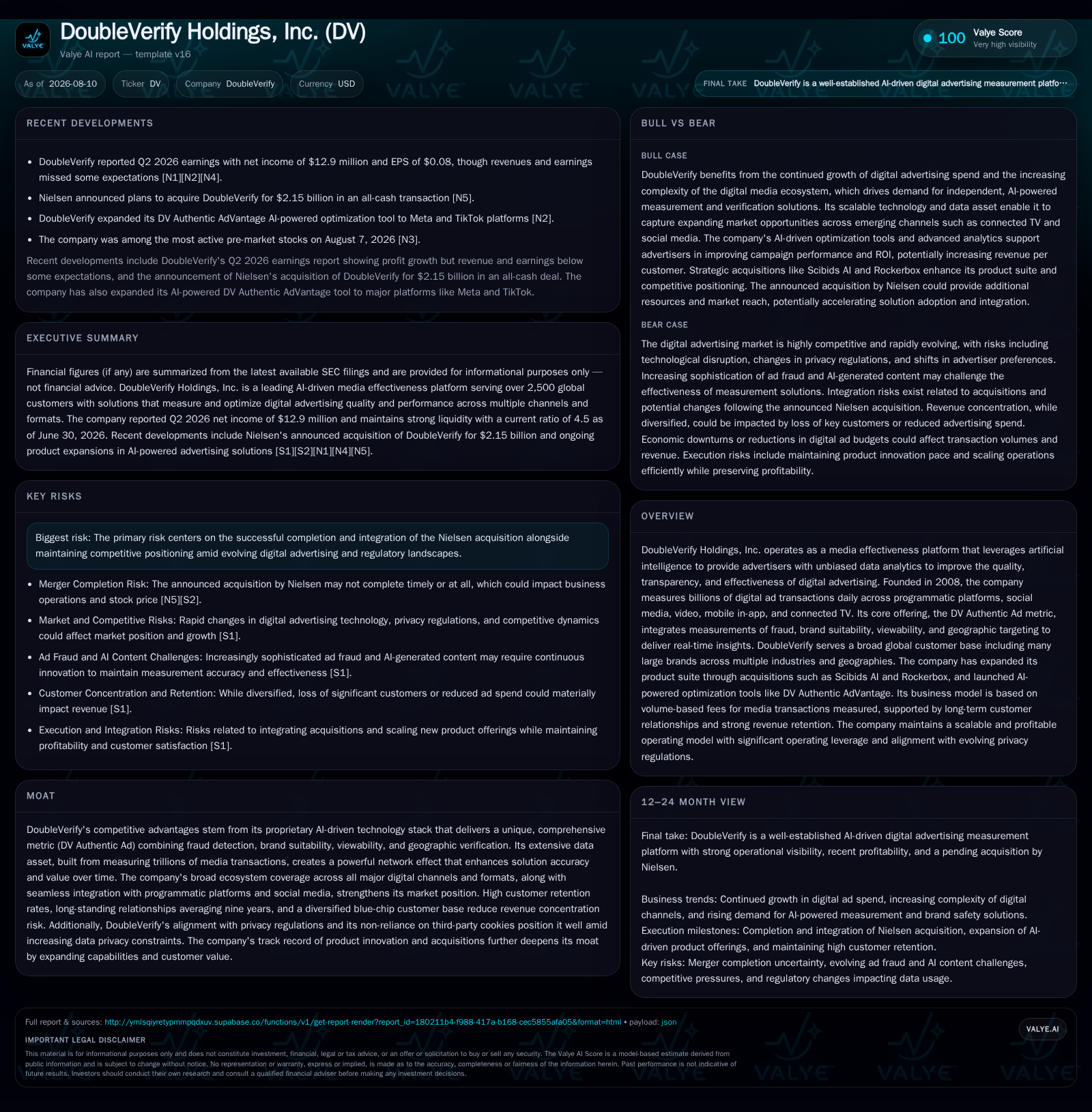
DoubleVerify’s Q2 2026 results reflected typical seasonal fluctuations in digital advertising spend, delivering revenues below expectations amid elevated stock-based compensation costs, signaling near-term margin pressure. The company's proprietary DV Authentic Ad metric integrates multiple verification vectors across broad digital media channels, anchoring its SaaS-based revenue tied to media transaction volume. The announced acquisition by Nielsen promises scale and cross-selling synergy potential, although integration risks and regulatory approvals remain key uncertainties. Growth remains supported by expanding digital ad complexity, AI advances, and CTV expansion, but the industry’s competitive and regulatory challenges continue to impose constraints.
Q2 Operating Dynamics Reflect Seasonal Trends and Margin Pressure
DoubleVerify’s second-quarter 2026 results highlighted the characteristic seasonality shaping digital advertising verification revenues. Revenues missed street estimates against a backdrop where advertisers traditionally reduce media spend in the mid-year periods following a Q4 peak aligned with holiday-driven campaigns [S1]. This cyclical softening constrains top-line growth temporarily but is intrinsic to the advertising calendar. Margins were pressured notably by stock-based compensation expenses stemming from a first-quarter grant of performance-based restricted stock units subject to market-driven vesting conditions calibrated via Monte Carlo simulation models [S2]. The inclusion of these PSUs across cost of revenue and operating expenses reflects management’s strategy to align employee incentives with stock performance yet introduces near-term earnings volatility. Such expenses dilute gross profit margin quality but are non-cash and relate primarily to talent retention in a tech-competitive environment.
The direct consequence is a more complex interpretation of operating profit trends; while net income exhibited positive growth compared to prior periods, detailed segment economics suggest seasonal softness in usage-driven SaaS platforms remains a dominant influence on quarterly variance [N2][N3]. Monitoring subsequent quarters for rebound patterns will confirm whether the company recovers as the industry shifts into heavier advertising spending seasons.
"DV Authentic Ad": The Core Proprietary Metric Driving Platform Value
At the heart of DoubleVerify's business model is its proprietary DV Authentic Ad metric—a unique composite score that analytically assesses each digital advertisement's integrity through multiple dimensions: fraud detection accuracy, brand suitability alignment, viewability thresholds adherence, and geographic delivery verification—all delivered precisely in real time. This integration underpins an AI-driven SaaS offering wherein advertisers pay predominantly on subscription or usage-based fees indexed directly to the volume of media transactions analyzed. Such revenue mechanics incentivize high platform adoption across extensive digital ad inventories while enabling scalable margins once fixed AI infrastructure costs are absorbed.
Combining these verification vectors into a single unified metric differentiates DoubleVerify from peers who often segment such services or rely on narrower feature sets. It also raises switching costs due to seamless visibility across formats (video vs. display), devices (mobile vs. CTV), and buying workflows (programmatic DSPs vs. direct social media buys) [S1]. Disaggregated analytics are available upon demand but most clients leverage the unified signal for rapid decision-making on fraud-safe media buy adjustments.
Peer companies such as Integral Ad Science focus similarly on brand safety and fraud detection but typically lack the integrated geographic targeting component at DoubleVerify’s scale; Nielsen Digital Ad Ratings provides complementary audience measurement data but does not replicate the holistic authenticity scoring embedded in DV’s platform. This product uniqueness contributes materially to high customer retention rates averaging nine years from diverse blue-chip clients globally.
Integrated Multi-Channel Coverage Builds Competitive Moat—Including CTV Expansion
DoubleVerify's technological ecosystem coverage extends well beyond traditional programmatic territories into emerging digital frontiers such as connected TV (CTV) while maintaining authoritative footprints in social media platforms and mobile in-app environments. This breadth addresses critical market fragmentation where advertisers struggle to achieve consistent quality visibility across heterogeneous channels.
With over 9.5 trillion media transactions measured in 2025 alone—up substantially year-on-year—the accumulated data asset creates network effects boosting machine learning model precision for fraud detection rates and geographic targeting accuracy [S1]. Higher transaction volumes enhance anomaly detection sensitivity and drive incremental value for advertisers seeking trusted attribution across multi-format campaigns
Moreover, expanding global data privacy regulations have raised barriers for mainstream solutions reliant on third-party cookies or invasive data collection practices; DoubleVerify’s compliance-aligned frameworks position it well within evolving legal landscapes that demand transparent user consent mechanisms without impairing measurement efficacy. Peer Innovid exemplifies CTV measurement specialization but lacks DoubleVerify’s comprehensive multi-channel unification; The Trade Desk integrates verification tools but primarily serves programmatic execution rather than independent verification.
Preparing for Scale: Nielsen Merger’s Impact on Market Position & Growth Path
Announced days before the Q2 earnings release was Nielsen's agreement to acquire DoubleVerify for $2.15 billion in an all-cash transaction [N1][S3]. This merger represents a strategic consolidation linking Nielsen’s robust audience measurement capabilities with DoubleVerify's nuanced digital ad quality analytics—potentially delivering a broader value proposition embedding end-to-end campaign verification alongside granular demographic insights.
Scale advantages accrue from cross-selling opportunities across shared client bases combined with technology stack synergies enabling richer real-time analytics dashboards integrating both viewership behavior and ad transaction authenticity. However, integration complexity inevitably introduces execution risk: merging two sizable SaaS ecosystems requires harmonizing disparate engineering standards plus customer support systems without alienating long-tenured clients reliant on stability [S3]. Regulatory scrutiny common in large industry consolidations adds uncertainty concerning timing or conditional approvals affecting merger completion pacing.
As an independent player targeting increased ecosystem breadth through acquisitions like Scibids AI and Rockerbox previously, this step up to becoming part of Nielsen propels DoubleVerify into new competitive dimensions where it must maintain innovation velocity amid cultural integration challenges.
Growth Vectors Anchored in AI Advancements and Data Network Effects
Growth drivers align strongly with broader industry trends documented at length in the annual report: global digital advertising budgets continue expanding driven by increasing programmatic complexity requiring sophisticated oversight tools; AI/machine learning advancements improve fraud pattern recognition accuracy reducing false positives; surging CTV adoption opens fresh measurement frontiers whereas mobile-in-app environments exhibit escalated demand for brand safety checks [S1][N7][N8].
The network effect derived from scaling trillions of measured impressions annually not only fortifies solution precision but creates a defensible moat difficult for new entrants lacking comparable scale or channel integration breadth. Enhanced predictive modeling capabilities also enable downstream product innovation such as DV Authentic AdVantage for AI-powered media optimization fostering further client stickiness.
Attribution improvements using deterministic identity graphs reinforce geographic targeting fidelity which becomes crucial under tighter privacy norms restricting probabilistic tracking avenues. Consequently, DoubleVerify leverages both data volume scale and intelligent processing sophistication concurrently—two pillars vital for sustainable growth amidst intensifying advertiser expectations.
Risks from Integration Complexity and Regulatory Environment
While growth prospects remain compelling, material risks require close monitoring. First is merger-related uncertainty including potential delays in closing caused by regulatory authorities or failed achievement of conditions precedent—events which could disrupt momentum or create retention issues among customers concerned about service continuity [S1][S2]
Secondly, evolving privacy legislations worldwide challenge data collection norms used by many ad verification technologies forcing ongoing investment in compliant solutions without compromising effectiveness—an area where failure could degrade product reliability or brand trust leading to client defections.
Competitive pricing pressures from both established peers (Integral Ad Science) and emerging platform-owned solutions integrated directly into programmatic exchanges threaten margin expansion if commoditization accelerates [S1]. Additionally, reliance on complex machine learning models introduces operational risks related to model bias or accuracy declines if training datasets become stale or adversarial tactics evolve.
The long sales cycles characteristic of enterprise SaaS also complicate revenue visibility making short-term forecasting challenging while dependency on key digital advertising ecosystems exposes revenue streams to external platform policy shifts beyond company control.
Milestones to Monitor in the Post-Merger Transition Phase
Key watchpoints encompass formal proxy filings associated with shareholder approval processes expected imminently post-announcement [S3], followed by calendar monitoring for antitrust clearance outcomes given sector consolidation sensitivities.
Operationally important metrics include maintenance of historically high customer retention post-merger as an indicator that integration execution does not disrupt service reliability or contract renewals—a meaningful proxy given average contracts extending nearly a decade pre-merger [S1][N1]
Attention should also focus on visible acceleration or stall points relating to extension of integrations between Nielsen's proprietary audience measurement datasets with DoubleVerify analytic interfaces indicating synergy realization pace.
Delivery against stated cost rationalization targets will provide signals about management effectiveness navigating dual priorities between investment continuation in R&D innovations versus capturing economies through consolidation.
Financial Profile Discussion: Balance Sheet Strength Supports Strategic Optionality
From a capital structure standpoint at June 30, 2026, DoubleVerify held approximately $210 million in cash and cash equivalents with no outstanding borrowings under its revolving credit facility [S2][F1]
Year-end reported operating income ($79 million) together with net income ($50 million) for 2025 illustrate underlying profit generation capability notwithstanding amplified non-cash equity compensation expense influencing short-term margins [F1]. Free cash flow generation will remain critical going forward for funding ongoing R&D investment necessary to preserve technological differentiation within fast-moving AI-adtech competition.
Maintaining this financial strength will be essential as unforeseen integration expenses or transitional inefficiencies may arise during merger consummation phases requiring agile capital allocation decisions.
Disclaimer: This is research-only, informational analysis and not investment advice. It may include AI-generated interpretation and general industry context. Always verify important details using primary sources.

Comments