
Tredegar's Mixed Performance Highlights Commodity Sensitivity and Segment Challenges
Q2 2026 results reflect strong aluminum extrusion growth offset by high performance film headwinds amid volatile commodity costs.
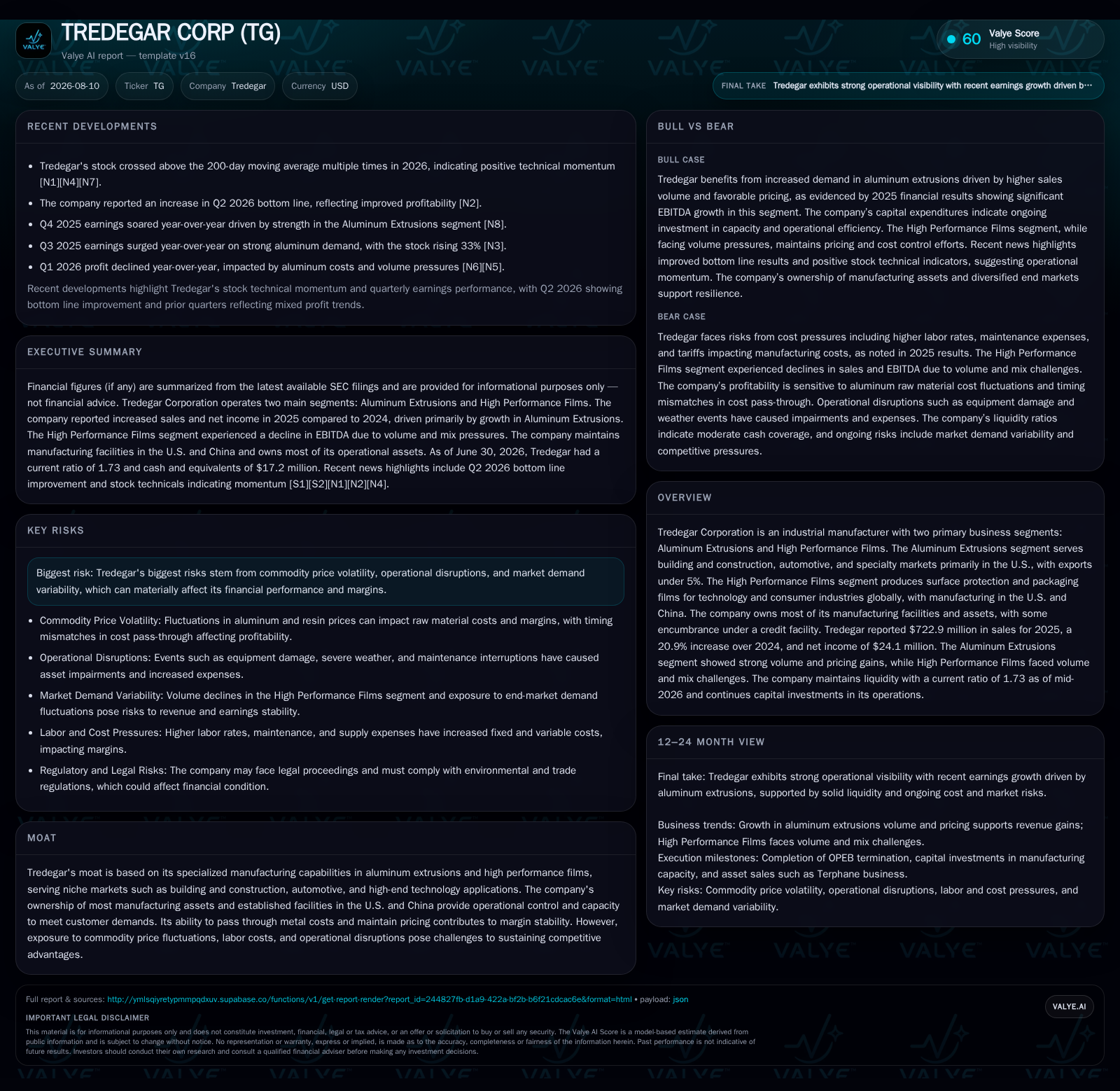
Tredegar Corporation’s Q2 2026 filings show continued momentum in its Aluminum Extrusions segment with volume and pricing gains driving revenue, while its High Performance Films segment faces volume and mix pressures. The company operates primarily in the U.S. with some manufacturing in China, serving building, automotive, packaging, and technology markets. Ownership of manufacturing assets provides operational stability but exposure to aluminum and polymer commodity price swings remains a key margin risk. Liquidity is adequate with a current ratio of 1.73 as of mid-2026. Key challenges include volume variability in films, currency risks, and ongoing cost inflation pressures.
Recent Operating Update
Tredegar Corp’s Q2 2026 results reaffirm the bifurcated nature of its business segments. The Aluminum Extrusions unit delivered robust volume expansion coupled with favorable pricing dynamics that contributed significantly to top-line improvement [S2][S3]. This segment primarily serves U.S.-based customers across building, construction, automotive, and specialty markets where demand remains resilient and price increases have been largely pass-through of aluminum cost inflation.
In contrast, the High Performance Films segment encountered volume headwinds alongside an adverse product mix shift during the quarter [S2]. Films are produced both domestically (Pottsville, PA) and overseas (Guangzhou, China), servicing global technology and consumer-facing markets that currently face softer demand cycles as well as competitive pressures on pricing. As these films tend to have more complexity in formulations including surface protection and packaging applications, mix changes can materially affect margins.
No material updates were made to risk factors in Q2 filings but risks surrounding raw material commodity volatility (aluminum ingots for extrusions; polymers for films), supply chain disruption potential, labor cost inflation, and foreign exchange exposures for Chinese operations remain focal points [S2][S1]
Business Model Overview
Tredegar operates two core segments: Aluminum Extrusions and High Performance Films. Revenue arises from selling value-added materials engineered to meet stringent customer specifications primarily across industrial end-markets.
Aluminum Extrusions: The company manufactures shaped aluminum profiles used structurally or decoratively in buildings, vehicles, and specialty applications. Customers pay based on volume ordered with prices adjusted regularly to reflect aluminum commodity cost fluctuations due to metal market volatility. Operational leverage depends heavily on manufacturing capacity utilization at the five U.S.-based extrusion plants (e.g., Carthage TN; Elkhart IN), which the company owns outright apart from one leased location [S1]. Fabrication and finishing services add incremental value beyond basic extrusion.
High Performance Films: Tredegar produces engineered plastic films serving surface protection (e.g., scratch-resistant coatings) and packaging needs (barrier films) globally. This segment requires complex polymer formulations sourced from petrochemical derivatives. Films sell at prices influenced by raw material resin costs but also product mix quality; premium specialty films command better margin profile than commoditized packaging grades [S1]. Manufacturing occurs at Pottsville plus Guangzhou facilities to balance geographic access versus cost efficiency.
Margins throughout both segments are under constant pressure from commodity input prices (aluminum ingot prices for extrusions; polymer resin prices for films) but Tredegar attempts to recoup input inflation via transparent customer contracts or periodic price adjustments. Product mix shifts—in particular within films—can either cushion or exacerbate margin swings.
Industry Structure and Competitive Context
Tredegar sits in a capital-intensive industrial manufacturing niche converting base raw materials into customized finished products that serve downstream builders, automotive OEMs, packagers, and tech product makers.
The aluminum extrusion industry is competitive yet dependent on U.S.-centric production facilities given transport costs relative to metal value density. Capacity utilization rates profoundly influence fixed-cost absorption; peers include Constellium and Novelis at different scales who also pursue technological improvements for lighter-weight alloys aligned with automotive/lightweighting trends.
Specialty film production is dominated by companies such as Berry Global Group or Sealed Air Corporation that compete on both innovation of polymers and scale efficiencies. Film manufacturers must grapple with ongoing product lifecycle evolution demanding continuous R&D investment alongside operational excellence.
Supply chain management for both aluminum inputs and polymers is critical due to commoditized raw material volatility exacerbated by geopolitical uncertainty affecting tariffs or energy prices critical for plastics production.
Growth Drivers
Construction & Automotive Demand: Continued spending on infrastructure and housing drives extrusion volumes as lightweight metal usage grows especially in transportation sectors requiring fuel efficiency gains.
Innovation in Specialty Films: Development of higher-value surface protection films targeting electronics or sustainable packaging solutions may unlock new markets or improve product mix favorably.
Pricing Power via Commodity Pass-Through: Ability to timely adjust selling prices roughly commensurate with rising aluminum or polymer costs safeguards margin integrity under inflationary environments.
Operational Efficiency & Capacity Management: Enhancements in yield rates, scrap reductions, workforce productivity gains alongside optimal plant capacity usage bode well for profit leverage amid demand fluctuations.
Geographic Balance: Presence in both U.S. (extrusions + film) and China (film) offers some diversification though currency risks require monitoring.
Risks / Watchpoints / Growth Constraints
Raw Material Cost Volatility: Aluminum price swings caused by global demand-supply imbalances directly impact extrusion input cost; similarly polymer resin price surges create margin compression unless fully passed through [S1][S2]
Demand Cyclicality & Volume Variability: Film volumes fluctuate more than extrusions reflecting greater consumer end-market sensitivity; adverse product mixes can weigh on overall segment profitability.
Labor Costs & Operational Disruptions: Inflationary labor environments combined with equipment downtime risks impose fixed-cost burdens; efficiency initiatives are essential but can require upfront capital deployment.
Foreign Exchange Exposure: Manufacturing operations in China expose Tredegar to RMB currency volatility impacting cost competitiveness or earnings translation [S1].
Competitive Pressure: In both industries peers continuously improve processes or introduce substitute materials potentially eroding market share absent innovation or client retention efforts.
What To Watch Next
Investors should monitor upcoming quarterly results for:
- Changes in capacity utilization rates reported at key manufacturing sites illustrating operational leverage progress,
- Trends in average selling prices per unit especially embedded aluminum cost pass-through effectiveness,
- Volume trajectory within the High Performance Films segment signaling stabilization or deterioration amidst cyclical consumer end-markets,
- Updates on raw material procurement strategies mitigating input volatility,
- Capital expenditure announcements potentially earmarked for efficiency upgrades or capacity expansions,
- Foreign exchange impacts due to RMB fluctuations on reported profitability from the China-based film operations,
- Progress on operational efficiency programs directly quantifying scrap rate reductions or yield improvements,
- Order backlog health or book-to-bill ratios elucidating near-term demand visibility.
Financial Profile Discussion
As of June 30, 2026, Tredegar held approximately $17.2 million in cash equivalent assets against total current liabilities of about $121.1 million resulting in a healthy current ratio of 1.73 indicating adequate short-term liquidity [F1]. While no recent debt update accompanies the latest quarterly filing beyond a prior best-effort total debt figure near $155 million as of September 2023 [F1], it appears the company maintains manageable leverage likely tied primarily to its credit facilities securing working capital needs.
Continued effective commodity cost pass-through combined with operational productivity improvement will be pivotal factors determining whether profitability scales sustainably alongside revenue growth going forward [N2]
This analysis does not constitute investment advice but aims to provide an informed perspective grounded in recent disclosures about Tredegar Corporation’s operating conditions within its industrial manufacturing niche serving aluminum extrusion and specialty film markets.
Disclaimer: This is research-only, informational analysis and not investment advice. It may include AI-generated interpretation and general industry context. Always verify important details using primary sources.

Comments