
ANI Pharmaceuticals Advances Ophthalmology Portfolio While Managing Supply Chain Risks
ANI Pharmaceuticals leverages its diversified product mix and manufacturing capacity amid evolving regulatory and market dynamics.
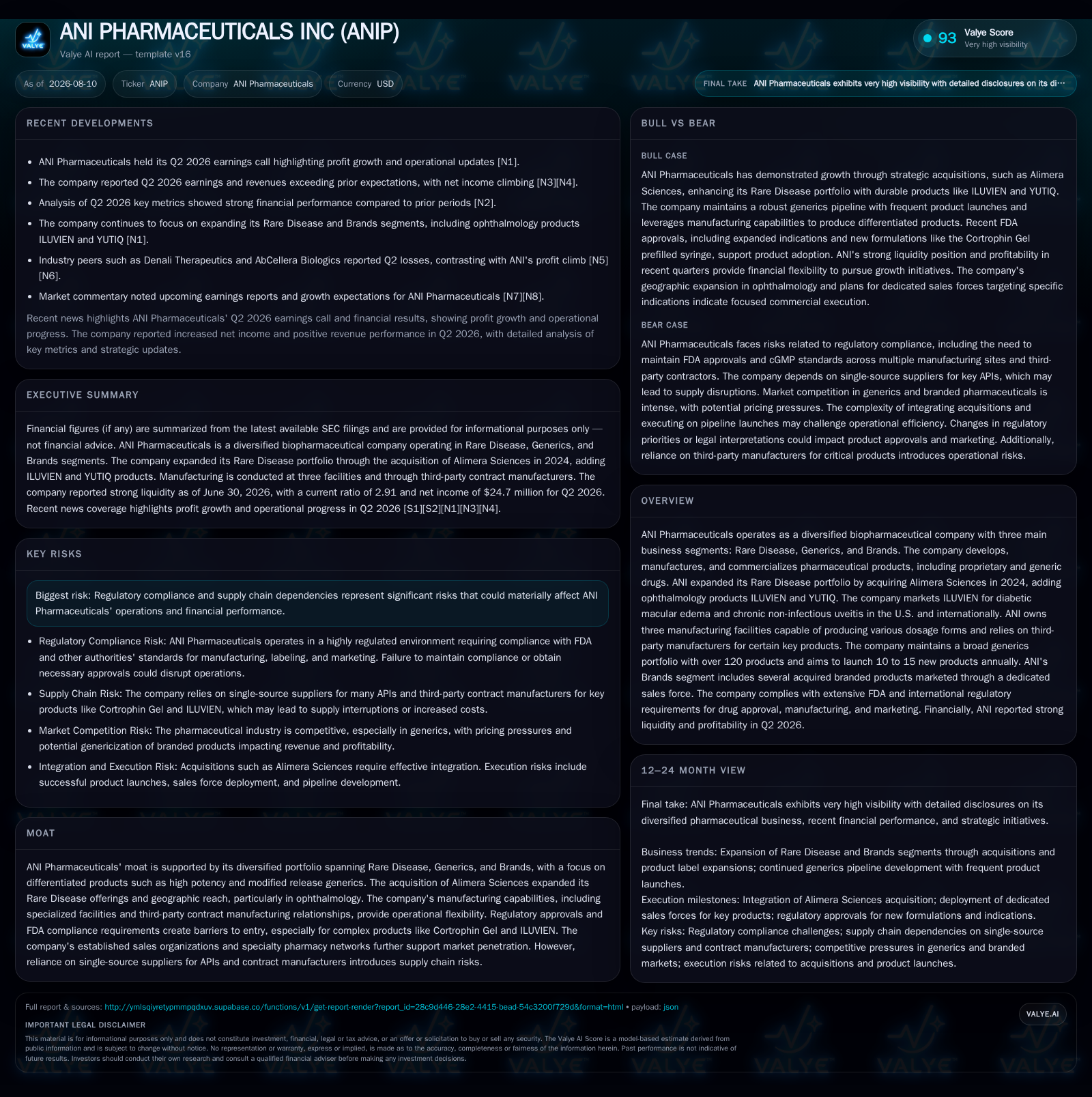
ANI Pharmaceuticals reported its Q2 2026 results highlighting ongoing commercialization progress following its 2024 Alimera Sciences acquisition, which expanded its Rare Disease segment with ophthalmology products ILUVIEN and YUTIQ. The company’s multi-segment business includes Generics, Brands, and Rare Disease portfolios, supported by three manufacturing facilities producing a wide range of dosage forms. Regulatory expansions, particularly the FDA’s broadened indication for ILUVIEN, along with strategic product focus shifts within ophthalmology, underpin growth drivers. However, supply chain dependence on single-source active pharmaceutical ingredient (API) suppliers and outsourcing partners remains a material operational risk. ANI maintains robust liquidity and a conservative balance sheet as it balances expansion investments with regulatory and competitive pressures.
Recent Operating Update: Solidifying Ophthalmology Focus Post-Alimera
ANI Pharmaceuticals' latest quarterly filing for Q2 2026 reinforces the company’s trajectory following its transformative acquisition of Alimera Sciences in September 2024 [S1]. This deal added ILUVIEN® and YUTIQ®—two ophthalmology-targeted therapeutics—to ANI’s Rare Disease segment, broadening its presence in specialty pharmaceuticals. Notably, the FDA's expanded approval in March 2025 granted ILUVIEN an additional indication for chronic non-infectious uveitis affecting the posterior segment of the eye (NIU-PS), complementing its prior diabetic macular edema (DME) indication. This label extension underpins ANI’s U.S. commercialization strategy to consolidate promotional focus on ILUVIEN rather than YUTIQ [S1].
During Q2 2026, ANI strategically transitioned promotional efforts towards ILUVIEN in the U.S., leveraging its dual-label benefits that align with international approvals already in place across seventeen European countries [S1]. This pivot suggests management’s intent to maximize market penetration via a singular flagship ophthalmology asset rather than diluting salesforce efforts across both drugs. Such focused marketing can improve efficiency given the complexities of specialty drug distribution channels and payer negotiations associated with rare disease products.
Business Model: Multi-Segment Diversification With Specialty Emphasis
ANI operates through three core segments: Rare Disease, Generics, and Brands. Its business model combines development, manufacturing, marketing, and distribution activities predominantly in the midstream pharmaceutical value chain [S1]. Revenue generation largely stems from product sales across these segments—proprietary branded drugs within Rare Disease and Brands, alongside high volume generic drugs.
The Rare Disease segment is distinguished by niche therapeutic areas such as ophthalmology (via ILUVIEN/YUTIQ) and Cortrophin Gel (Repository Corticotropin Injection USP). These products often command higher pricing due to limited competition but face significant regulatory scrutiny and reimbursement complexities [S1]. For instance, Cortrophin Gel relies on carefully controlled supply chains for its active pharmaceutical ingredients (APIs) sourced from select manufacturers
The Generics portfolio comprises over 120 approved products featuring high potency and modified release formulations designed to exploit formulation sophistication as a competitive barrier [S1]. Annual plans target launching between 10 to 15 new generics each year—a metric signaling sustained internal development capability or selective in-licensing initiatives that help counteract typical margin erosions in commoditized generics markets.
The Brands business includes acquired branded pharmaceuticals marketed through a dedicated sales force and specialty pharmacy networks. This approach supports enhanced patient access strategies critical in rare disease therapies that depend heavily on specialty pharmacies for distribution and reimbursement authorization.
Revenue flows are driven by the intersection of volume (unit sales), price per unit (governed by payor contracts or market exclusivity), new product launches adding incremental sales lines, and geographic expansion—particularly important given ILUVIEN's presence across U.S. and European markets [S1]
Industry Structure And Competitive Position
ANI sits at the midstream node of the pharmaceutical industry's value chain characterized by development capabilities blended with manufacturing infrastructure tailored for specialized dosage forms including potent products needing contained environments [S1]. This contrasts with pure-play contract manufacturing organizations (CMOs) or research-focused biopharmaceutical firms that rely on external manufacturers.
Peers in the generics space such as Teva Pharmaceutical Industries highlight intense commoditization pressures; however, ANI’s niche emphasis on high-potency modified-release generics partially insulates it from price erosion typical of standard generics producers. Meanwhile, within rare diseases and specialty pharmaceuticals — akin to Horizon Therapeutics or Alimera Sciences pre-acquisition status — differentiation rests on proprietary technologies coupled with complex regulatory pathways that erect barriers to entry.
Further competitive advantage stems from ANI's vertically integrated manufacturing footprint housed across three facilities capable of diverse dosage form production—including oral solids, semi-solids, liquids, topical applications as well as controlled substances subject to stringent FDA oversight [S1]. This capability enhances operational flexibility compared to companies reliant purely on CMOs while exposing ANI to certain operational risks linked to plant utilization efficiency.
Growth Drivers: Regulatory Expansion And Product Pipeline Momentum
Regulatory approvals remain key growth catalysts for ANI's business profile. The FDA's expanded label for ILUVIEN exemplifies this dynamic—successfully opening new patient populations without necessitating commercial launch of entirely new molecular entities [S1]. Continued efforts targeting additional indications or geographic approvals could further accelerate revenue growth.
Supplementing organic growth is an active pipeline aiming to introduce multiple generic products annually while nurturing rare disease assets through clinical development or label enhancements. The focus on complex generics—such as high-potency or modified-release formulations—provides some defense against rapid commoditization seen elsewhere in generics markets.
Additionally, acquisitions like Alimera Sciences add proprietary IP-protected branded products that deepen ANI’s therapeutic reach beyond generics alone. Commercial strategies leveraging specialty pharmacy pathways bolster market penetration especially in hard-to-reach rare disease cohorts requiring sophisticated reimbursement navigation.
Manufacturing capacity expansion or optimization also acts as a lever for scaling supply alongside new product introductions. Regulatory compliance improvements tethered to FDA audits will confirm readiness to support expanded commercial demand volumes without interruption.
Risks And Watchpoints: Supply Chain Vulnerabilities And Regulatory Compliance
Despite diversification benefits, ANI faces notable risks tied primarily to supply chain concentration. Several key APIs employed notably in Cortrophin Gel are procured from single-source suppliers or produced by contract manufacturers outside ANA’s full control [S1]. Disruptions here could significantly delay production culminating in revenue shortfalls or contractual nonperformance penalties.
Furthermore, noncompliance by third-party contract manufacturers may lead to inability to commercialize affected products promptly—introducing operational volatility uncommon among fully integrated pharmaceutical companies [S1].
Regulatory risks encompass not only FDA approval delays but also ongoing compliance with complex laws governing drug pricing programs such as Medicaid Drug Rebate Program or Medicare Manufacturer Discount Program which directly influence net realized prices [S1]. Healthcare policy changes at federal or state levels could constrain reimbursement rates thereby pressuring pricing power.
Intellectual property challenges—patent expirations on key products including ILUVIEN/YUTIQ—and challenges defending exclusivity rights represent mid-term threats inherent to pharmaceutical innovation cycles. Additionally, management recognizes cybersecurity vulnerabilities impacting clinical trial data protection or internal IT infrastructure security as emerging risks warranting heightened vigilance [S1]
What To Watch Next: Execution On Launch Cadence And Label Expansion Trajectory
Future milestones critical for assessing ANI's operating momentum include quarterly metrics around new product introductions within its generics pipeline—targeting consistent entries between 10-15 annually [S1]. Market acceptance patterns stemming from physician adoption rates or payor coverage policies will be informative.
Progress on clinical programs potentially expanding rare disease indications or further label extensions remains a valuable leading indicator tracking pipeline efficacy.
Monitoring supply chain continuity metrics—such as contract manufacturer audit outcomes or API sourcing agreements—will be crucial given their outsized impact on fulfillment capability.
Finally, any announcements related to healthcare reforms affecting drug pricing models or changes in reimbursement dynamics could materially influence growth sustainability prospects.
Financial Profile Discussion
ANI Pharmaceuticals maintains solid financial footing as evidenced by $360 million cash & equivalents at quarter-end June 30, 2026 alongside current assets totaling $825 million against current liabilities near $284 million — yielding a healthy current ratio close to 2.9x supportive of operational liquidity needs [F1]
Though total debt disclosures have not been updated recently beyond September 2018 levels near $144 million [F1], pro forma adjustments linked to recent acquisitions have been funded via substantial credit facilities executed in August-September 2024 offering both term loans ($325 million) and revolving credit capacities ($75 million) maturing in 2029 enabling adequate capital structure flexibility [S1].
This financial positioning enables balanced capital allocation towards R&D investment required for pipeline expansion while sustaining marketing expenditures necessary to capitalize on recent label expansions plus continued generic launches [S3]. Cash flow generation trends driven by diverse revenue streams will determine forthcoming leverage evolution.
Overall EBITDA margin trends indicating operational efficiency improvements post integration phases should be tracked closely alongside R&D spend percentage relative to total revenue reflecting innovation emphasis essential for sustaining longer-term competitive moats.
This analysis is based exclusively on information disclosed by ANI Pharmaceuticals through SEC filings dated up to August 7th, 2026 supplemented with relevant industry context derived independently without forward-looking assessments or investment research views.
Disclaimer: This is research-only, informational analysis and not investment advice. It may include AI-generated interpretation and general industry context. Always verify important details using primary sources.

Comments