
Clover Health Leverages Data-Driven Platform Amid Medicare Advantage Expansion and Star Rating Recalibration
Clover Health demonstrates membership growth and technology-driven differentiation while navigating regulatory developments and rising administrative costs in Medicare Advantage.
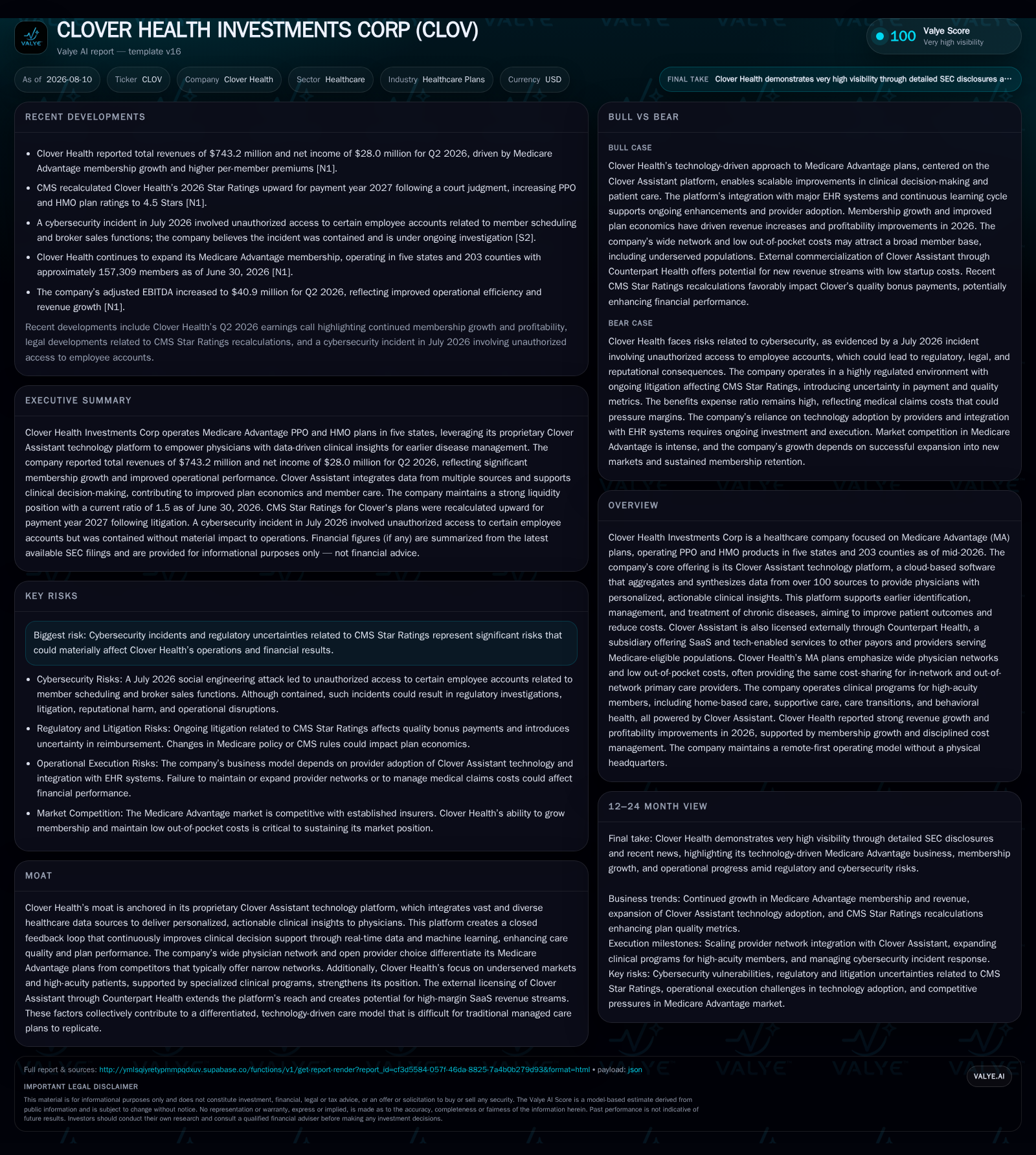
In Q2 2026, Clover Health reported strong revenue growth of 56% driven by expanding Medicare Advantage membership to over 157,000 across five states and 203 counties. The company’s proprietary Clover Assistant platform underpins its strategy to improve clinical decision-making and member outcomes through wide physician networks and competitive cost-sharing plans. Notably, a court-ordered recalculation improved its CMS Star Ratings for PPO and HMO plans, potentially enhancing future reimbursement. However, rising general administrative expenses linked to membership expansion and ongoing regulatory risks including cybersecurity remain watchpoints. The company maintains solid liquidity with $443 million in cash and investments as of June 2026, supporting capacity to scale its integrated insurance and SaaS business model.
Recent Operating Update
Clover Health Investments Corp reported strong second-quarter results on August 7, 2026, reflecting robust momentum in its core Medicare Advantage (MA) insurance business. Total revenues grew by 56% year-over-year to $743.2 million for Q2 and rose by nearly 59% for the first six months of the year compared with prior periods [S2]. This expansion was driven primarily by a surge in MA membership reaching approximately 157,309 members at quarter-end spread across five states and 203 counties, underscoring successful geographic penetration efforts [S2]. The company's income from operations swung positively to $28 million for Q2 after operating losses in prior comparable periods, signaling improved operating leverage amidst scale gains.
Parallel to top-line growth, general and administrative expenses climbed by $45.8 million — a sizable 46% increase versus H1 2025 — largely driven by augmented professional fees, broker commissions related to member acquisition channels, and other operating costs necessary to support the growing member base [S14]. Despite this cost pressure, adjusted SG&A expenses scaled more slowly than revenues leading to a reduction in adjusted SG&A as a percentage of total revenue from 18% down to around 16%, indicating improving operational efficiency with scale [S14].
From a quality performance perspective critical in managed care reimbursement frameworks, CMS announced on June 9, 2026 an uplift in Clover's PPO MA Star Ratings from an initial rating of 3.5 stars for contract H5141 to an adjusted rating of 4.5 stars applicable for payment year 2027 following favorable court litigation outcomes [S7]. Simultaneously, the company’s HMO plans (contract H8010) saw their rating improve from 4.0 stars to also reach 4.5 stars under the same updated CMS guidance. These enhancements not only improve future quality-based bonus payments but also serve as a strong market validation signal enhancing plan competitiveness against peers [S7].
Business Model Overview
Clover Health primarily operates within the Medicare Advantage segment offering PPO and HMO plans focused on individuals eligible for Medicare benefits. The company earns revenues predominantly through premiums paid by members under contracts with CMS that are risk-adjusted based on member demographics and health status factors [S13]. Medical claims costs represent the largest expense line under the benefits expense ratio (BER), which was reported near approximately 91.5% in normalized terms during full-year 2025—reflecting the proportion of premiums spent on member care delivery including medical claims incurred plus related quality improvement expenses [S1]. Maintaining BER near this level is essential for sustaining profitability given premium rate constraints.
A distinctive feature differentiating Clover's MA offerings is its wide-access physician network paired with highly competitive out-of-pocket cost structures; notably it offers similar copayment amounts for primary care provider (PCP) visits both in-network and out-of-network enhancing member choice freedom unlike many competitors who employ narrow or tiered networks that restrict access or raise costs [S13]. This openness aligns with Clover’s view that extensive provider availability improves overall member satisfaction and engagement.
Central to its operational strategy is Clover Assistant—a proprietary cloud-based software platform that integrates data from over one hundred disparate sources delivering personalized clinical decision support at point-of-care enabling earlier identification, management, and treatment of chronic diseases [S1][S13]. This real-time clinical intelligence enhances provider productivity and patient outcomes while potentially reducing avoidable healthcare utilization such as hospitalizations. Furthermore, Clover Assistant creates a closed feedback loop where increasing provider interaction yields continuous algorithm refinement leveraging machine learning—a substantial moat protecting competitive advantage in clinical enablement within MA markets.
Beyond internal use powering its insurance products, Clover has launched Counterpart Health as a subsidiary marketing this platform externally as Software-as-a-Service (SaaS) along with tech-enabled services targeting other payors/providers serving Medicare populations nationwide. This extension represents a diversification avenue promising higher-margin SaaS revenues decoupled from traditional risk-based insurance underwriting dynamics [S13]
Revenue flows derive primarily from member premiums remitted monthly (member months basis), influenced by membership growth rates, premium pricing updates set annually by CMS plus risk adjustment capture efficacy related to coding accuracy reflecting acuity levels.
Industry Context & Competitive Positioning
Within the Healthcare Plans industry segment focused on Medicare Advantage products, Clover competes against large incumbents such as UnitedHealth Group (Optum), Humana, Aetna (CVS Health), Centene/Elevance Health among others who commonly offer narrower provider networks often trading off breadth for cost control advantages. Clover distinguishes itself through open access network designs coupled with cutting-edge clinical support technologies aimed at improving care quality metrics—the latter forming critical inputs into CMS Star Ratings which directly affect bonus payments impacting profitability.
CMS Star Ratings remain pivotal benchmarks that influence payor reimbursement levels and consumer choice during annual enrollment periods; upgrades from litigation-backed recalculations materially enhance Clover’s prospects close-term by increasing bonus pool eligibility without necessitating operational changes beyond normal course activities [S7]. Monitoring trends in these ratings will be key in assessing sustained competitive positioning.
Moreover, administrative efforts including broker relationships underpin marketing channel effectiveness essential for enrollment growth—a costly but necessary investment reflected in rising SG&A spend proportional to expanding membership volumes [S14]. Successfully balancing marketing efficiency versus acquisition costs marks a principal operational challenge validated by current scale economics.
Growth Drivers
Several identifiable vectors underpin Clover’s ongoing growth trajectory:
- Aging U.S population demographics buoy demand for Medicare Advantage coverage as Medicare-eligible cohorts swell.
- Strategic expansion into additional geographic markets increasing county coverage from roughly 200 to over 203 counties at present enhances addressable market size.
- Leveraging superior CMS Star Ratings elevates competitive attractiveness translating into enrollment gains through positive consumer signals tied to quality bonuses.
- Continuous innovation within Clover Assistant platform advancing clinical insights fosters deeper physician engagement accelerating clinical program uptake unlocking downstream cost savings.
- External commercialization via Counterpart Health’s SaaS offering broadens revenue base beyond direct insurance underwriting thereby diversifying earnings streams.
Tracking KPIs such as monthly new member enrollments (membership growth), premiums earned per member month (PMPM), benefits expense ratio stabilization or improvement reflecting medical claim management efficacy, as well as quarterly updates on CMS Star Ratings provide direct visibility into growth momentum.
Risks and Watchpoints
Operational risks chiefly relate to escalating general administrative expenses spurred by broker commissions and professional fees needed to sustain rapid membership scale—pressure that could compress margins absent proportional revenue increases or claims control improvements [S14]. Sustaining favorable BER metrics amid rising medical inflation also warrants vigilance.
From an external perspective cyber threats pose material risks given healthcare industry prevalence as breach targets; unauthorized access or ransomware attacks could disrupt operations or compromise sensitive patient/member info damaging reputation alongside potential regulatory sanctions requiring significant remediation spend [S2].[N9]
Regulatory uncertainties surrounding coding audits impacting risk adjustment reimbursements create financial variability exposure further complicated by government investigations or legal proceedings typical within managed care firms focused on federal programs subjecting Clover to potential fines or recoupments if discrepancies arise [S5][S9].
Additionally pending appeal actions related to the court ruling on Star Rating recalculation could introduce timing ambiguity around final payment adjustments challenging near-term cash flow predictability [S7]
Competitively sustained innovation within provider enablement technologies remains crucial; rivals deploying sophisticated analytics or value-based care incentives might erode differentiation if Clover's product evolution lags or licensing adoption underperforms externally.
What to Watch Next
Key upcoming milestones include continued quarterly updates on MA membership trends reflecting retention post-enrollment surges especially through annual election periods. Monitoring margins through quarterly benefits expense ratios alongside adjusted SG&A scaling rates will clarify margin trajectory sustainability.
CMS communication regarding appeals outcomes related to Stars Litigation may reset payment expectations impacting forward reimbursement scenarios.[N1]
Progress reported in Counterpart Health subscription sales velocity will signal success scaling SaaS revenues beyond insurance underwritings [N1]
Clinical program engagement metrics aligned with increased provider utilization of Clover Assistant may presage improved MLR impacts long term.
Any material cybersecurity incident disclosures would be a critical red flag warranting reassessment of information security rigor.
Financial Profile Discussion
As of June 30, 2026, Clover Health maintained cash, cash equivalents, and investments totaling approximately $443 million—up substantially from $319.9 million at December year-end supporting liquidity needs amid ongoing operating expansion [S2][F1]. The company's current ratio stands at about 1.5x indicating adequate short-term asset coverage against liabilities [F1]. Total debt remains low at roughly $5.4 million (latest available figure without substantial new borrowings noted) resulting in a net cash position supportive of capital flexibility during growth stages [F1].[N1]
While historical net losses have persisted ($85 million loss reported year ended December 31, 2025), recent quarters show progression towards positive operating income enabled by improved scale efficiencies plus control over adjusted SG&A excluding stock comp charges providing clearer core operating profit visualization [S11][S14]. Continuation of these trends is fundamental for financial sustainability given premium rate negotiation constraints inherent within government-reimbursed insurance models.
Capital deployment continues prioritizing technology platform enhancements amid administrative infrastructure scaling necessary for geographic expansion putting some near-term pressure on free cash flow generation capacity [N1][N3]
Overall liquidity positioning positions Clover favorably subject to execution discipline balancing growth investments against operating leverage attainment hurdles.
Disclaimer: This analysis is based solely on publicly available regulatory filings dated up through August 7, 2026 ([S1]-[S29]), supplemental news releases ([N1]-[N5]), and companyfacts financial metrics ([F1]). All interpretations herein are informational with no investment advice intended.
Disclaimer: This is research-only, informational analysis and not investment advice. It may include AI-generated interpretation and general industry context. Always verify important details using primary sources.

Comments