
Community Trust Bancorp Expands Dividend and Sustains Regional Banking Strength
CTBI reports solid Q2 2026 results with a significant dividend increase, leveraging its regional bank moat in Kentucky and neighboring states.
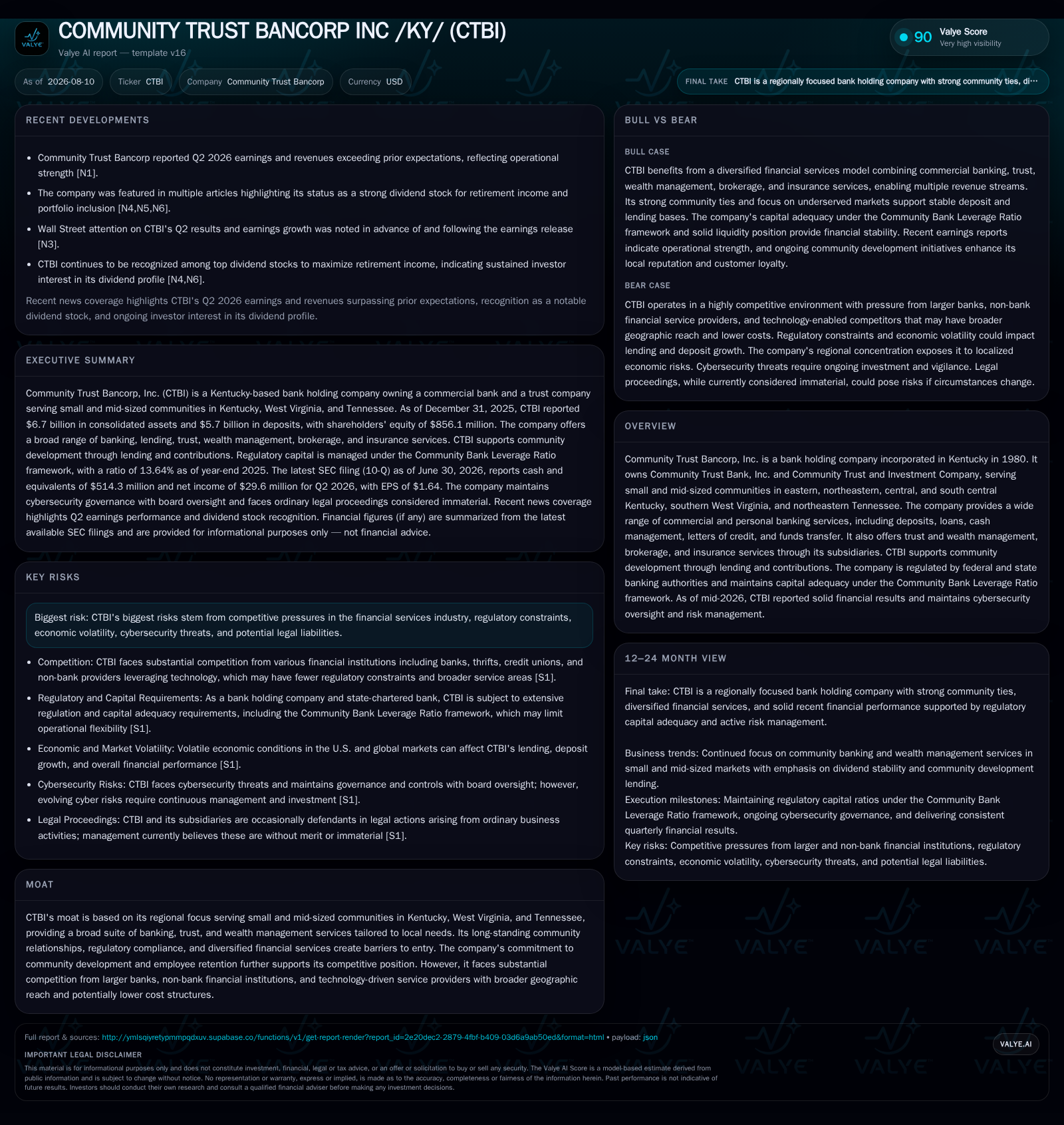
Community Trust Bancorp, Inc. (CTBI) delivered a strong second quarter with financial results that exceeded estimates, bolstered by a diverse portfolio of banking and trust services concentrated in small and mid-sized communities across Kentucky, West Virginia, and Tennessee. The company declared a notable 22.6% increase in its quarterly dividend and a one-time special dividend, reflecting confidence in its earnings stability and capital adequacy under the community bank leverage ratio framework. CTBI’s business model centers on net interest income from loans and deposits, complemented by fee income from wealth management and trust operations, all supported by deep local relationships. The company faces competitive pressures from larger banks and fintechs but reinforces its position through community development lending and strong regulatory compliance.
Recent Operating Update
Community Trust Bancorp, Inc. (CTBI) reported second quarter 2026 financial results on August 7th exceeding consensus estimates for earnings and revenue [N1][S2]. This outperformance stems largely from stable net interest margins aided by favorable interest rate spreads in their primary lending markets combined with steady fee income contributions from wealth management subsidiaries. Further underscoring financial strength, on July 28th CTBI’s Board raised the quarterly dividend by 22.6% to $0.65 per share starting October 1st and approved a one-time special dividend of $0.06 per share paid concurrently [S3][S25]. Such dividend actions reflect robust capital adequacy buffers as well as management’s confidence in recurring cash flows.
Business Model Overview
CTBI operates as a regional bank holding company headquartered in Kentucky, controlling Community Trust Bank, Inc., which is state-chartered and serves eastern Kentucky along with parts of southern West Virginia and northeastern Tennessee, plus Community Trust and Investment Company handling trust and investment services [S1][S19]. Its business model combines two synergistic segments: traditional commercial and consumer banking including deposit-taking and lending products; alongside trust, brokerage, insurance, and wealth management services that generate fee-based revenue.
Revenue derives primarily from net interest income generated via loan portfolios consisting of commercial term loans, construction financing, mortgage loans, personal loans as well as revolving lines of credit [S1]. This income benefits from CTBI’s localized knowledge enabling competitive yet prudent underwriting standards aligned with regional economic dynamics. Their deposit base is broad-based with about $5.7 billion reported at year-end 2025 supporting funding needs organically without reliance on wholesale liabilities [F1]. Non-interest income from trust assets under management totaling $4.1 billion adds diversification to revenue streams while providing sticky customer relationships due to fiduciary roles undertaken [S1][F1].
The firm emphasizes community development lending ($59.6 million funded during 2025) focusing on affordable housing projects and revitalization initiatives targeting underserved areas within their footprint—an approach that supports credit quality mitigation via enhanced local goodwill as well as regulatory goodwill points for compliance frameworks [S5]. This dual focus on banking fundamentals plus community engagement defines CTBI’s durable moat within its regional market niche.
Industry Structure and Competitive Position
As a regional bank serving smaller population centers spread across multiple states but concentrated chiefly in rural Appalachia areas of Kentucky and beyond, CTBI fits the archetype of community-oriented financial institutions where local knowledge and long-standing relationships are critical competitive advantages. However, it competes against an increasingly wide range of challengers—from larger national or regional banks such as Regions Financial or Fifth Third Bancorp active nearby—and emerging non-bank fintech lenders benefiting from more scalable technology platforms offering streamlined digital access for retail customers.
CTBI’s advantage lies in its integrated service offering covering both deposit/lending needs coupled with wealth management services through Community Trust Investment Company, fostering cross-selling opportunities that are less commoditized than pure deposit or loan products alone. The bank's size (with assets around $6.7 billion) places it beyond micro-community banks yet distinctly smaller than large regional peers typical of multi-billion dollar franchises operating across many states [F1]. Regulatory adherence under the community bank leverage ratio framework affords CTBI capital relief compared to more stringent Basel III rules that larger banks must follow; this simplification aids capital planning efficiency but also places limits on rapid asset scaling absent raising new equity or adjusting leverage ratios dramatically [S4].
Growth Drivers
CTBI’s growth is closely tied to modest but steady economic activity within its geographic footprint encompassing small towns dependent on industries such as mining legacy transitioning to diversified manufacturing or service sectors alongside burgeoning healthcare demand spurred by aging populations. Loan growth prospects hinge on new commercial credit requests tied to business expansions or infrastructure projects fuelled by community reinvestment programs.
Meanwhile, demographic trends favor sustained demand for personalized banking relationships over impersonal national chains especially among older demographics preferring face-to-face contact for complex transactions or trust planning services. Wealth management growth benefits from rising awareness among local high-net-worth clients looking for integrated advisory solutions close to home rather than national brokers.
Community development lending not only fuels incremental loans but acts as a reputational differentiator enhancing client loyalty—a crucial factor given fintech entrants aggressively courting retail customers via mobile channels lacking CTBI’s local depth [S5]. Furthermore, improved technology adoption managed internally ensures operational efficiency gains allowing better customer service delivery without disproportionate cost escalations.
Risks and Watchpoints
Credit risk remains paramount given exposure to localized economic cycles prone to volatility owing to dependence on sectors sensitive to commodity prices or federal subsidies affecting Appalachian regions’ employment trends [S1]. Deterioration in asset quality could pressure loan loss provisions eroding earnings stability.
Interest rate risk is another concern amid potential policy shifts impacting net interest margins if deposit costs rise faster than loan yields or if prepayment speeds accelerate reducing earning asset duration advantage—a common challenge facing regional banks today.
Regulatory compliance burdens continue growing particularly around anti-money laundering rules, consumer protection laws like UDAAP enforcement, data privacy mandates, and heightened scrutiny on cybersecurity practices which necessitate ongoing investments in control systems overseen by dedicated veteran IT governance personnel reporting regularly to board committees [S1].
Competitive pressures intensify as non-bank fintech firms with flexible cost bases reshape customer expectations regarding digital experiences; while CTBI’s smaller scale limits rapid tech innovation investments relative to those peers.
Legal exposures typical in banking activities exist but current proceedings do not materially threaten consolidated performance according to management disclosures [S13]. Finally, deposit outflows linked to macroeconomic uncertainty or shifts in FDIC insurance assessment formulas may influence funding cost structures unfavorably over time.
What to Watch Next
Subsequent quarters will reveal if CTBI can sustain its improved earnings trajectory against macroeconomic headwinds including potentially rising funding costs or slower loan demand amid economic moderation in core markets. Tracking loan growth rates alongside deposit retention metrics will illuminate franchise health.
Monitoring trust assets under management trends provides insight into wealth management segment momentum which plays an increasingly important role offsetting traditionally interest rate-sensitive banking revenues. Community development lending volumes also signal management commitment towards social impact while balancing credit risk exposure.
Regular updates on cybersecurity risk assessments or incident reports shared at board levels will be important given prevalence of cyber threats facing all regional banks.
Dividend policies remain constructive signals; any further increases should indicate confidence but must align prudently with regulatory capital guidelines under the CBLR framework allowing flexibility without overleveraging balance sheets.
Financial Profile Discussion
At June 30, 2026, Community Trust Bancorp held approximately $514 million in cash and cash equivalents providing ample liquidity buffers supporting daily operations and regulatory reserves without resorting to external borrowing lines currently estimated near $63.8 million total debt outstanding at prior year-end levels indicating moderate leverage usage relative to asset size suggesting conservative capital deployment strategies [F1][S2].[F1]
Capital adequacy remains strong with community bank leverage ratios above 13%, significantly surpassing the regulatory threshold of 9%, reflecting solid Tier 1 capital cushions capable of absorbing stress scenarios without immediate recapitalization concerns [S4]. This foundation allows the recent dividend increase including special payment without jeopardizing safety metrics.
Overall balance sheet composition aligns with best practices for regional banks balancing asset growth potential against cautious underwriting standards ensuring long-term franchise durability despite competitive disruptions or economic cyclicality.
This analysis leverages the most recent SEC filings alongside industry context relevant for regional banking players focusing on mid-sized market presence supported by trust service diversification. It highlights operational resilience reflected by recent earnings beats paired with strategic capital returns signaling financial health while recognizing evolving challenges from competition and regulation inherent in the sector. No investment advice is offered herein.
Disclaimer: This is research-only, informational analysis and not investment advice. It may include AI-generated interpretation and general industry context. Always verify important details using primary sources.

Comments