
Chicago Rivet & Machine Co Contends with Automotive Cyclicality and Liquidity Challenges in Q2 2026
Q2 2026 results highlight automotive demand pressures and liquidity risks amidst ongoing cost control efforts.
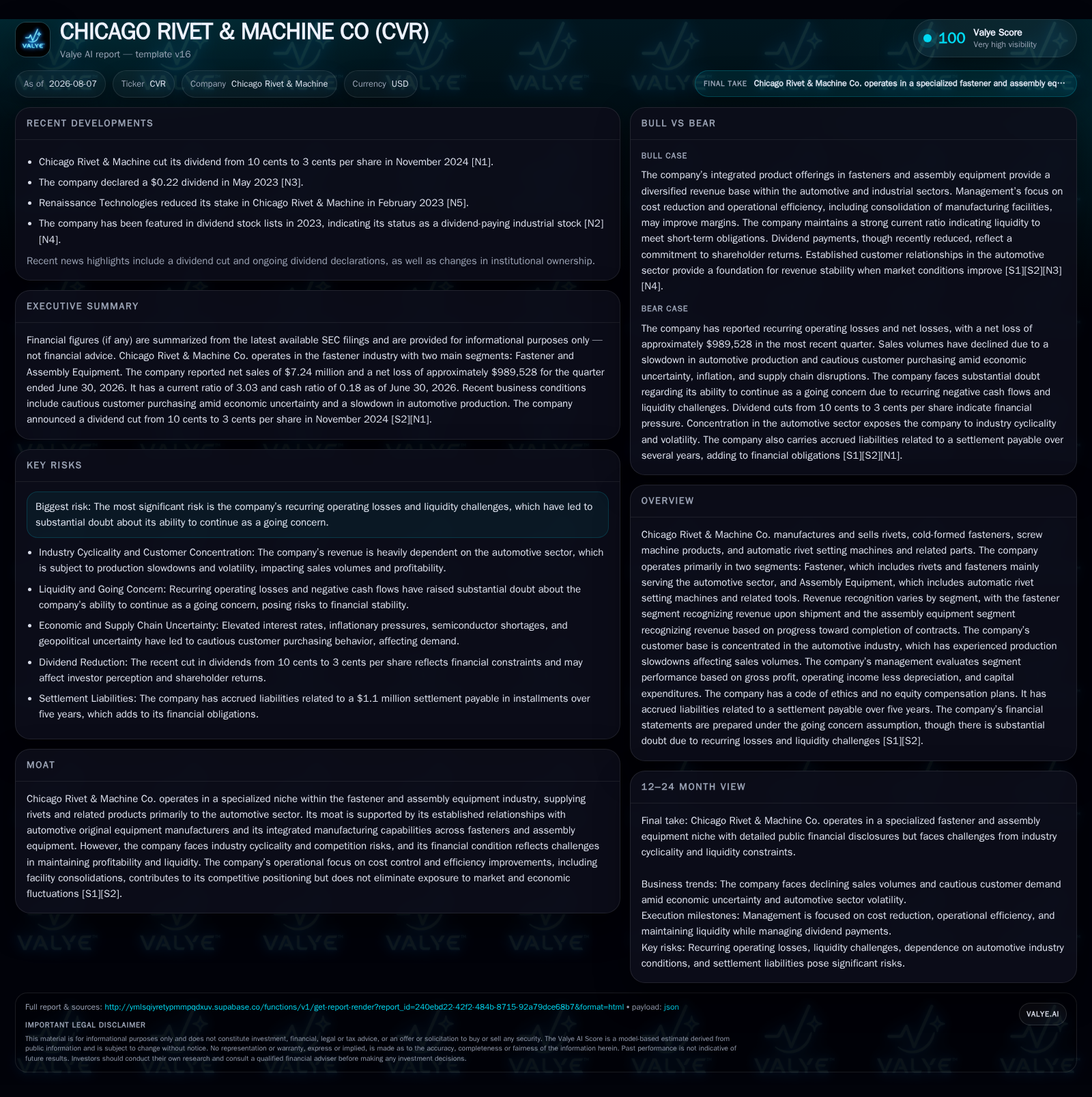
Chicago Rivet & Machine Co’s Q2 2026 performance reflects flat revenues constrained by a persistent automotive production slowdown impacting its fastener segment. Its dual-segment business model entails shipment-based revenue recognition for rivets and fasteners, while assembly equipment revenues follow progress-based accounting, creating different cash flow patterns. The company’s operational response focuses on cost control through facility consolidations, but recurring operating losses and tightening liquidity have raised substantial doubt about its going concern status. Key near-term milestones include managing credit covenant compliance, stabilizing backlog, and securing additional financing to navigate the cyclical downturn.
Latest Q2 Operating Trends: Sales Stagnation Amid Automotive Production Slowdown
In its latest quarterly filing ending June 30, 2026, Chicago Rivet & Machine Co reported sales of approximately $7.24 million in Q2, representing a slight decline of $61,452 or 0.8% compared to Q2 2025 [S2]. This relative stabilization masks underlying segment dynamics; the fastener segment—dominated by rivets, cold-formed fasteners, and screw machine products serving primarily automotive original equipment manufacturers (OEMs)—continues to face volume headwinds aligned with broader automotive sector slowdowns. Given that this segment recognizes revenue upon shipment to customers, decreased OEM production directly depresses top-line volumes [S2]. The assembly equipment segment, providing automatic rivet setting machines and related parts, reported steadier demand but contributes less overall revenue. This near flat revenue performance evidences persistent cyclicality pressure on Chicago Rivet’s core fastener product line.
Dual Revenue Recognition Models Reflect Segmental Customer Behavior and Contract Nuance
Chicago Rivet’s bifurcated business model involves distinct revenue recognition approaches tailored to the nature of each segment. Fastener products are recorded as revenue upon shipment when control passes to customers—primarily large automotive suppliers expecting just-in-time delivery—enabling relatively short sales cycles and immediate cash conversion potential for this component of the business [S2]. Conversely, assembly equipment revenues are recognized based on progress toward completion of labor-intensive contracts using a labor-based measure, reflecting longer production cycles and deferred revenue streams [S2]. This creates variable cash flow timing across segments: fasteners generate immediate invoices tied closely to shipments; assembly equipment provides contract visibility but defers recognition until milestones are met. Understanding this difference is key to analyzing working capital trends and margin volatility within Chicago Rivet’s industrial hardware niche.
Industry Positioning: Manufacturing Integration Balances Cyclicality Risks
Operating primarily within the industrial hardware and fasteners manufacturing sector, Chicago Rivet occupies a specialized tier supplying mechanical fastening components as well as complementary assembly tools essential for downstream vehicle assembly [S1][S2]. This integration across both consumable rivets/fasteners and automatic rivet setting machines provides a competitive advantage by enabling cross-selling opportunities with automotive OEMs accustomed to relying on established suppliers for both components and installation machinery. However, this integration simultaneously reinforces exposure to OEM production cycles—when automotive demand contracts as currently observed, both segments see correlated pressure albeit with differing timing due to segment accounting methods. Peers such as Alcoa Fastening Systems illustrate how scale and product breadth can mitigate cyclicality impacts; Chicago Rivet’s smaller size coupled with concentrated customer exposure accentuates vulnerability during automotive downturns.
Growth Potential Versus Sector Headwinds: Innovation in Assemblies and Market Expansion Constraints
While the automotive industry remains Chicago Rivet’s dominant end market driving both fastener volume and assembly machine demand, growth vectors appear constrained by prevailing macroeconomic uncertainty [S1]. Innovation initiatives targeting lightweight or specialized fastening solutions could provide incremental differentiation but require substantial capital investment amid tight liquidity conditions. Similarly, expansion into adjacent industrial sectors beyond automotive offers theoretical upside yet lacks near-term visibility given ongoing cyclicality in primary markets [S1]. Assembly equipment replacement cycles present opportunities for new sales but rely on capital spending willingness from OEMs recovering unevenly. Overall, growth prospects hinge on the company’s ability to regain stable automotive production volumes while managing technological upgrades in its specialized machinery lines.
Operating Leverage through Cost Control: Facility Consolidation Impact
To offset margin erosion from volume declines and persistent raw material cost inflation affecting production costs (labor, energy, outsourced services), Chicago Rivet emphasizes operational efficiency initiatives including facility consolidations completed in recent years such as integrating Albia operations into Tyrone manufacturing [S1][S4]. These moves target improved economies of scale and reduced overhead to enhance gross profit margins despite top-line pressure. While helpful for restraining fixed cost absorption challenges amplified at lower volumes—especially notable at H&L Tool where >80% revenue ties to automotive supply—the company still reports recurring operating losses reflecting constrained operating leverage [S1][S2].
Key Risks Spotlight: Customer Concentration, Liquidity Status, and Going Concern Doubts
Customer concentration risk is pronounced given the majority of fastener sales derive from a handful of large automotive OEM partners [S1][S20]. These buying decisions directly affect Chicago Rivet's production volume metrics—a primary KPI influencing gross profit margin sustainability due to fixed manufacturing cost structures. Liquidity challenges compound risk exposure; the company maintains a revolving credit facility capped at $2.5 million (non-revolving portion expired end-2025) carrying interest at prime +1% subject to a 7% floor [S2][S10]. Covenant violations related to minimum profitability and net worth were waived by lenders during early 2026 [S3][S5], reflecting financial stress.
As of June 30, 2026 cash balances stood at roughly $770,000 against current liabilities exceeding $4 million—a current ratio above 3 partly aided by significant working capital components but underscoring tight near-cash runway given negative operating incomes exceeding $1 million for H1 2026 [F1][S2][S10]. The filing explicitly notes substantial doubt about continued operations within one year absent successful strategic actions including asset sales (certain H&L assets classified as held-for-sale) and pursuit of alternative financing sources [S10]. This scenario highlights elevated refinancing risk despite zero long-term debt outstanding [F1], shaped by ongoing operating losses amid an uncertain industrial hardware cycle.
What to Monitor Next: Covenant Compliance, Backlog Development, and Sales Pipeline Momentum
Upcoming milestones critical for reassessing Chicago Rivet’s viability include management’s ability to renew or refinance its March 2025 Credit Agreement expiring August 31, 2026 [S3][S10], alongside the execution pace on asset disposals intended to bolster liquidity [S7]. Backlog levels tied particularly to assembly equipment contract progress could provide leading indicators of recovery if improving order inflows materialize beyond Q2 softness [S16]. Additionally, sales pipeline expansion efforts leveraging strengthened commercial leadership may signal potential volume rebound or diversification away from automotive OEM concentration [S15]. Monitoring collection metrics on trade receivables remains vital given company acknowledgment of credit risk inherent in its primarily domestic Midwestern automotive customer base [S20].
Financial Profile Discussion: Cash Reserves, Debt Status, Covenant Waiver Dynamics
As June 30, 2026 reporting shows, Chicago Rivet maintains cash & equivalents near $770K with no reported long-term debt outstanding as of December 31, 2024 [F1]. The company’s revolving credit facility includes a $2.5 million line of credit, with the non-revolving portion expired at the end of 2025 and not renewed [S2]. Despite this liquidity buffer generating a favorable current ratio exceeding 3 due largely to working capital constituents totaling over $12 million in current assets against $4.28 million in current liabilities [F1], the company’s ongoing operating losses (over $1 million in H1) erode cash flow sustainability.
Repeated lender waivers for breaches of financial covenants during early-to-mid 2026 evidence continuing strain on profitability thresholds required under financing agreements [S5][S10]. The company's strategic asset sale programs including disposition classified assets totaling nearly $180K reflect tactical attempts at liquidity enhancement amid constrained financing alternatives [S7][S10]. Continuing negative cash flow casts doubt on balance sheet resilience absent decisive operational or financing turnaround moves. Careful attention should be paid over the coming quarters to covenant compliance outcomes upon credit facility renewal or replacement alongside effectiveness of cost mitigation measures already underway.
This analysis draws exclusively upon publicly filed SEC documents dated through August 2026 combined with established industry understanding of industrial hardware manufacturing economics and customer dynamics typical within the fastener supply chain serving the automotive OEM market. Readers should consider this report as objective industry-informed commentary rather than investment guidance or research view.
Disclaimer: This is research-only, informational analysis and not investment advice. It may include AI-generated interpretation and general industry context. Always verify important details using primary sources.

Comments