
Compass Minerals Faces Profitability Pressure Amid Leadership Shift and Operational Challenges
Q3 2026 results reveal net losses despite revenue beating estimates, with new COO appointed to guide operational execution.
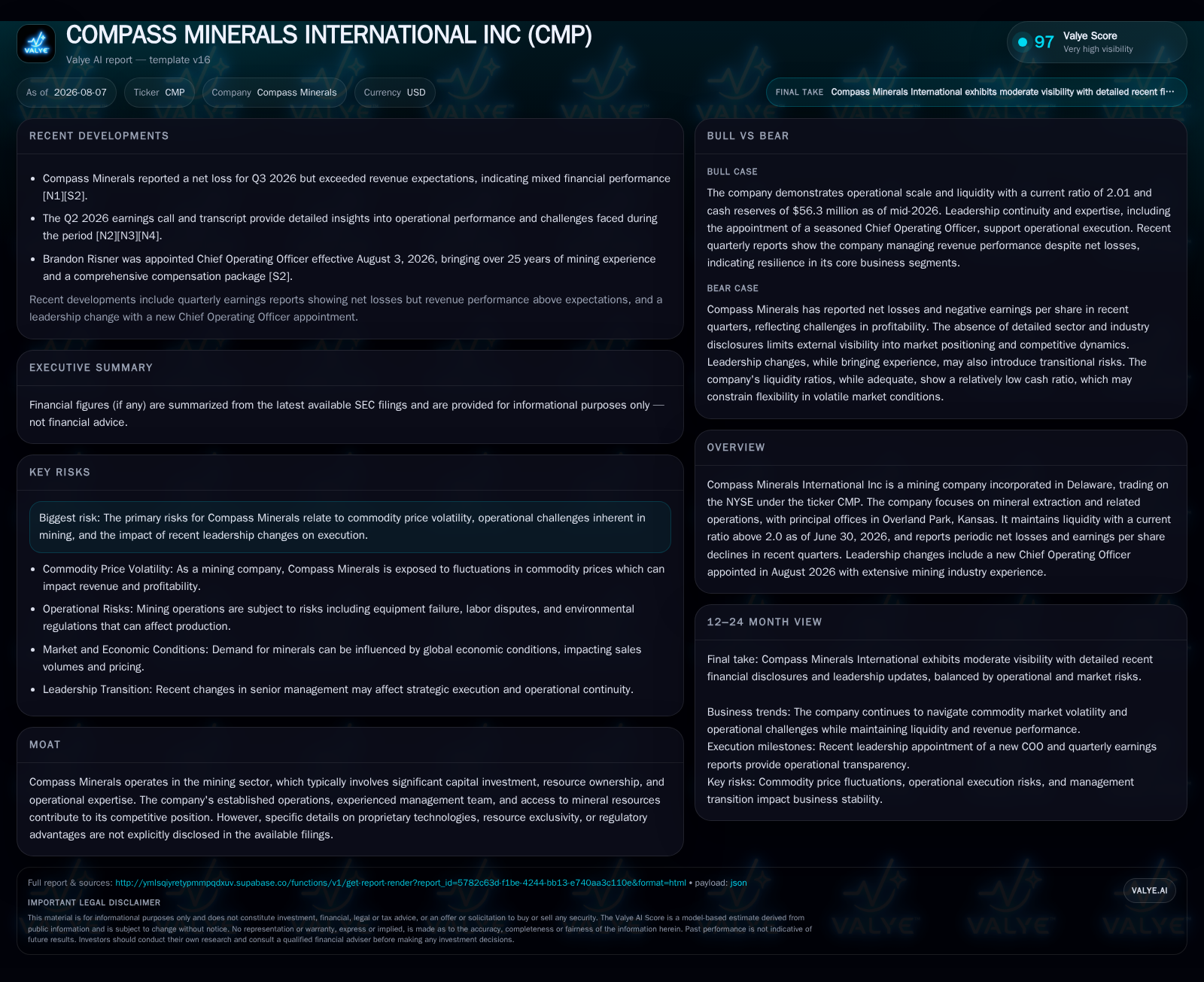
Compass Minerals International reported fiscal Q3 2026 results marked by a net loss and an earnings per share decline even as revenue surpassed expectations. The company’s liquidity remains solid with a current ratio above 2.0, but profitability concerns persist alongside commodity price volatility risks. A recent leadership change appoints Brandon Risner as Chief Operating Officer, signaling a strategic focus on operational efficiency amid sector headwinds.
Recent Operating Update
Parallel to the earnings release, Compass Minerals announced an important leadership change effective August 3, 2026, appointing Brandon Risner as Chief Operating Officer (COO) following the departure of Patrick Merrin [S3][S13]. Mr. Risner’s promotion from Vice President of Operations brings extensive industry experience exceeding 25 years across various mining disciplines, including prior roles at Peabody Energy [S13]. His stewardship is likely aimed at enhancing operational execution and mitigating ongoing challenges related to mine throughput and cost control.
Business Model Overview
As a Delaware-incorporated mining company, Compass Minerals focuses on extracting and providing mineral commodities primarily utilized in deicing, agriculture, and industrial chemical applications [S1]. Revenue generation hinges on selling bulk minerals such as salt products or specialty minerals to downstream customers including distributors and end users in sectors like road maintenance and crop nutrition [S1]. These sales are influenced by production volumes mined plus the prevailing commodity prices achieved in spot or contracted markets.
The capital-intensive nature of mining requires substantial ongoing investment in exploration, development, permitting compliance, and sustaining equipment—all fundamental cost drivers impacting margins [S1]. The profitability profile is also heavily contingent on operational efficiency; unit operating costs per ton mined and processed directly influence gross margins. Furthermore, resource depletion necessitates reserve replacement strategies to sustain mine life and long-term cash flows.
Compass Minerals’ business thus navigates a complex balance where production throughput, ore grades, capex deployment, and pricing power interplay to drive financial results. The recent operating environment’s negative swing into losses indicates strain from one or more of these levers falling short during challenging external factors.
Industry Structure and Competitive Context
The mining and minerals extraction industry is highly cyclical with companies like Compass Minerals positioned upstream in the value chain as raw material suppliers. They compete on factors including cost curve positioning—the relative efficiency of extraction cost structures—and reserve quality among peers. While specific comparisons are not available here, maintaining competitive advantage depends significantly on sustaining low unit costs through efficient operations.
Commodity price exposure is a double-edged sword: companies benefit from rising prices but suffer margin erosion when prices decline sharply or become volatile [S1][S2]. Upstream players often use hedging strategies to stabilize cash flows but these were not explicitly described for Compass Minerals
Additionally, regulatory compliance and environmental management impose fixed overheads that can swell during tighter standards or permitting delays—common industry headwinds that can constrain project execution timelines.
Growth Drivers
Long-term growth for Compass Minerals could stem from improving global demand for key minerals driven by infrastructure spending (e.g., road salt), agricultural intensification (fertilizer additives), and industrial applications. Favorable commodity price cycles would enhance revenues assuming operational volumes are sustained. Moreover, technological innovations that lift extraction efficiency or reduce unit costs could provide margin enhancement potential.
The emergence of new projects or expansions — while capital intensive — can extend mine life and scale output if executed well. Leadership stability under COO Risner might facilitate better project delivery outcomes amid past execution variability.
Investments in sustainability practices can also protect licenses to operate over time in environmentally sensitive jurisdictions fostering regulatory goodwill.
Risks and Watchpoints
Key risks confronting Compass Minerals encompass:
- Commodity price volatility: Fluctuating market prices directly impact revenue realization per unit sold making profits unpredictable.
- Operational challenges: Equipment failures, labor shortages, or geological surprises can disrupt mine throughput adversely affecting volumes.
- Reserve depletion: Failure to replenish ore reserves impacts future production capacity threatening long-term viability.
- Regulatory landscape: Heightened permitting hurdles or environmental liabilities could elevate costs or delay expansions.
- Leadership transition: New COO must demonstrate capability in driving operational improvements rapidly; any execution missteps could exacerbate performance weakness.
- Debt levels: With nearly $728 million total debt against $56 million cash reserves reported at quarter-end June 30 [F1], leverage remains notable constraining financial flexibility especially if operating cash flows do not improve.
Monitoring production volume trends, realized pricing per ton sold (or equivalent), safety incident rates indicating operational steadiness, and capital expenditure discipline will be critical to gauge if Compass Minerals can stabilize profitability going forward.
What To Watch Next
Upcoming milestones include quarterly earnings updates which will reveal if the new COO’s initiatives translate into improved operational metrics or margin expansion. Investor attention should focus on:
- Quarterly production volumes relative to prior periods.
- Changes in realized commodity prices whether spot or contract-driven.
- Commentary on capex plans targeting expansion or maintenance.
- Updates on reserve replacement strategies ensuring sustainable mine lives.
- Progress on cost reduction programs or efficiency enhancements implemented under new leadership.
- Balance sheet adjustments such as debt repayment reducing leverage burden.
Transparency around these indicators will clarify Compass Minerals’ trajectory through the current challenging cycle.
Financial Profile Discussion
Compass Minerals entered Q3 2026 with a solid liquidity stance illustrated by a current ratio of approximately 2.01 (current assets of $499.1 million versus current liabilities of $247.9 million) as of June 30 [F1]. Cash & equivalents stood at about $56.3 million providing immediate working capital support. However, total debt remains substantial near $728 million with net debt estimated around $671.7 million after accounting for cash balances [F1]. Such leverage amplifies risk if earnings fail to generate robust free cash flow consistently.
Going forward, preserving liquidity while managing leverage through disciplined capital allocation will be essential amid ongoing sector volatility. Incremental improvements in operational metrics should ideally translate into positive EBITDA generation improving coverage ratios over time.
Disclaimer: This report is for informational purposes only and does not constitute investment advice or research views.
Disclaimer: This is research-only, informational analysis and not investment advice. It may include AI-generated interpretation and general industry context. Always verify important details using primary sources.

Comments