
Matador Resources Eyes Growth via Strategic Acquisitions Amid Industry Volatility
Recent quarterly results underscore operational strength while acquisition execution remains a key risk factor.
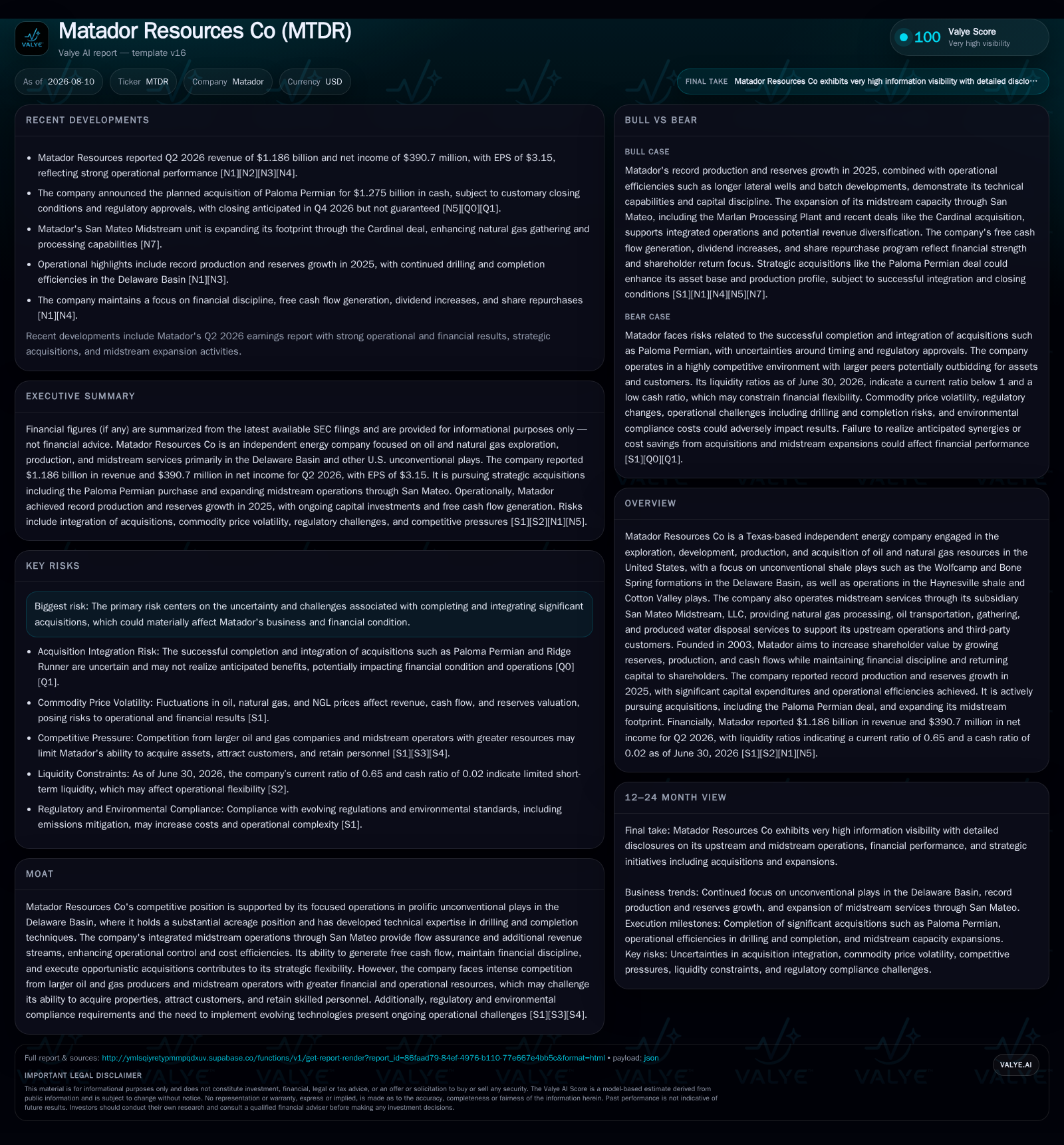
Matador Resources Co reported robust second-quarter 2026 operational performance highlighted by solid production growth and midstream expansion, reinforcing its position in the Delaware Basin and other unconventional plays. The company is pursuing significant acquisitions in the Permian Basin expected to close in late 2026, which are critical to sustaining reserve replacement and production growth but carry integration risks. Matador’s integrated upstream and midstream business model provides diversified cash flow sources and supports cost efficiencies, though capital discipline will be essential given moderate leverage and cyclicality in commodity prices.
Recent Operating Update
Critically, Matador reiterated its plans to complete two sizable acquisitions: Paloma Permian Holdings LLC for $1.275 billion in cash and Ridge Runner assets; both are expected to close in Q4 2026 but remain subject to customary closing conditions and possible termination rights that introduce timing uncertainty [S2][S23]. These acquisitions aim to bolster the company’s acreage position and reserves base within the prolific Permian Basin. However, the filings emphasize risk surrounding successful integration post-close without immediate clarity on synergy realization or incremental capital spending impacts [S2].
Business Model Overview
Matador operates predominantly as an upstream independent energy company focused on exploration, development, production, and strategic acquisitions across key U.S. unconventional shale plays. Its footprint centers on the Delaware Basin formations of Wolfcamp and Bone Spring as well as additional assets in Haynesville shale gas and Cotton Valley fields [S1][N6]. Revenue primarily derives from selling produced hydrocarbons—oil, natural gas, and NGLs—to a variety of buyers under spot market or contract arrangements where commodity prices substantially influence earnings.
The company further integrates vertically through San Mateo Midstream LLC (51% owned), which offers midstream infrastructure services including gathering pipelines, natural gas cryogenic processing plants with about 720 MMcf/day capacity, oil gathering systems with sizable throughput capability exceeding 100,000 barrels per day design capacity, plus saltwater disposal wells handling roughly 475,000 barrels per day [S1][S16]. This segment generates more predictable fee-based revenues from both Matador’s internal volumes and third-party customers. This diversification helps mitigate some upstream margin volatility while enhancing flow assurance for Matador’s drilling operations.
Capital expenditures are allocated across drilling programs aiming at organic reserve replacement and production expansion while simultaneously funding midstream facility upgrades. The company's financial discipline is evident in balancing internal capital with opportunistic acquisitions that expand scale or improve asset quality [N6][S5]. Dividend policy remains active with quarterly payments sustained alongside a sizeable share repurchase program indicating confidence in free cash flow generation under prevailing commodity prices [S5].
Industry Structure and Competitive Position
Within the highly competitive U.S. independent exploration & production sector dominated by peers such as Devon Energy or Pioneer Natural Resources (general peers), Matador differentiates itself through specialized technical expertise in Delaware Basin reservoir exploitation combined with integrated midstream capabilities—a strategic advantage enabling cost control versus pure-play producers reliant on third-party infrastructure.
The focus on high-margin unconventional shale plays aligns with industry trends emphasizing horizontal drilling coupled with hydraulic fracturing innovation. Capacity constraints typical of regional pipelines or processing facilities pose challenges but Matador’s ownership stake in San Mateo grants prioritized access reducing third-party bottlenecks common elsewhere.
Competition also arises from larger integrated majors who possess greater financial strength allowing them to outbid for acreage or execute large-scale multi-basin operations providing diversification benefits inaccessible to smaller players like Matador. Nevertheless, independents typically demonstrate nimbleness in capital allocation decisions adapting faster amid fluctuating commodity price cycles.
Growth Drivers
Key industry tailwinds supporting Matador’s growth outlook include:
- Increasing demand for oil and natural gas domestically amid ongoing global energy transitions favoring cleaner-burning fuels such as natural gas.
- Continued technological advancements in drilling/completion that improve well productivity and reduce finding & development costs enhancing returns on incremental capital deployed.
- Reservation additions through strategically targeted acreage acquisitions like Paloma Permian assets designed to augment reserves cost-effectively against aging legacy fields.
- Expansion of midstream infrastructure supporting throughput growth both internally sourced from upstream volumes plus third-party contracting opportunities growing fee-based revenue lines.
- Favorable regulatory environment in key basins that balances environmental considerations with pragmatic development policies enabling operational continuity.
Monitoring improvements in drilling efficiency metrics (e.g., rig productivity), reserve replacement ratios above 100%, sustainable LOE management per BOE produced, plus rising multi-year production backlog indicators are vital signals of sustainable long-term value creation.
Risks and Watchpoints
Matador faces several critical uncertainties:
- Major Acquisition Integration Risk: Executing Paloma Permian acquisition remains uncertain; failure or delays could disrupt strategic plans affecting market sentiment and operational momentum [S2][S23].
- Commodity Price Volatility: Earnings exposure elevated due to fluctuating crude oil/natural gas prices impacting realized sales prices directly leading to cash flow variability.
- Regulatory/Environmental Risks: Increased scrutiny around greenhouse gas emissions or water usage could elevate operating costs or restrict certain practices particularly impacting hydraulic fracturing operations.
- Capacity Constraints: Regional midstream bottlenecks or pipeline outages may hamper timely delivery reducing netbacks.
- Competitive Pressures: Larger entities contesting for high-quality acreages increase land acquisition costs challenging economical reserve additions.
- Leverage & Liquidity Risks: While net debt was approximately $109 million as of 2012-11-14 [F1], current liquidity and leverage positions are not explicitly detailed in recent filings, warranting prudent financial management amid operational and market uncertainties.
What to Watch Next
Upcoming milestones include:
- Closing status of Paloma Permian acquisition anticipated late Q4 2026; any delay or failed closing would necessitate reassessment of reserve growth strategy.
- Quarterly updates on production volumes revealing whether organic drilling offsets natural decline rates supported by any new drilling locations benchmarked against peer efficiencies.
- San Mateo Midstream throughput volumes reflecting growing third-party customer adoption signaling effective asset monetization beyond internal needs.
- Operating cost trends (LOE per BOE) as a gauge for organizational discipline versus inflationary pressures.
- Capital expenditure execution vis-à-vis budget signaling potential rebalancing between organic capex versus acquisition-driven growth investments.
- Adjustments in dividend policy or share repurchase activity indicative of balance sheet strength commitments amidst industry cyclicality.
Financial Profile Discussion
As of June 30, 2026, Matador’s balance sheet shows current assets of approximately $1.0 billion against current liabilities of about $1.55 billion, resulting in a current ratio near 0.65 [F1]. Cash and equivalents stand at roughly $26 million [F1]. Total debt and net debt figures are based on earlier reported levels from 2012, with net debt around $109 million [F1]; more recent debt or leverage data have not been disclosed in current filings. The company maintains access to revolving credit lines with capacity exceeding $2 billion, providing potential financial flexibility [S10][S11].
This analysis synthesizes publicly filed information from Matador Resources’ most recent SEC reports alongside contextual industry knowledge relevant through August 2026. It aims solely to clarify underlying business dynamics without providing any investment research views or stock-related advice.
Disclaimer: This is research-only, informational analysis and not investment advice. It may include AI-generated interpretation and general industry context. Always verify important details using primary sources.

Comments