
Datadog’s Q2 2026 Metrics Reveal Subscription Expansion Amid Competitive SaaS Pressures
Datadog reported better-than-expected subscription growth in Q2 2026, driven by multi-product adoption and AI innovation, though margin pressures and macro risks challenge near-term profitability.
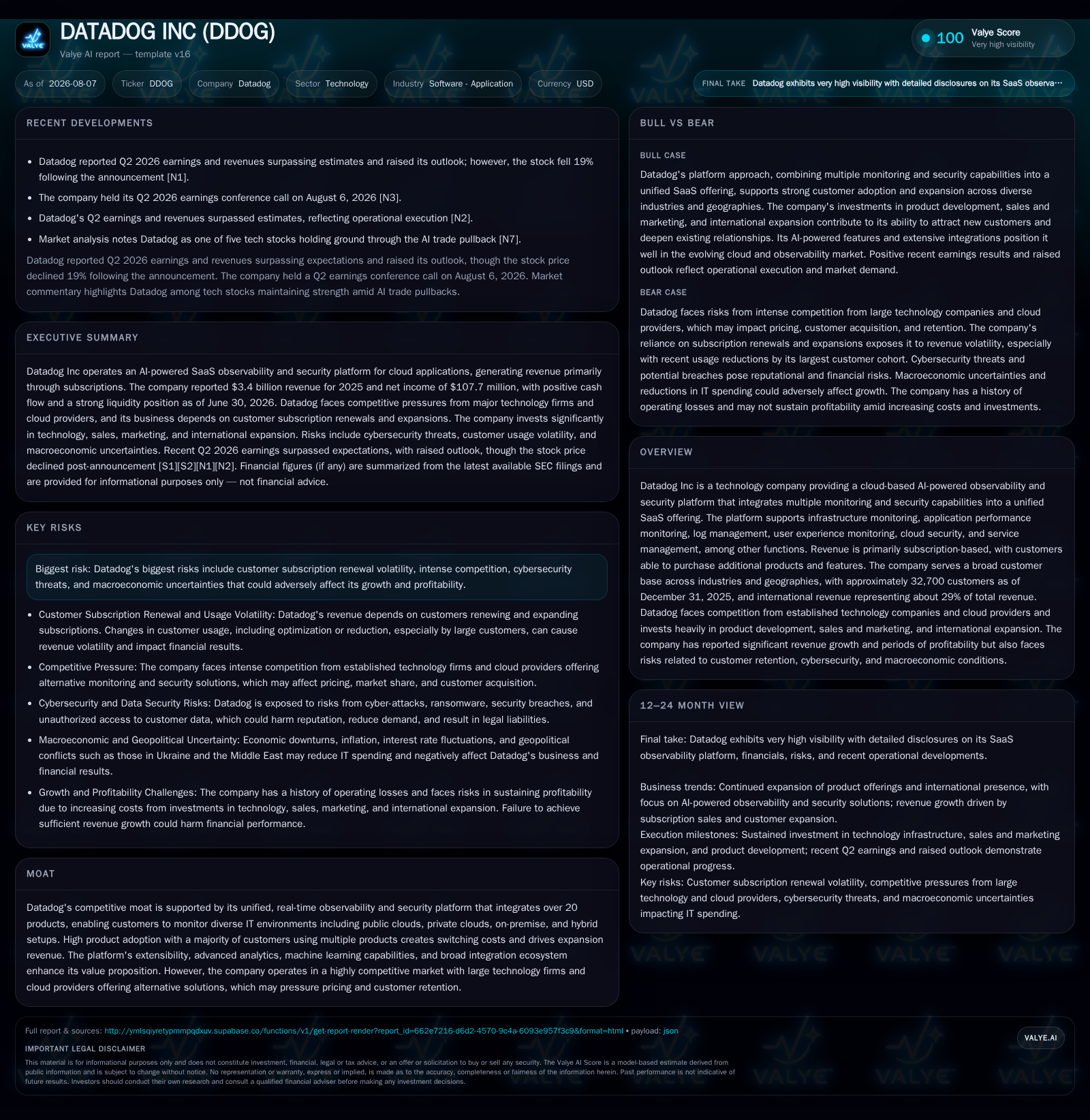
In its August 6, 2026 quarterly filing, Datadog Inc showcased strong annual recurring revenue (ARR) expansion fueled by the land-and-expand model within its unified observability and security platform. The company’s net dollar retention rate improved as customers adopted additional products, reflecting healthy product extensibility. However, intensifying competition from large cloud providers bundling observability tools has pressured pricing and boosted sales and R&D costs, compressing margins. Macroeconomic uncertainties add to renewal and growth risks. Investors should watch for future operating leverage gains, churn trends, and international expansion milestones to gauge sustainability.
Q2 Earnings Recap: Subscription Growth Outpaces Expectations Despite Stock Decline
The company's land-and-expand sales motion is evident as expansion revenue accounts for roughly three-quarters of ARR growth, underscoring the stickiness of its SaaS platform in customers' cloud operations stacks. These dynamics confirm continued successful execution of a self-service adoption model with a short time-to-value proposition fueling upsell without heavy reliance on professional services [S1], which is typical among high-quality SaaS platforms.
Unified Platform Drives Multi-Product Adoption But Pressure Mounts on Margins
Datadog operates an integrated observability stack spanning infrastructure monitoring, application performance monitoring, log management, user-experience analytics, security services, and more — delivered as a cloud-native, multi-tenant SaaS platform designed for hybrid and multi-cloud environments [S1]. The breadth enables substantial cross-sell opportunities; as of December 31, 2025, approximately 84% of customers used two or more products with growing penetration into larger product bundles (e.g., over four or six products per customer), illustrating deepening platform entrenchment [S17]. This breadth generates considerable platform extensibility benefits and higher average revenue per user (ARPU), critical SaaS KPIs tied to durable net dollar retention.
However, this multi-product strategy demands sustained investment in sales & marketing along with research & development (R&D), an inevitable tradeoff that currently exerts downward pressure on operating margins. Increasing headcount in both engineering and commercial teams raised expenditure levels in these categories in Q2 and prior periods, diluting near-term profitability despite absolute revenue gains [S2], [N2]. Datadog’s increased sales spend also correlates with efforts to navigate competitive challenges posed by bundled solutions offered directly by global cloud providers who increasingly encroach on traditional third-party observability vendors’ territory [S14].
AI Integration Enhances Product Innovation Yet R&D Spending Elevates Operating Costs
Consistent with industry trends embedding artificial intelligence (AI) across SaaS offerings for automated anomaly detection, predictive analytics, and enhanced security capabilities, Datadog continues substantial R&D investments that fuel differentiated product innovation leveraged during sales cycles [S1], [S25], [S28]. The firm emphasizes advancing machine learning models integrated into its observability suite which supports customer operational excellence and reduces mean time to resolution.
Such cutting-edge innovation positions Datadog competitively but simultaneously inflates operating expenses as development team scale increases alongside the technical complexity inherent in AI solutions. These costs challenge near-term operating leverage given that monetization of these innovations often trails investment timing due to typical SaaS sales cycles.
Market Dynamics: Competition From Cloud Giants Challenges Pricing Power
Datadog faces a market structure where hyperscale cloud providers including AWS, Microsoft Azure, and Google Cloud offer native observability tooling bundled into their IaaS/PaaS portfolios. This forces Datadog into frequent direct competition not only on feature sets but also on total cost of ownership considerations underscored by cloud provider integration convenience.
This dynamic puts pressure on traditional pricing models anchored around subscription fees plus usage-based variable charges (containers monitored, custom metrics ingested) — key revenue mechanics for Datadog [S14]. It also raises potential risks of revenue mix dilution if marketplace-driven transactions increase at lower margins or if enterprise customers choose bundled options over third-party platforms unless value differentiation through extensibility or data analytics superiority can be convincingly demonstrated
Land-and-Expand Effectiveness: Customer Footprint Deepening Amid Macro Uncertainty
At the core of Datadog’s subscription-based business model lies the land-and-expand strategy where initial product adoption acts as an entry point to deepen footprints organically within accounts without proportional increases in sales acquisition expense [S20]. As of December 31, 2025 there were about 4,310 customers generating ARR exceeding $100k — representing approximately 90% of overall ARR — underscoring strong concentration towards mid-size to large enterprises capable of significant expansion within their IT environments
The trailing twelve-month net dollar retention rate improved to about 120%, propelled by expansion usage of existing clients despite macroeconomic uncertainty impacting IT budgets broadly across sectors globally—including inflationary pressures and geopolitical instability that historically suppress discretionary software spending [S8], [N1]. The company's execution here is consistent with leading SaaS peers like New Relic or Elastic that capitalize on multi-product adoption patterns to drive predictable recurring revenues.
Risks on the Radar: Renewal Volatility, Cyber Threats, And Macroeconomic Headwinds
The company explicitly acknowledges volatility risks around customer subscription renewals which weigh heavily on recurring revenue visibility given tightening corporate IT budgets in cyclical downturns or geopolitical crises affecting global supply chains [S9], [S10]. Additionally, cybersecurity risk exposure inherent in delivering cloud-based observability platforms mandates continuous investment in internal controls. Any failure could erode customer trust or trigger costly liabilities.
Emerging regulatory regimes govern the deployment of AI technology embedded within Datadog's offerings; compliance imposes further R&D costs and managerial focus diversion alongside possible reputational risk if ethical breaches or privacy violations occur related to AI functionalities or data handling practices across jurisdictions like the EU's AI Act effective since August 2024 [S24], [S16]. These factors collectively imply that operational resilience will require sustained vigilance amid expanding legal complexity.
What Investors Should Watch Next — Guidance Update And Operational Milestones
Post-Q2 earnings call commentary emphasized the need for balancing reinvestment cycles against emerging profit margin constraints while continuing geographic expansion primarily focused on EMEA and APAC markets where international revenue comprises roughly 29% of total revenue—a figure stable over recent years but still a source of incremental growth potential given ongoing footprint scaling efforts from regional offices across Amsterdam to Tokyo [S17], [N3].
Investors should monitor sequential trends in churn rates amid macro headwinds alongside improvements in sales efficiency metrics such as CAC payback periods—a critical reflection point for sustaining long-term unit economics given elevated sales & marketing expense outlays documented recently. Further signals will come from whether net dollar retention can sustain above historical highs amid competitive incursions.
Financial Profile Discussion: Balancing Growth Investments with Cash Position
As of June 30, 2026 quarter end Datadog reported cash plus cash equivalents totaling approximately $435 million supported by strong current assets positioning yielding a current ratio around a healthy 3.2—reflective of conservative liquidity management enabling ongoing strategic investment flexibility without immediate refinancing risk or balance sheet stress [F1]
Operating losses have increased relative to prior periods due to continued upscaling of R&D and sales functions but these are offset partially by robust free cash flow generation historically indicative of quality SaaS convertibility despite short-term profit compression risks documented internally. Maintaining this balance will be critical going forward especially if macroeconomic uncertainties prolong enterprise spending caution.
This analysis reflects information available as of August 7, 2026. Readers should consider additional filings or news updates that might affect operational dynamics beyond this date. This report does not constitute investment advice; instead it provides an analytical perspective on Datadog Inc’s recent operating environment within the SaaS sector.
Disclaimer: This is research-only, informational analysis and not investment advice. It may include AI-generated interpretation and general industry context. Always verify important details using primary sources.

Comments