
Gevo Advances Modular Renewable Fuel Capacity Despite Capital Intensity and Scaling Risks
Gevo's Q2 2026 results highlight operational scaling of its proprietary Alcohol-to-Jet technology and carbon capture integration amid ongoing financial and execution challenges.
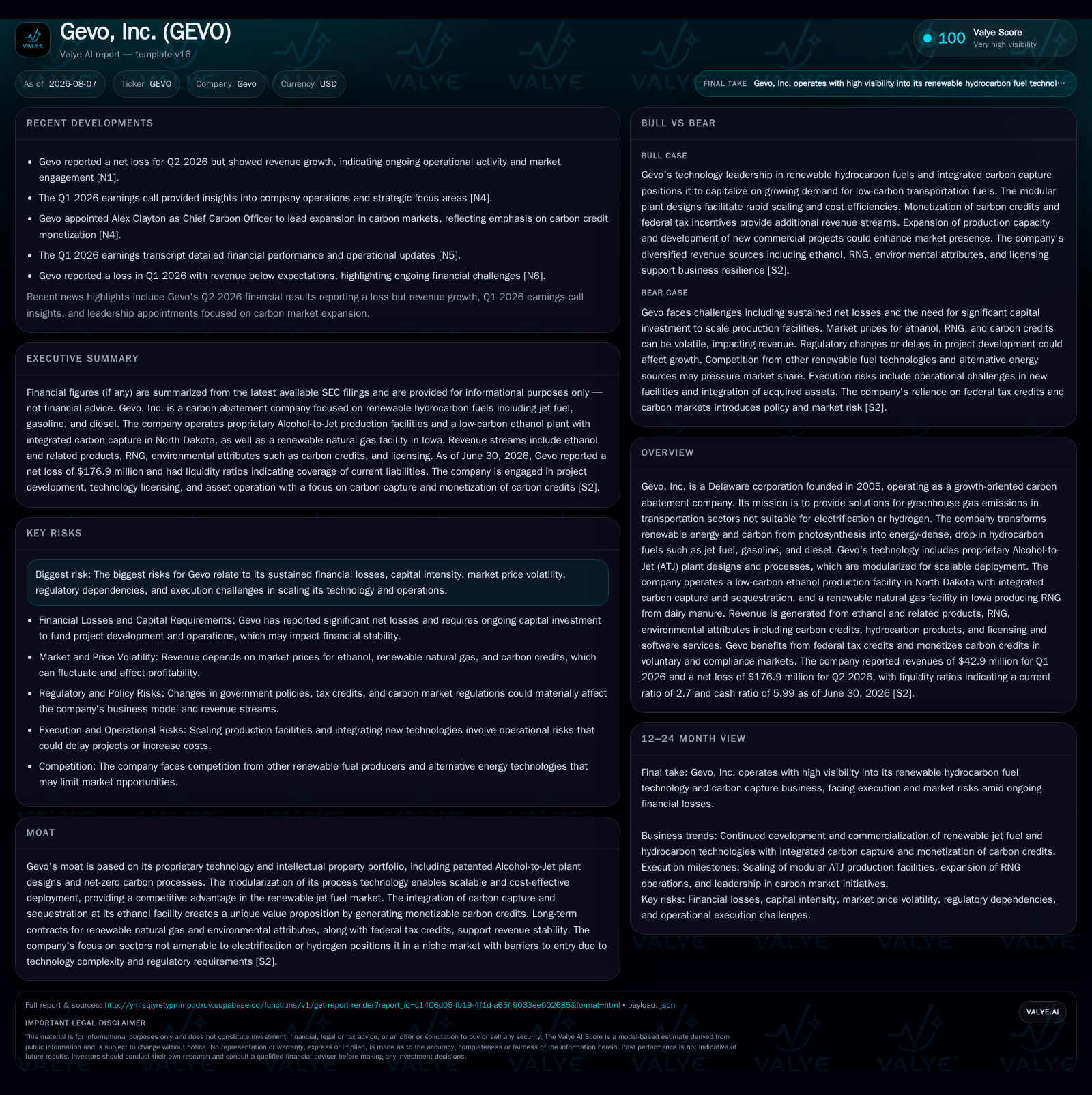
In its latest quarterly filing, Gevo demonstrates meaningful progress in scaling its renewable fuel production including low-carbon ethanol, renewable natural gas, and sustainable aviation fuel (SAF) derived via proprietary Alcohol-to-Jet (ATJ) technology. The company’s modular plant designs and integrated carbon capture and sequestration (CCS) initiatives underpin expanding deliveries of environmental credits which stabilize revenue streams. However, sustained losses and high capital expenditures reflect intrinsic industry challenges around capacity ramp-up, feedstock cost volatility, and regulatory dependency. Gevo’s licensing ambitions position it uniquely within the renewable fuels value chain despite a capital-intensive path fraught with execution risk.
Quarterly Operating Momentum Reflecting Production Scale-Up and Environmental Credits Growth
Integration of Class VI permitted carbon capture at the North Dakota facility adds value not only through emissions reduction but also via expanded generation of carbon credits. The permitted injection volume is approximately 170,000 metric tons CO2 per year with room for future expansion up to one million metric tons annually—a strategic lever enhancing sustainability claims tied to Gevo’s low-carbon products [S4]. This combination positions Gevo favorably within increasingly stringent regulatory frameworks incentivizing lower carbon intensity fuels.
How Modular Alcohol-to-Jet Technology Shapes Gevo’s Competitive Edge in Low-Carbon Fuels
Gevo’s proprietary Alcohol-to-Jet (ATJ) technology is central to its renewable hydrocarbon fuel strategy equipping it for growth in sectors where electrification or hydrogen deployment lags—chiefly aviation. The patented process converts biomass-derived carbohydrates into alcohol intermediates that are further processed into hydrocarbons mimicking traditional jet fuel, gasoline, or diesel molecules [S1]. Modular plant designs allow scalable deployment adapting to project economics and feedstock availability — a differentiation versus larger monolithic biofuel plants.
This licensing-based business model both secures recurring revenue streams from process royalties and reduces upfront capital risks compared with solely owning production assets. Industry peers in biofuels technology licensing lend context; companies offering modular plant solutions can achieve cost-effective scale expansion while addressing project-specific technical challenges inherent to biomass conversion [S1]. This dynamic supports future breadth of application across varied feedstocks and geographies.
Supply Chain Realities: Biomass Feedstock Access and Plant Utilization Challenges
Successful implementation of Gevo’s patented biofuel conversion relies heavily on consistent access to biomass feedstocks such as corn for ethanol or dairy manure for RNG generation. Feedstock input costs have exhibited volatility partially mitigated by Gevo's use of commodity futures contracts intended as hedges against price swings impacting raw material expenses. These derivative strategies do not eliminate earnings volatility but smooth procurement cost exposure over time [S15][S16].
Plant utilization rates directly affect unit operating costs; higher throughput spreads fixed costs while tightening margins if feedstock supplies falter or plants experience downtime. Operational disclosures indicate ongoing efforts to improve efficiency while balancing idling costs associated with maintenance or capacity transition phases [S9]. Continued optimization is critical given the capital-intensive nature of biofuel manufacturing infrastructure that demands high utilization for return on investment viability.
Renewable Fuel Market Structure: Pricing Dynamics, Regulatory Incentives, and Peer Positioning
Gevo participates primarily within the US renewable fuels sector influenced by regulatory schemes like the Renewable Fuel Standard (RFS) mandating minimum blending volumes supported through tradable Renewable Identification Numbers (RINs) and state-level programs such as California's Low Carbon Fuel Standard generating LCFS credits [S1]. These credit mechanisms subsidize production economics by creating incremental revenue tied to verified greenhouse gas reductions measured as carbon intensity scores.
Relative peers such as Renewable Energy Group focus on biodiesel/RNG segments with more extensive scale while Neste Corporation exemplifies vertically integrated large-scale sustainable aviation fuel production internationally. By contrast, Gevo leverages its technology licensing moat aligned with niche specialization in Alcohol-to-Jet hydrocarbon fuels targeting hard-to-electrify transport sectors. Regulatory incentives remain vital demand drivers but expose firms to policy shifts potentially impacting credit valuations or amendment timelines.
Growth Catalysts: Federal Tax Credits, Contractual Offtake Agreements, and CCS Expansion Potential
Federal tax incentives embodied in Code Section 45Z provide clean fuel producers like Gevo financial rewards per gallon based on qualifying emission factors. These credits constitute a nonmonetary asset recognized as an offset against production costs under GAAP accounting standards enhancing reported gross margins when realized via sales or credit monetization [S14]
Strategic contractual partnerships bolster Gevo's market access—illustrated by agreements with BP entities supplying RNG into Californian compressed natural gas fleets integrating environmental credit packages including LCFS credits. Such partnerships provide revenue visibility aiding capital planning decisions around expansion projects including Red Trail Energy asset acquisition which brings complementary CCS reservoirs supporting advanced sequestration volume targets [S5][S6][S4]
Risk Exposures: Capital Intensity, Execution Complexity, Feedstock Volatility, and Regulatory Dependence
Gevo faces several structural risks typical of next-generation renewable fuels providers: substantial capital expenditures required for plant construction or upgrades weigh heavily on cash flow dynamics evidenced by ongoing operating losses despite rising revenues [N1][F1]. Execution complexity involves scaling proprietary ATJ technology beyond proof-of-concept stages into commercial throughput while maintaining product quality standards.
Feedstock price fluctuations challenge margin compression unless effectively hedged; derivative contracts contribute some insulation albeit with accounting volatility recognized directly through earnings [S15][S16]. Regulatory dependence remains acute as major revenue components stem from environmental credits governed by evolving federal/state policies—posing persistent uncertainty should legislative landscapes shift or incentive sunsets occur [S13].
What To Watch for Operational Execution Benchmarks and Policy Developments Post Q2 2026 Results
Key upcoming milestones include demonstrable ramp-up of carbon capture volume at permits’ thresholds revealing scalability of CCS infrastructure integrated at the North Dakota facility [S4]. Monitoring licensing-related revenue trends linked to additional ATJ plant deployments will clarify progress toward broader commercial footprint beyond owned operations. Contract renewals or expansions in RNG supply agreements particularly with BP entities act as revenue stability indicators amid volatile commodity markets.
Regulatory scrutiny around environmental credit policies—including potential amendments to LCFS credit measurement rules or RIN pricing mechanisms—requires attentive watch as changes would materially influence revenue outlooks [S2][S3]. Additionally, capital expenditure pacing reflecting development timelines for new modular ATJ plants will evidence management’s ability to convert technological IP advantages into tangible capacity growth
Financial Profile Discussion: Liquidity Cushion Amid Ongoing Losses and Capital Outlays
As of June 30, 2026, Gevo held approximately $58 million in cash and equivalents against $175 million of total debt resulting in net debt around $117 million—a leverage profile indicative of high capital intensity typical within biofuel project development phases [F1]
However, continuous operating losses persist driven by elevated depreciation/amortization charges associated with fixed asset investments plus significant project development outlays aimed at scaling SAF production capacity [N1][S2][F1]. Capital spending remains elevated directed toward both organic expansions and acquired assets like Red Trail Energy facilitating CCS capabilities. Managing burn rates without dilutive financing rounds will be essential for balancing growth aspirations against financial flexibility.
This analysis synthesizes disclosed operating data combined with sector knowledge specific to the renewable fuel industry focusing on corporate-scale dynamics of advanced biofuel producers like Gevo. All company-specific figures derive from the latest SEC filings dated August 6, 2026 ([S1],[S2],[S3]) complemented by referenced news reports ([N1]). Absent explicit long-term guidance data precludes forecasting but identified KPIs provide actionable monitoring vectors for stakeholders following progress in this nascent yet strategically critical energy transition segment.
Disclaimer: This is research-only, informational analysis and not investment advice. It may include AI-generated interpretation and general industry context. Always verify important details using primary sources.

Comments