
Consolidated Edison’s Regulatory Surcharge Caps and Receivables Shape 2026 Financial Stability
Consolidated Edison reports resilient Q2 2026 performance amid regulatory rate plan constraints and ongoing receivables management challenges.
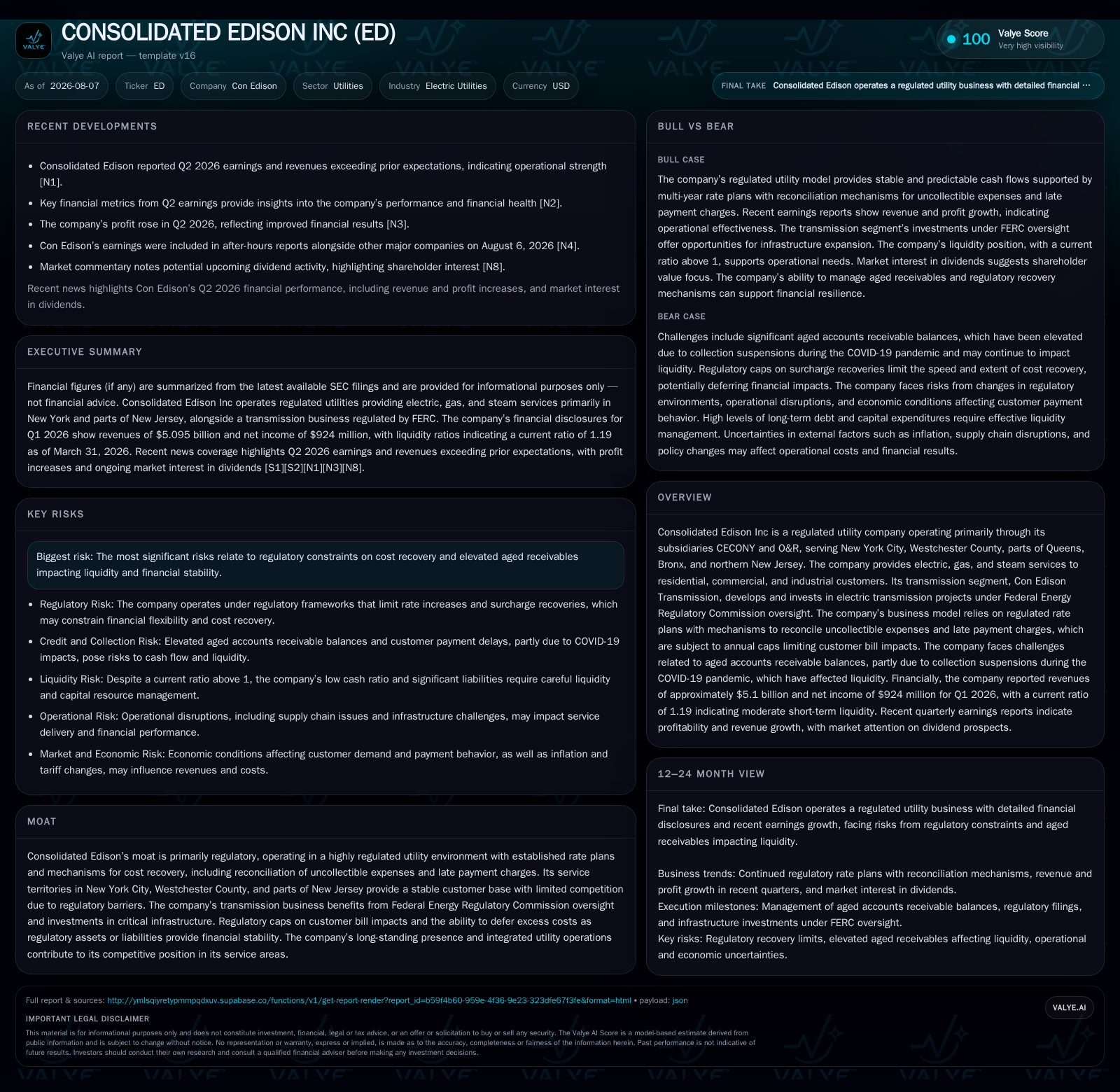
Consolidated Edison Inc (ED) released its Q2 2026 filing highlighting stable revenue streams from its regulated electric, gas, and steam utilities serving New York City and surrounding areas. The company operates under rate plans that include annual reconciliation mechanisms for uncollectible expenses and late payment charges, subject to regulatory caps that limit customer bill impacts. Elevated aged customer accounts receivable balances persist due to pandemic-related collection suspensions but are managed within regulatory frameworks. Con Edison’s transmission segment continues investing under Federal Energy Regulatory Commission (FERC) oversight, supporting grid reliability and incremental rate base growth. Key risks include collection timing pressures on liquidity and financial exposure from surcharge caps. Capital expenditures remain essential for regulated rate base expansion and future earnings.
Recent Operating Update Highlights
Consolidated Edison Inc’s Q2 2026 filing confirms operational resilience across its core regulated businesses: CECONY providing electric, gas, and steam services primarily in New York City metro area; O&R serving southeastern New York State and northern New Jersey; plus its FERC-regulated transmission subsidiary [S2][N1]. The company reported earnings and revenues exceeding estimates despite macroeconomic headwinds, supported by stable consumption volumes moderated through structured rate plans [N1][N2].
CECONY’s current three-year electric and gas rate plans (2026–2028) integrate annual reconciliations of actual versus tariffed uncollectible expenses and late payment charges. These reconciliations enforce strict surcharge caps limiting incremental bill impacts to roughly 0.5% per commodity—translating to approximately $57 million for electric in 2026 increasing toward $63 million by 2028 [S1]. This framework balances customer protection with financial discipline but introduces recovery timing risk when costs exceed caps.
Business Model Insights
Con Edison’s revenues derive primarily from regulated tariffs approved by the New York Public Service Commission for CECONY and similar bodies for O&R. Customers pay based on measured energy consumption (electricity megawatt-hours, gas therms) combined with delivery service charges. The model isolates supply costs from delivery fees while incorporating surcharges to reconcile variances in costs such as energy procurement or bad debt write-offs [S1]
This cost-of-service regulation ensures predictable cash flows largely insulated from commodity price volatility but subjects earnings growth to regulatory approval cycles determining allowed return on equity (ROE), capital cost recovery, and surcharge limits. The inclusion of reconciliation mechanisms for uncollectible expenses mitigates credit risk exposure but capped surcharges require careful management of bad debt levels lest unrecovered amounts accumulate as deferred regulatory assets.
Capital expenditures drive expansions in the regulated rate base upon PSC approval, which underpin future authorized earnings through cost-plus regulation principles [S1]. Investments target system modernization, reliability improvements, and environmental compliance initiatives
Industry Structure & Competitive Positioning
As a vertically integrated utility with exclusive service territories in a major metropolitan region, Consolidated Edison enjoys a quasi-monopoly position typical of U.S. regulated utilities. This exclusivity is maintained through robust regulatory oversight that limits entry by competitors.
The transmission business operates under FERC jurisdiction focusing on long-term infrastructure projects essential for interstate power flows. Compared with peers like American Electric Power or NextEra Energy Transmission operations, Con Edison Transmission emphasizes reliability-driven projects rather than merchant ventures [S1].
Regulatory frameworks impose ROE caps balancing investor returns against consumer protections—contrasting with deregulated market participants exposed directly to commodity price fluctuations.
Growth Drivers
Key growth catalysts include:
- Sustained capital expenditure programs replacing aging infrastructure and deploying smart grid technologies that expand the regulated rate base.
- Incremental customer load growth driven by regional demographic trends and electrification initiatives increasing electricity demand.
- Regulatory approvals allowing surcharges beyond base tariffs for environmental compliance, storm resiliency upgrades, or other mandated programs.
- Progress on transmission projects under FERC enabling enhanced grid capacity supporting renewable integration.
These factors collectively enhance earnings visibility through stable cost-of-service regulation anchored in growing asset bases.
Risks & Watchpoints
Elevated aged accounts receivable represent a significant credit risk with direct implications for liquidity [S1]. At end-2025, CECONY held $1.427 billion in receivables over 60 days—substantially above pre-pandemic levels (~$408 million at February 2020)—reflecting collection suspensions during COVID-19 followed by gradual resumption
Given the annual surcharge cap limits on recovering bad debt write-offs and late fees (capped at approximately 0.5% bill impact per commodity), any excess unrecoverable amounts convert into deferred regulatory assets subject to future recovery uncertainty.
Other risks include potential delays or adverse outcomes in rate case proceedings affecting allowed returns or cost recovery schedules; execution challenges on large capital projects especially those requiring multi-agency coordination; evolving environmental regulations imposing additional compliance costs without immediate tariff relief; and shifts in consumption patterns that could affect throughput.
What To Watch Next
Investors should track:
- Quarterly trends in accounts receivable aging to assess easing or worsening credit risk.
- Regulatory developments concerning possible adjustments or extensions of surcharge caps beyond current rate plan expirations in 2028.
- Progress updates on key transmission infrastructure projects under FERC oversight reflecting capacity buildout pace.
- Rate case filings or PSC decisions impacting allowed ROE, tariff structures, or cost recovery mechanisms.
- Emerging impacts from environmental policies or electrification trends influencing load growth dynamics.
Financial Profile Discussion
Ongoing capital expenditures remain pivotal to expand the regulated rate base—a primary driver for future authorized earnings increases intrinsic to valuation models among peers such as Southern Company or Eversource Energy who share comparable regulatory environments.
The capped nature of certain surcharges related to uncollectible expenses underscores the importance of disciplined credit management alongside proactive regulatory engagement to secure timely recovery recognition preserving balance sheet strength.
This analysis synthesizes publicly filed data through Q2 2026 without offering investment advice but contextualizes Consolidated Edison’s operating results within sector-specific regulatory dynamics emphasizing the critical influence of surcharge caps and receivables management.
Disclaimer: This is research-only, informational analysis and not investment advice. It may include AI-generated interpretation and general industry context. Always verify important details using primary sources.

Comments