
HF Sinclair Advances Lubricants Separation Amid Refining Strength and Operational Challenges
Q2 2026 results highlight HF Sinclair's refining volume growth and strategic transformation amid volatile commodity price spreads.
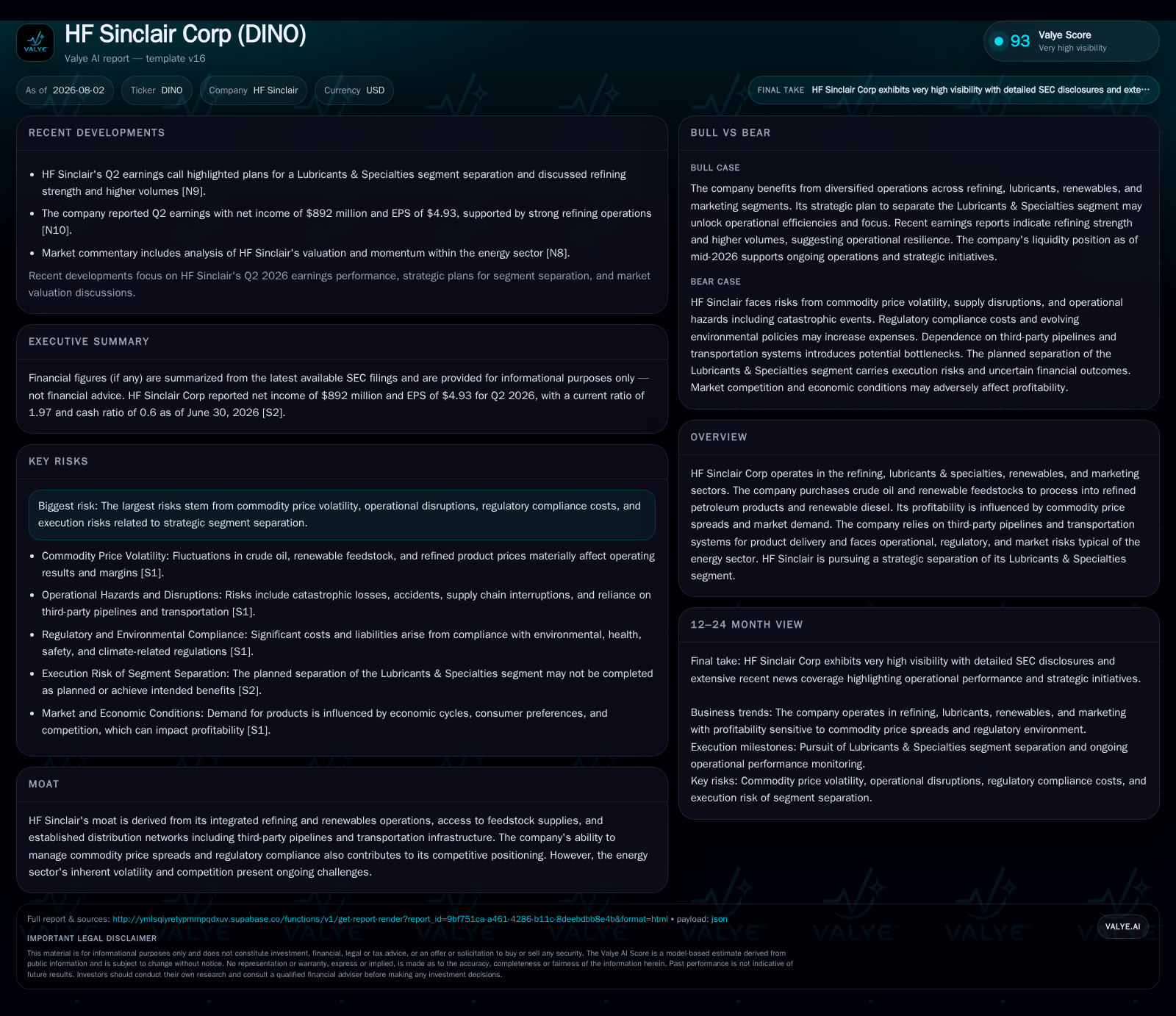
HF Sinclair Corp exceeded Q2 2026 earnings estimates driven by increased refinery throughput and strong renewable diesel production. The company is progressing with a strategic separation of its Lubricants & Specialties segment to sharpen operational focus, though execution risks remain. While benefiting from favorable commodity price spreads, HF Sinclair faces typical integrated refining risks including feedstock cost volatility, regulatory compliance costs, and supply chain dependencies. Growing renewable diesel output supports product diversification within a shifting energy landscape.
Recent Operating Update
HF Sinclair reported Q2 2026 results on July 30 that surpassed analyst expectations primarily due to increased refinery throughput and solid growth in renewable diesel production volumes [S2], [N10]. The company highlighted a favorable job mix contributing to revenue gains despite commodity feedstock cost pressures that compressed refining margins. This operational strength underscores effective utilization of its integrated refining assets during volatile commodity markets.
The company reiterated its strategic plan to separate the Lubricants & Specialties segment into an independent entity. This move aims to simplify corporate structure and unlock shareholder value by allowing each business to pursue tailored strategies. However, management cautioned that the separation could face timing delays or may not fully deliver anticipated financial or operational benefits given execution complexities inherent in such transformations [S2], [N9].
Additionally, HF Sinclair announced the retirement of Executive Vice President and General Counsel Eric Nitcher effective July 31, with plans for an orderly transition designed to maintain continuity in legal oversight without disrupting operations [S3].
Business Model Analysis
HF Sinclair operates primarily in the downstream oil refining and marketing sector with a portfolio spanning crude oil procurement, complex hydrocarbon refining including renewable feedstocks, lubricants and specialty chemicals manufacturing, and petroleum product distribution through wholesale channels. The company's revenue is generated by converting raw materials into refined fuels (gasoline, diesel including renewable diesel), lubricants for industrial applications, and specialty products where premium pricing can be captured.
Profitability hinges critically on managing refining margins—the spread between crude feedstock costs and refined product prices—which are influenced by global commodity price volatility. To mitigate earnings volatility from fluctuating commodity prices, HF Sinclair employs derivative hedging strategies targeting inventory risk management [S10]. Key operational drivers include refinery throughput rates (barrels per day), capacity utilization efficiency, product yield optimization, and distribution network effectiveness.
The Lubricants & Specialties segment operates under a distinct economic model relying heavily on third-party distributors to reach industrial customers. This channel strategy introduces certain execution risks but allows for broader market penetration. The planned spin-off intends to isolate this segment’s financials from capital-intensive refining operations, potentially enabling more focused investment in specialty formulations and innovation.
Renewable diesel production has become an increasingly important part of HF Sinclair’s product mix. This aligns with regulatory incentives promoting low-carbon fuels and provides diversification against structural declines in traditional petroleum fuel demand driven by environmental policies.
Industry Structure and Competitive Position
HF Sinclair competes within the integrated oil refining and marketing industry alongside peers such as Valero Energy—recognized for significant renewables integration—and PBF Energy with its independent refining focus. Unlike major integrated oil companies like ExxonMobil or Marathon Petroleum that operate extensive upstream reserves or midstream logistics networks, HF Sinclair concentrates on downstream refining combined with selected renewable fuel production.
The company’s competitive advantage stems from asset integration: medium-complexity refineries positioned strategically for efficient crude access via third-party pipelines and proximity to key regional markets for refined products. Expertise in renewable diesel conversion technology further enhances differentiation. However, reliance on third-party pipeline infrastructure exposes HF Sinclair to logistical constraints that could impact throughput during maintenance or regional disruptions.
Competitive pressures arise from fluctuating crude markets affecting feedstock availability and costs; evolving environmental regulations increasing compliance costs; expanding biofuel mandates requiring capital investment; and emerging alternative fuel technologies influencing long-term refined product demand.
Operational resilience is measured by consistent capacity utilization despite maintenance cycles or unplanned outages—a key indicator of management effectiveness relative to peers.
Growth Drivers
Growth prospects center on expanding renewable diesel production capacity in response to regulatory demand for cleaner transportation fuels. Capital investments aimed at improving process efficiency and flexibility support broader market access.
The Lubricants & Specialties spin-off not only simplifies corporate structure but could accelerate innovation in specialty segments potentially yielding higher margins less susceptible to commodity cycles.
Efforts to optimize distribution logistics—such as enhancing pipeline throughput agreements or terminal expansions—also underpin volume growth while controlling delivery costs.
Macro tailwinds include recovering transportation fuel demand amid economic growth coupled with rising global energy consumption trends supporting sustained volume increases beyond cyclical fluctuations.
Risks and Constraints
Commodity price volatility remains the dominant risk factor impacting refining margins unpredictably. Sudden spikes in feedstock costs without corresponding product price increases can compress profitability given fixed operating cost structures.
Execution risk surrounds the Lubricants & Specialties separation; delays or failure could divert management focus or increase costs adversely affecting financial performance.
Environmental regulations impose escalating compliance obligations including emissions controls and pipeline integrity programs mandated by PHMSA oversight. Potential liabilities related to past contamination or operational incidents add complexity.
Supply chain vulnerabilities linked to third-party pipeline dependencies present bottleneck risks that may reduce refinery throughput during disruptions or maintenance periods.
Cybersecurity threats targeting increasingly digitized refinery operations represent emerging operational risk requiring ongoing mitigation investment.
Labor relations challenges involving unionized workforce segments could disrupt productivity if negotiations deteriorate.
Geopolitical uncertainties affecting crude supply sources introduce external volatility complicating input cost management over medium-term planning horizons.
What To Watch Next
Investor attention will focus on progress toward completing the Lubricants & Specialties spin-off including regulatory approvals and capital structure decisions post-separation that will define strategic clarity.
Sequential changes in refinery throughput will indicate operational momentum amid seasonal demand shifts.
Refining margin trends relative to feedstock cost movements will provide insights into sustainability of recent profitability improvements against commodity cyclicality.
Regulatory developments impacting renewable fuel blending requirements will influence capital allocation priorities toward low-carbon fuel production capabilities.
Announcements regarding timing and scope of capital projects related to renewables expansion or refinery upgrades will shape medium-term growth outlooks.
Market response to the commercial performance of lubricants products post-spin-off will indicate whether focused management teams can drive segment-specific growth effectively.[N10], [N9], [S2]
Financial Profile Discussion
At June 30, 2026, HF Sinclair held approximately $2.26 billion in cash and equivalents against total debt near $2.8 billion resulting in a net debt position around $538 million—a moderate leverage level providing financial flexibility [F1]. Current assets totaled about $7.39 billion compared with current liabilities near $3.75 billion yielding a healthy current ratio of approximately 1.97 indicative of sound short-term liquidity [F1].
Trailing twelve-month operating income through December 31, 2025 was approximately $927 million with net income near $579 million reflecting operational leverage despite volatile commodity markets [F1]. Capital expenditures remain significant given ongoing investments in renewable diesel capacity expansion alongside required maintenance capex at complex refineries. Management emphasizes balancing growth-oriented capex with free cash flow generation to maintain credit profile stability amid earnings cyclicality [S2], [S4].
Hedging activities targeting inventory price exposure help moderate earnings fluctuations quarter-to-quarter but inherently limit upside during favorable commodity price moves—a common approach among commodity-refining firms managing earnings volatility [S10].
In summary, HF Sinclair’s financial profile combines moderate leverage consistent with peer refiners alongside adequate liquidity supporting its strategic transformation agenda while maintaining operational continuity within a capital-intensive industry environment.
Disclaimer: This analysis is based solely on publicly available filings as of August 2026 without forward-looking projections or investment advice.
Disclaimer: This is research-only, informational analysis and not investment advice. It may include AI-generated interpretation and general industry context. Always verify important details using primary sources.

Comments