
Arxis Advances Precision Components with Strategic Acquisitions and Risk Management
Robust cash reserves and interest rate hedging underpin Arxis’s operational resilience amid inflation and currency exposures.
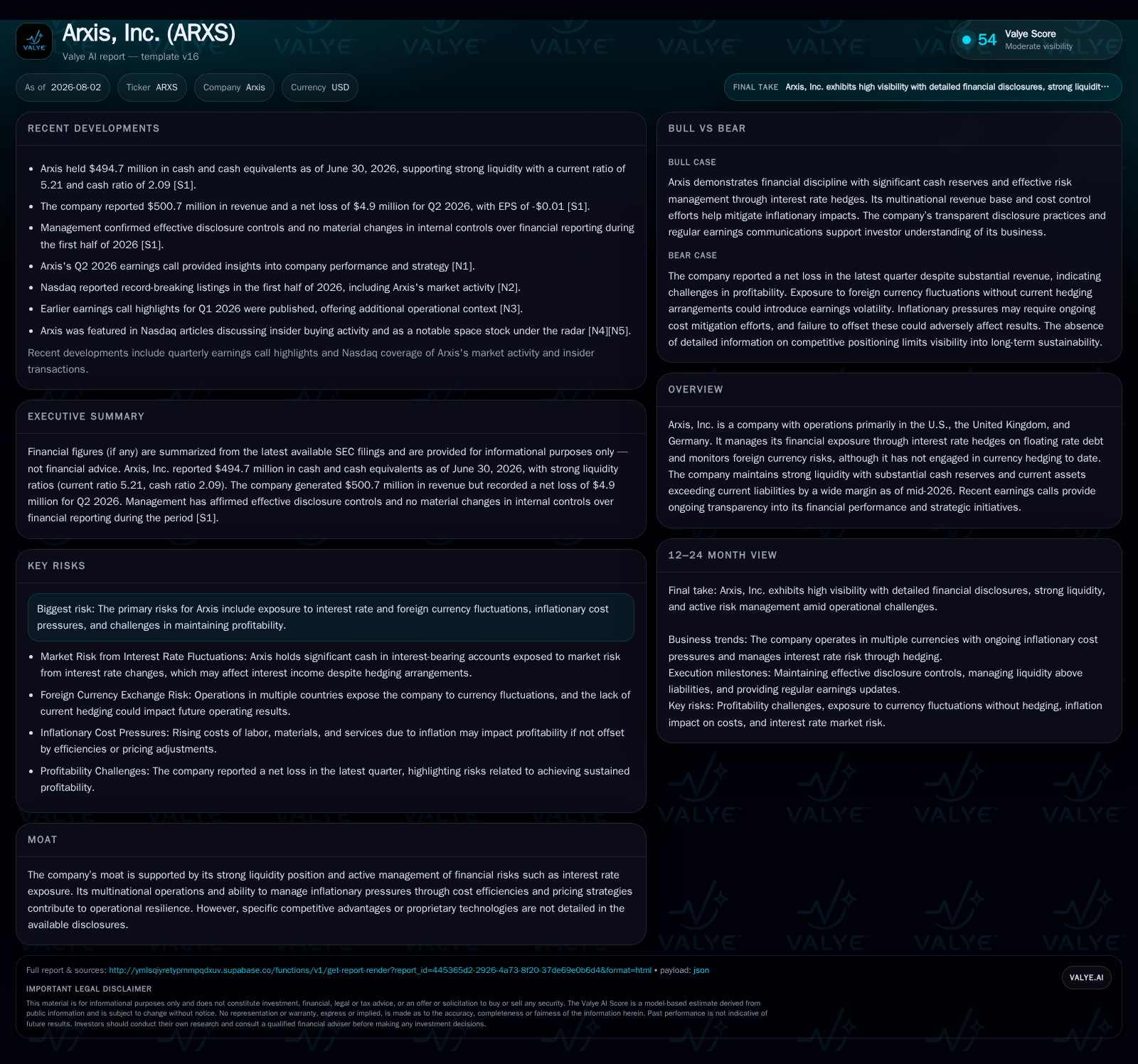
Arxis, Inc. reported steady second-quarter revenue supported by recent acquisitions expanding its engineered components portfolio, particularly in aerospace and defense markets. The company actively manages floating rate debt exposure through interest rate hedging while facing ongoing inflationary pressures mitigated by manufacturing efficiencies and selective pricing. Its multinational presence in the U.S., UK, and Germany introduces foreign currency risks, currently unhedged but monitored closely. Arxis maintains strong liquidity with over $490 million in cash and a current ratio above 5, providing financial flexibility to support growth initiatives.
Recent Operating Update
In its latest quarterly filing dated July 30, 2026, Arxis, Inc. demonstrated stable execution with revenue totaling approximately $500.7 million for the quarter ended June 30, 2026 [F1]. Operating income was reported at $32.7 million despite headwinds from inflationary cost increases in labor and materials consistent with broader economic trends [S2]. These cost pressures are acknowledged as manageable through continued manufacturing efficiencies, selective pricing strategies, and alternative sourcing efforts. The firm cautioned that persistent inflation could necessitate further mitigation actions.
On July 29, 2026, Arxis also issued an event filing announcing its Q2 earnings release accompanied by additional business updates [S3]. The disclosures highlight the company’s ongoing commitment to managing financial risk — notably through various interest rate agreements that hedge approximately $1.78 billion of its floating rate debt, mitigating exposure to rising interest rates through at least December 2028 [S2]. The aggregate fair value of these contracts was $2.2 million at quarter-end.
Additionally, recent acquisitions completed earlier in the year have expanded Arxis's portfolio into high-precision electronic components (MagCanica) and elastomeric diaphragm seals (Micro-Tronics), supplementing its established presence in mechanical components for aerospace and defense original equipment manufacturers (OEMs) [S4][S29]. These strategic transactions are funded partly through existing cash reserves and careful use of debt facilities.
Business Model Overview
Arxis operates predominantly in the industrial hardware sector focused on designing and manufacturing engineered components such as elastomeric seals and metallic parts tailored to aerospace, defense, industrial machinery, medical device sectors, among others. The company's revenue is primarily generated through contract manufacturing relationships with OEMs who integrate these precision components into mission-critical assemblies.
Contracts often involve long-term supply agreements or project-based orders where volume commitments influence capacity utilization — a key operational KPI that drives revenue fluctuations alongside average selling prices (ASPs) dictated by product mix and inflation adjustments. Margins are sensitive to raw material costs (notably metals and elastomers), labor input costs affected by wage inflation, quality control demands mandated by aerospace/defense certifications, and supply chain reliability.
Manufacturing efficiency gains translate directly into cost reductions impacting gross margin stability. Pricing strategies also play a vital role as inflationary environments require recalibration of contract terms or pass-through mechanisms without jeopardizing customer retention or competitiveness.
Given Arxis’s multinational operations across the U.S., UK, and Germany, revenue streams are naturally exposed to foreign currency translation risks; this adds complexity to revenue recognition dynamics because local operating expenses fluctuate against the reporting U.S. dollar basis [S2]. Currently, Arxis does not employ foreign currency hedging instruments but monitors potential impacts carefully.
Industry Structure & Competitive Position
Arxis falls within the midstream segment of the industrial hardware value chain — producing specialized mechanical and electronic components rather than final consumer products. This positions it competitively among precision component manufacturers serving aerospace/defense sectors alongside peers like Parker-Hannifin and Woodward Inc., which also emphasize certification standards, quality control rigor, and supply chain resilience.
Competition hinges on capabilities such as precision manufacturing yield rates, on-time delivery adherence crucial for OEM production schedules, breadth of product offerings spanning metallic to elastomeric solutions, geographic footprint for proximity to key customers, and financial robustness enabling sustained innovation investment.
Arxis’s integration of recently acquired companies enhances this competitive stance by adding technical capabilities (e.g., non-contact torque sensing technology from MagCanica) broadening end-market exposure. However, neither proprietary technology dominance nor specific market share leadership claims have been substantiated in filings.
Growth Drivers
Several catalysts underlie Arxis’s growth prospects:
- Acquisition-Led Expansion: Recent deals like Micro-Tronics (elastomeric assemblies) and MagCanica (high-precision sensor technology) extend both product range and market served within commercial aerospace/defense verticals [S4][S29].
- Market Capital Spending: Increased aerospace/defense sector capital expenditure cycles spur demand for mission-critical precision components requiring certified manufacturing partners.
- Price/Mix Improvements: Inflation-driven pricing adjustments combined with migration toward higher-value products underpin ASP growth dynamics.
- Manufacturing Efficiencies: Ongoing initiatives targeting yield enhancement reduce cost of goods sold (COGS) percentage of revenue.
- Geographic Diversification: Operations distributed across U.S., UK, Germany enable closer customer engagement in multiple regional industrial hubs.
- Contract Renewal & New Wins: Sustained focus on OEM relationship management aiming for renewal stability amidst competitive bidding scenarios may drive order backlog growth.
Monitoring KPIs such as capacity utilization levels post-acquisition integration performance will be critical indicators of successful growth execution.
Risks & Watchpoints
Core risks confronting Arxis encompass:
- Inflationary Cost Pressures: While current increases have been mitigated successfully via efficiencies or pricing power, prolonged inflation could erode margins if corrective actions fail or customer pushback intensifies [S2].
- Interest Rate Exposure: Floating-rate debt requires continual hedging vigilance; unfavorable shifts could escalate interest expense beyond planned levels despite existing derivatives covering most exposure [S2].
- Foreign Currency Fluctuation: Multinational revenue/cost exposures create translation volatility—absence of active FX hedging means earnings could be disproportionately affected by Euro or Pound Sterling movements [S2].
- Supply Chain Disruptions: Component manufacturers depend heavily on reliable raw material sourcing; disruptions would impair lead times affecting on-time delivery metrics vital for OEM contracts.
- Customer Concentration & Contract Terms: Heavy reliance on a limited number of large OEM clients introduces dependency risk if contracts lapse or competition intensifies.
- Integration Complexity: Assimilating incremental acquisitions including operational harmonization poses challenges that could delay expected synergy realization impacting near-term profitability.
Close monitoring of backlog levels alongside quarterly margin trends will help discern pressure points early.
What To Watch Next
Key upcoming milestones include:
- Quarterly updates on order backlog size reflecting new contract wins or renewals post-Micro-Tronics/MagCanica integration.
- Progress reports on margin improvement efforts especially through reported manufacturing yield rates improvements or COGS percentage reduction.
- Updates on foreign exchange exposure mitigation strategies potentially introducing FX hedging instruments.
- Financial flexibility maintenance measured by liquidity levels against planned capital expenditures or further acquisition targets.
- Interest rate hedge effectiveness amid evolving market rates impacting net interest expense volatility disclosure.
Investors should triangulate these markers with broader macroeconomic trends influencing aerospace/defense capital spending patterns.
Financial Profile Discussion
As of June 30, 2026, Arxis held $494.7 million in cash and equivalents alongside total current assets exceeding current liabilities by a wide margin (current ratio approximately 5.21), underscoring robust liquidity supportive of working capital requirements and strategic acquisitions [F1]. Total debt stood at roughly $1.73 billion dominated by floating rate instruments hedged economically via derivative agreements totaling $1.78 billion notional amount aimed at insulating cash flows from steep interest rate hikes [F1][S2].
Net debt after accounting for cash balances approximates $1.24 billion reflecting a leveraged but manageable capital structure benefiting from adequate liquidity cushions [F1]. Continued strong free cash flow generation will be critical to servicing this debt expeditiously without constraining ongoing investment in manufacturing capex or strategic acquisitions.
No material impairments were recognized related to goodwill or intangible assets acquired during recent transactions consistent with management’s assessment that acquired businesses continue generating anticipated synergies [S16]. Operating results so far reflect resilience against inflationary headwinds combined with prudent financial risk management practices deployed around interest rates lending confidence to ongoing earnings stability despite external uncertainties.
This analysis reflects publicly available information as of early August 2026 without speculative forecasts or research view bias. It aims to synthesize key business dynamics within Arxis’s core industrial hardware sector context highlighting drivers and vulnerabilities critical for monitoring emerging operating trends.
Disclaimer: This is research-only, informational analysis and not investment advice. It may include AI-generated interpretation and general industry context. Always verify important details using primary sources.

Comments