
ASGN’s Transition to Everforth Challenges Revenue Stability and Margin Mix
Q2 2026 results reveal subtle revenue declines and margin pressures amid brand transition, talent competition, and shifting revenue mix.
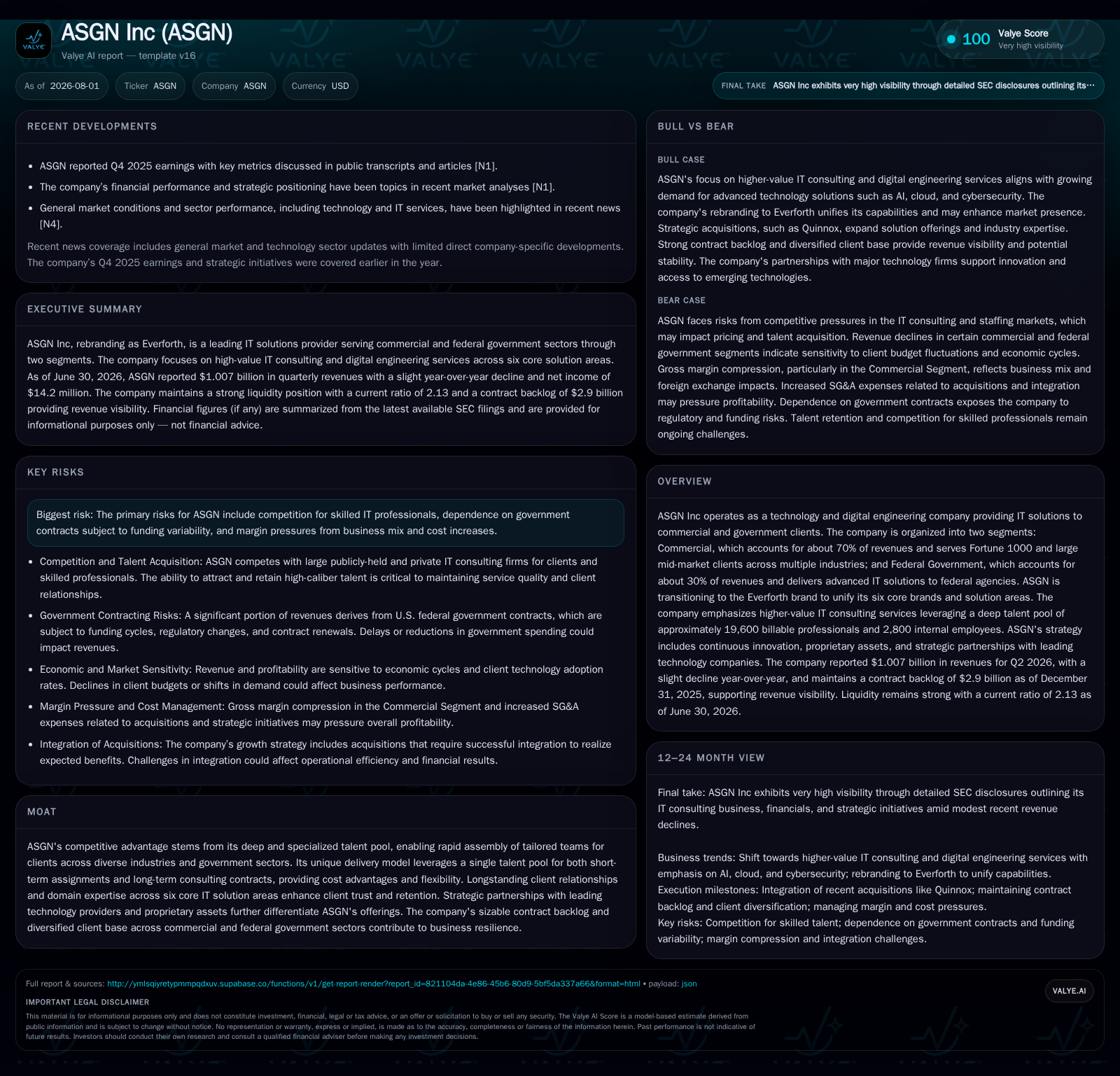
ASGN Inc reported a modest 1.3% revenue decline in Q2 2026 to $1.007 billion, driven by broad softness in its Commercial segment outside of the Technology, Media, and Telecom vertical, and more pronounced pressure in Federal Government revenues. Gross margin compressed by 40 basis points reflecting mix shifts away from permanent placement and foreign exchange impacts linked to operations in Mexico. The ongoing Everforth rebranding initiative introduces operational complexities while the company faces macroeconomic headwinds and intense competition for skilled IT talent. ASGN’s dual-segment business model balances higher-margin consulting growth against cyclically sensitive staffing declines, with utilization and contract backlog standing as key metrics to monitor.
Q2 Earnings Reflect Early Strain Amid Everforth Brand Transition
Gross profit declined by about 3% year-over-year with consolidated gross margin compressing by roughly 40 basis points to 28.3%. This deterioration was mainly attributable to business mix dynamics within the Commercial segment — notably reduced permanent placement revenues which typically command higher margins — along with foreign currency fluctuations impacting lower-margin delivery throughput from Mexico-based centers [S2][S24]. Meanwhile, the Federal Government segment posted a slight margin uptick driven by targeted portfolio profitability improvements despite revenue pressure [S24]. This combination underscores the delicate balance ASGN must manage between growing high-value consulting services while contending with cyclical headwinds in staffing.
Everforth’s transition represents material operational complexity. Launched formally in late 2025 to unify six legacy brands --- Apex Systems, Creative Circle, CyberCoders, ECS, GlideFast, and TopBloc --- it reflects strategic intent to present a cohesive technology consulting platform spanning six solution areas: Cloud & Infrastructure; Data & AI; Software Development & Engineering; Customer Experience; Cybersecurity; Enterprise Platforms [S1][S3]. Although this consolidation aims for long-term competitive advantage via brand cohesion and cross-selling synergy, short-term risks include client confusion and integration costs that could pressure near-term operating margins.
Dual-Segment Business Model: Revenue Mix and Margin Pressure Insights
ASGN’s business is structured predominantly into two operating segments: Commercial (approximately 70% of total revenues) serving Fortune 1000 corporations and large mid-market clients across multiple industries; and Federal Government (around 30%) delivering advanced IT solutions to U.S. federal agencies focused on defense, intelligence, national security, civilian government functions [S1][S6]. The dual-segment model exposes differing growth dynamics and margin profiles.
The increase in consulting share supports structural gross margin expansion potential due to better pricing power and improved visibility on longer-duration contracts supported by proprietary assets and alliances with technology platform vendors such as AWS, Microsoft, Google cloud services, Salesforce, ServiceNow among others [S5]. Conversely, the decline in assignment volumes limits billable utilization leverage—the key operating KPI representing proportion of workforce hours billed versus available—and compresses aggregate margin if lower-margin staffing grows disproportionately [S10][S20].
In the Federal Government segment—exclusively consulting—the marginal revenue decrease (-2.3% in Q2) ties closely with contract funding shifts related to Department of Defense initiatives such as DOGE (Department of Government Efficiency), plus general government budgetary uncertainties that affect contract award cadence and renewals [S1][S2]. Margins here are traditionally lower given cost-plus or fixed-price government contracting rules plus intensified compliance overhead.
Competitive Landscape: Talent Scarcity Meets Contract Volatility
A central structural challenge for ASGN is managing wage inflation pressures amid fierce competition for highly skilled IT professionals across both commercial markets and specialized federal roles requiring security clearances [S20]. With approximately 19,600 billable professionals leveraging advanced IT skills ranging from cybersecurity experts (notably about 500 with clearances) to AI/data scientists within government programs [S10], maintaining high utilization rates depends on both recruitment effectiveness and retention strategies.
Utilization trends are pivotal because they directly affect revenue per billable professional—a proxy for productivity—and thus overall gross margins. However, tight labor markets push up compensation expenses that can erode profitability unless matched by pricing power or superior delivery capabilities.
Compounding these internal workforce dynamics are external contract risks particularly in the federal sector where annual appropriations cycles introduce volatility into contract backlog realization—a metric reported at $2.9 billion end-2025 reflecting future revenue visibility yet subject to political budget uncertainty [S8]. Peer companies operating similarly also face balancing agile resource deployment against securing long-term prime contracts securing stable cash flows.
Evolving Client Demand: Consulting Gains vs. Staffing Headwinds
Enterprise CIO priorities increasingly favor comprehensive consulting engagements enabling digital transformation initiatives over ad hoc staffing surges [S1][S10]. Clients seeking cloud migration support, AI integration advisory, cybersecurity strategy implementation tend toward higher-value fixed-price or managed service arrangements that deliver predictable outcomes.
ASGN's reported increase in commercial consulting revenues alongside declining assignments aligns with this shift yet exposes the company to transitional execution risk especially during broader macroeconomic weakness where firms may delay or scale back nonessential transformation projects [S2][S25]. This dynamic necessitates close monitoring of client engagement depth beyond headline bookings—examining renewal rates, contract duration trends, and sustained pipeline vigor.
Growth Catalysts: Digital Innovation and Strategic Partnerships at a Crossroads
Despite near-term pressures evidenced in Q2 performance metrics, ASGN’s growth thesis rests substantially on robust demand tailwinds from ever-expanding digital transformation adoption driven by cloud infrastructure modernization, explosion in data analytics needs including AI/ML applications, heightened cybersecurity imperatives amidst evolving threat landscapes [S5]. These underlying secular themes enable ASGN's consulting services offerings grounded in proprietary accelerators and technology partnerships with leading hyperscalers (AWS/Microsoft/Google) as well as cybersecurity platform providers (CrowdStrike, Elastic).
Recent acquisitions such as Quinnox bolster digital engineering capabilities adding scalable IP-driven service layers that go beyond pure personnel placement toward outcome-oriented consulting products [S4][S24]. Successful integration execution will be decisive for translating these assets into sustainable margin expansion.
Risk Factors: Wage Inflation, Government Contract Funding Variability, and Margin Squeeze
Key risks evidenced or reiterated include intensified competition for IT talent leading to upward wage cost pressure which could outstrip pricing power especially on staffing segments; dependence on volatile federal budgets affecting contract renewals or prize expenditures; margin compression from changing business mix as permanent placement declines weigh against higher-margin consulting gains lagging scale benefits; execution risks tied to rebranding consolidation under Everforth posing client transition challenges; customer concentration risks given top federal agencies represent over a quarter of consolidated revenue though no single commercial client exceeds 10%; exposure to regulatory compliance complexity inherent in government contracting [S21][S22]
"Watch List": Upcoming Milestones Under Everforth Integration and Contract Wins
Monitoring ASGN’s transition milestones for Everforth brand rollout completion through mid-2026 remains critical given potential operational disruption impacts on client retention or new deal flow [S3]. Tracking billable headcount trends alongside utilization rates will provide clarity on resource deployment efficiency under competitive labor conditions.
Contract backlog evolution especially within Federal Government remains a real-time barometer of medium-term organic growth outlook given funding uncertainty. Additionally, shifts in consulting versus staffing proportion measured quarterly will validate whether profitable mix expansion persists amid macro cycles.
Strategic partnership developments—new alliances or expanded co-delivery agreements with hyperscalers or cybersecurity vendors—should be watched closely as indicators of service capability enrichment supportive of long-term differentiation.
Financial Profile Discussion
As of June 30, 2026 balance sheet snapshot shows total debt approximating $1.45 billion offset by cash balance around $161 million resulting in net debt near $1.29 billion; current assets exceed current liabilities by a factor suggesting a comfortable liquidity buffer (current ratio ~2.13) [F1]. Interest expense has risen consistent with elevated borrowings linked to recent acquisitions such as Quinnox alongside amortization charges tied to acquired intangibles impacting operating income metrics modestly [S24][S25]. SG&A expenses increased slightly driven by acquisition-related integration costs alongside strategic planning expenses associated with brand unification efforts.
This financial profile affords ASGN flexibility for continued investment in talent acquisition and technology asset development while remaining compliant with debt covenants amid moderate leverage ratios observed historically.
This analysis synthesizes data from ASGN’s latest SEC filings through Q2 2026 combined with industry-standard knowledge frameworks focusing on IT staffing & consulting market dynamics without projecting specific future financial guidance or market positioning beyond documented evidence,,[F1]. No buy-side investment research views are provided.
Disclaimer: This is research-only, informational analysis and not investment advice. It may include AI-generated interpretation and general industry context. Always verify important details using primary sources.

Comments