
NewMarket’s Specialty Additives Business Sustains Margins Amid Modest Revenue Growth
NewMarket Corporation reports steady segment profitability and strong balance sheet despite slight shipment declines and commodity cost pressures.
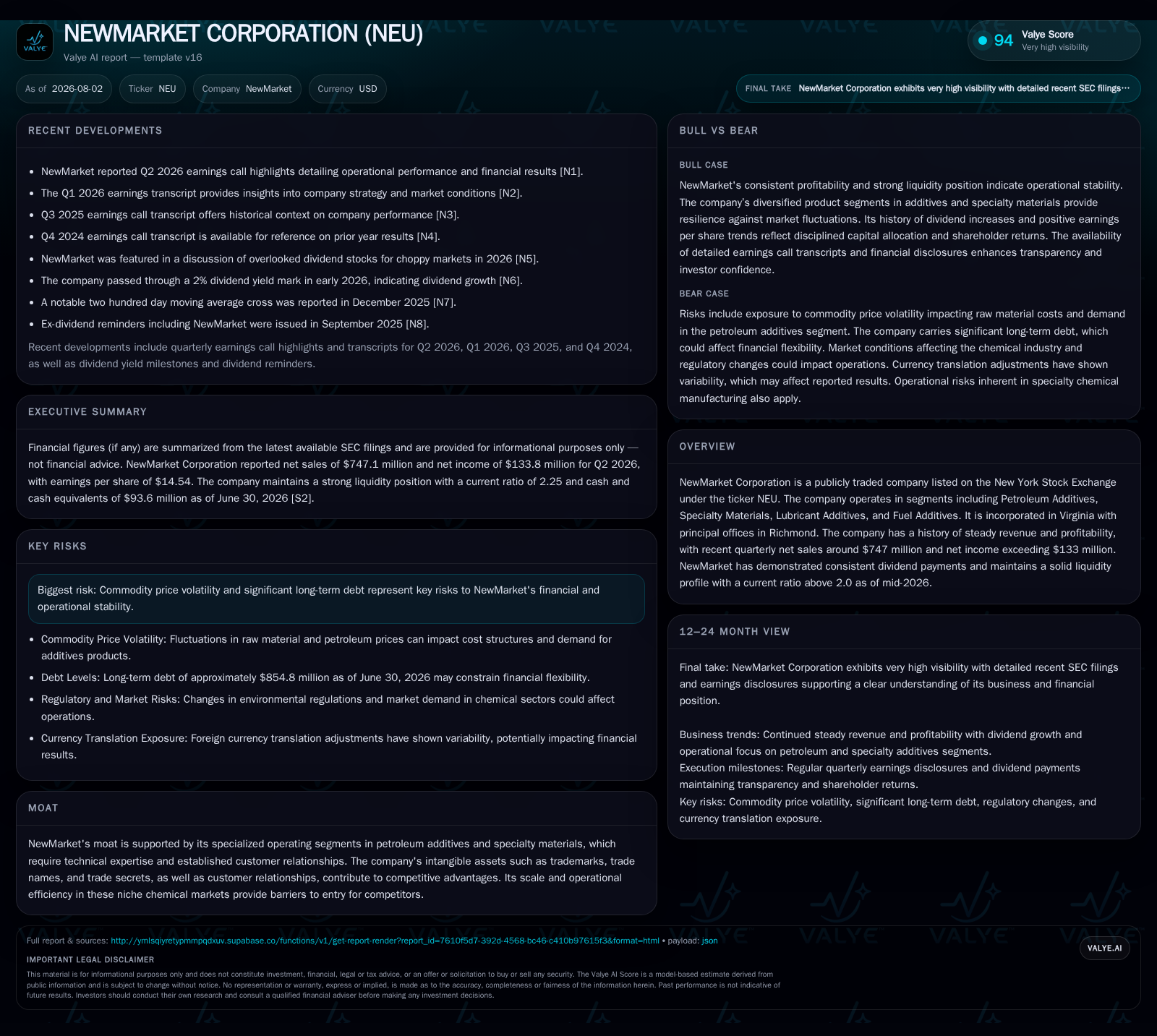
In the latest quarter ended June 30, 2026, NewMarket Corporation maintained solid operating profit margins in its petroleum additives segment while navigating a 1.1% decrease in net sales over the first six months of 2026. The specialty materials segment, bolstered by recent acquisitions, showed improved quarterly profitability despite volatile quarterly results typical of high-technology specialty chemicals. Strong cash flow supported continued capital returns and debt reduction, with long-term debt easing to $854.8 million and a robust current ratio of 2.25, highlighting financial flexibility. Going forward, NewMarket’s strategic focus on R&D investments, operational efficiency, and integration of specialty materials assets underpin its competitive position in a complex regulatory and commodity environment.
Recent Operating Update
Conversely, the specialty materials segment posted a near doubling in operating profit during Q2 compared to the same period last year ($22.3 million vs. $10.5 million), driven by integration benefits from the recently acquired Calca Solutions—specializing in high-purity hydrazine propellants critical to aerospace applications [S6], [S12]. The segment’s profitability was relatively flat for the six-month window but is characterized by substantial quarterly fluctuations tied to government contracting cycles and product mix shifts.
Business Model Insights
NewMarket operates primarily as a midstream chemical manufacturer supplying specialized formulations—petroleum additives including lubricant and fuel additives—to refiners globally along with proprietary specialty materials aimed at aerospace and defense industries [S1]. Revenue accrues largely via point-in-time recognition upon delivery under long-term supply contracts or performance obligations with variable consideration clauses such as rebates or tiered pricing [S28].
The company’s moat derives from advanced formulation chemistry backed by substantial R&D investment (~4.5% of net sales), extensive customer relationships primarily with global oil companies and U.S. government contractors, trade secrets, and scale advantages that erect meaningful barriers against new entrants [S1], [S6]. This intellectual property enables NewMarket to offer differentiated additives that improve fuel efficiency and emissions profiles during tightening regulatory standards—an increasingly pivotal growth driver.
Customer retention is supported not merely by product efficacy but also ongoing technical support and collaborative development programs essential in this sector given the complexity of fuel and lubricant base stocks alongside evolving regulations. The specialty materials unit's niche role supplying critical aerospace propellants complements this base business with exposure to defense budgets but entails greater earnings volatility reflective of contract timing [S6], [S28].
Industry Structure and Competitive Position
NewMarket sits within the specialty chemicals industry focused on petroleum additives alongside peers such as Afton Chemical, Lubrizol Corporation, Chevron Oronite, Infineum International, Clariant Specialty Chemicals, and Eastman Chemical Company (general peer candidates). Each competes on product innovation, scale manufacturing capabilities, regulatory compliance rigor, geographic reach, and customer service excellence.
The sector faces structural headwinds from raw material cost swings—primarily hydrocarbon derivatives—and stringent environmental regulations demanding continuous formula adjustments requiring sustained R&D inputs. Customer buying decisions hinge on additive performance validation through rigorous testing cycles coupled with supply reliability—factors favoring incumbents like NewMarket with established customer trust and global manufacturing footprints.
Growth Drivers
Longer-term demand growth is anchored in rising global fuel consumption tempered by acceleration toward cleaner energy sources—a trend which paradoxically fuels interest in advanced fuel additives that enhance efficiency and lower emissions. Regulatory mandates globally continue mandating reformulated fuels increasing complexity for refiner additive purchases.
NewMarket’s strategic acquisition of Calca Solutions signals targeted expansion into high-value specialty materials relevant to aerospace propulsion where innovation-led differentiation is crucial. This diversifies revenue streams beyond petroleum-based products while maintaining synergies through shared chemistry expertise.
Continued investment in global manufacturing enhancements aims to alleviate capacity constraints enabling faster customer responsiveness while controlling unit costs—a critical margin lever given input cost volatility [S16]. Furthermore, growing lubricant markets internationally provide additional avenues for additive volume growth.
Risks and Watchpoints
A primary risk remains commodity price volatility impacting raw material costs which constitute a significant portion of cost of goods sold (about 68% of net sales in recent periods) [S2]. While some price increases can be passed through via contractual mechanisms or pricing adjustments, timing mismatches may compress margins temporarily.
Environmental liabilities linked to current or legacy sites persist as non-negligible contingent risks; while adequately accrued presently per management disclosures, sudden regulatory changes or unexpected remediation costs could materially affect financial conditions [S10]. Operational disruptions—such as single-source plant risks—and geopolitical uncertainties could impact supply chains or customer demand patterns.
Customer concentration inherent in this business exposes NewMarket to renewal risk although longstanding relationships mitigate immediacy concerns; technological obsolescence risk underscores the imperative for ongoing R&D investment.
What to Watch Next
Key metrics include volume trends within both petroleum additives (shipment tonnage) and specialty materials segments given expected quarterly variability especially from government contract timing effects [S6]. Monitoring operating profit margins will help assess effectiveness of pricing power amid input inflation.
Integration progress post-Calca acquisition will bear watching as management guides on capturing synergies while managing cost bases [S6]. Capital deployment strategy toward either further acquisitions or organic growth investment will influence future scalability.
Regulatory developments affecting chemical formulations or environmental liabilities warrant vigilance; any material shifts could necessitate costly reformulations impacting operating costs.
Financially, continued free cash flow generation enabling debt reduction alongside dividend growth constitutes another marker of durable operational performance.
Financial Profile Discussion
As of June 30, 2026, NewMarket reported approximately $93.6 million in cash and equivalents against current liabilities near $511 million resulting in a healthy current ratio of about 2.25—indicative of sound liquidity positioning capable of absorbing short-term operational demands [F1], [S2]. Total long-term debt was reported at $854.8 million mid-2026 following principal repayments on senior notes [S4].
Research & development spending represented circa 4.5% of net sales during Q2 sustaining focus on innovation vital for market leadership amid evolving standards [S6]. Despite commodity headwinds inflating raw material inventories elevated working capital modestly contracted free cash flow conversion excluding discretionary capital moves appears robust.
In sum, NewMarket exhibits disciplined capital management balancing shareholder distributions with prudent leverage mitigation maintaining flexibility for growth investments or opportunistic acquisitions aligned with its core competencies.
Disclaimer: This is research-only, informational analysis and not investment advice. It may include AI-generated interpretation and general industry context. Always verify important details using primary sources.

Comments