
Tenable Holdings Builds AI Momentum Amid Vulnerability Management Competition
Tenable’s Q2 2026 results reveal accelerating AI-driven platform adoption and revenue growth alongside liquidity pressures and execution risks in a competitive cybersecurity market.
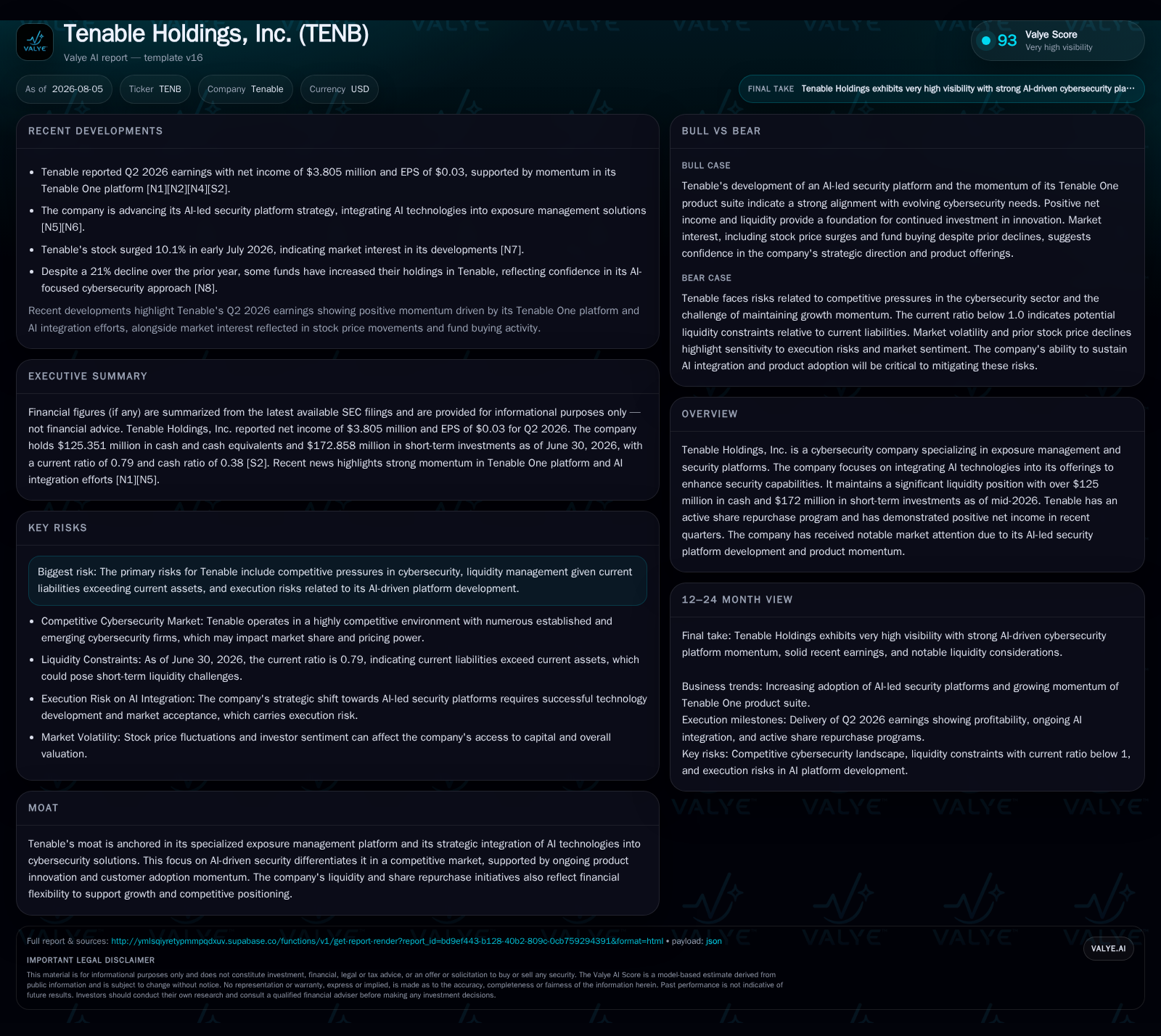
Tenable Holdings, Inc. reported encouraging second-quarter 2026 operating results marked by positive momentum in its AI-enhanced exposure management platform. Subscription revenue growth and improved net retention indicators reflect strengthening customer adoption amid intensified competition against peers like Qualys and Rapid7. However, liquidity metrics indicate short-term asset-liability pressure with a current ratio below 1, while execution risk on AI platform integration remains a key watchpoint. Tenable continues to invest in product innovation and capital allocation initiatives including share repurchases, signaling confidence despite financial constraints.
Q2 Operational Progress Frames Tenable’s Moving Needle in Exposure Management
Why this matters: Tenable’s ability to convert innovation into revenue gains during fierce vulnerability management competition signals strategic momentum. This progress matters because exposure management platforms require continuous updating to address rapidly evolving threat landscapes; customers are increasingly valuing AI-enhancement as an efficacy differentiator. Sustainable ARR growth paired with favorable retention trends would be key validation markers that the platform's value proposition resonates strongly with enterprise buyers.
Implied caution: Embedded within these positive indicators are ongoing execution risks tied to platform development speed and sales cycle length. These factors will determine whether momentum can be maintained or amplified.
(Re)Defining Customer Value: Tenable’s AI-Enhanced Security Platform Model
Tenable operates a subscription-based Software-as-a-Service (SaaS) business model centered around its core exposure management technology offering continuous visibility into cyber risk through vulnerability assessment tools integrated with threat detection capabilities [S1]. Customers primarily include large enterprises, managed security service providers (MSSPs), government agencies, and compliance-focused organizations requiring comprehensive security platform coverage.
Central to Tenable's differentiation is the integration of artificial intelligence (AI) and machine learning (ML) technologies that augment traditional vulnerability scanning with predictive analytics and automated risk prioritization [N5][N6]. This positions Tenable to reduce manual overhead for security teams while improving the speed and accuracy of threat detection.
From a monetization perspective, recurring revenues depend on contract renewals supported by high net revenue retention rates and low churn — factors influenced heavily by product stickiness and perceived value-add through AI enhancements [N2]. Early signals from recent quarters indicate an uptick in net retention driven by upselling additional modules or increased usage consumption patterns
Why this matters: The embedding of AI capabilities can be strategically transformative for customer lifetime value (LTV) by enhancing utility and reducing churn risk. A premium pricing regime becomes plausible if the technology demonstrably improves security outcomes versus legacy or commoditized alternatives.
Competitive Dynamics: Where Tenable Fits Among Vulnerability Managers and Security Leaders
The cybersecurity software landscape where Tenable competes is multifaceted, encompassing vulnerability management stalwarts such as Qualys and Rapid7 alongside broader security platform providers like CrowdStrike Holdings (with endpoint security emphasis) and Palo Alto Networks (noted for network/cloud security platforms). Tenable's positioning lies at the intersection of exposure management with emerging strengths in AI-enhanced analytics [S1].
Competition centers on innovation pace, platform breadth, integration capabilities with existing enterprise IT infrastructures, pricing models, sales efficiency, and ecosystem partnerships. Industry trends indicate increasing consolidation as well as differentiation through machine learning-driven automation.
Why it matters: Competitive intensity exerts margin pressure but also incentivizes continuous R&D investment—evident in Tenable's focus on AI platform evolution. Winning or losing market share will correlate with speed of feature rollout, quality of analytics delivered, ease of deployment across hybrid cloud/on-premises environments, and sales cycle efficiencies.
Sector peers show mixed profitability profiles influenced by scale differences; Tenable's challenge is growing recurring revenues fast enough to offset R&D spending while managing customer acquisition costs within sustainable payback periods.
Demystifying Growth Drivers: Recurring Revenue Trends and Market Adoption Signals
The global cybersecurity market is propelled by accelerating cyber threat sophistication, intensifying regulatory mandates around data privacy/security compliance, hybrid cloud adoption surge among enterprises, expansion of digital attack surfaces due to IoT proliferation/remote workforces, and increased demand for automation through AI-infused analytics.
In this context, Tenable's core value proposition—delivering actionable cyber risk insights via an integrated exposure management platform—addresses several pain points preventing organizations from managing vulnerabilities efficiently across heterogeneous IT environments.
Key industry KPIs like ARR growth rate, NRR stabilization or improvement, reduction in customer churn rate, average contract value expansion through upsells/cross-sells are material early signals of durable demand shifts favoring platforms that seamlessly embed advanced analytics at scale.
Why it matters: Sustained customer adoption benchmarks signal whether Tenable is successfully capitalizing on structural tailwinds underpinning cybersecurity spend growth. Higher net retention rates relative to peers would underscore effective account expansion strategies supported by differentiated features.
Key Risks Highlighted: Execution Complexities Loom Over Expansion Ambitions
While operating momentum is encouraging, material uncertainties persist concerning execution risks detailed in the latest 10-Q filings [S2][S20]. Chief among these are challenges related to integrating complex AI functionalities robustly at scale without introducing new vulnerabilities or operational disruptions.
Moreover, liquidity considerations warrant attention. Its current ratio stands at about 0.79 indicating short-term liabilities exceed current assets [F1]. This suggests operational cash-flow generation must improve sufficiently to mitigate refinancing or working capital pressures in upcoming periods.
Additional risks stem from competitive pricing pressures that may compress margins if innovation advantages erode or if larger competitors exert scale benefits through bundled offerings.
Why it matters: Execution missteps could delay revenue recognition or increase cost overruns impacting profitability profiles during critical product transition phases. Liquidity stress might constrain spending flexibility especially on R&D which is essential for sustaining competitive differentiation.
"What’s Next" for Investors: Milestones to Track in Platform Development and Financials
Looking ahead into late 2026 and beyond, investors should prioritize metrics such as:
- Sustained ARR acceleration driven by new customer acquisition plus account expansions,
- Further improvement in Net Revenue Retention indicating stronger customer loyalty,
- Successful delivery milestones on AI platform enhancements validating product roadmap execution,
- Operating income improvements reflecting scalability gains amid R&D investments,
- Refinancing actions or changes in leverage profile that affect balance sheet health [N2][S2]
A close eye on product adoption velocity across target verticals coupled with sales cycle duration measurements will also provide insight into demand sustainability given competitive dynamics.
Financial Profile Discussion: Liquidity Strains and Capital Allocation Mechanics
Tenable entered Q3 2026 contending with liquidity constraints highlighted by its Q2 2026 balance sheet showing a current ratio below the critical threshold at approximately 0.79 [F1]. Such figures emphasize short-term working capital mismatches necessitating prudent cash flow management or refinancing actions.
Nonetheless, the company has demonstrated capacity for disciplined capital allocation via ongoing share repurchase programs recently augmented according to SEC disclosures [S3], reflecting confidence in intrinsic valuation despite balance sheet pressures.
Operating income remains challenged but trending positively given previous negative quarters; continuous improvement here would enhance free cash flow conversion critical for deleveraging efforts [F1]. Monitoring these financial parameters alongside operating metrics provides a comprehensive view of enterprise resilience amid evolving cybersecurity market demands.
This analysis synthesizes multiple sources including latest SEC filings up to August 2026 combined with sector insights pertinent to cybersecurity software firms focused on exposure management platforms integrating artificial intelligence. It does not constitute investment advice but seeks to elucidate key operational themes shaping Tenable Holdings’ near-term trajectory within the competitive vulnerability management landscape.
Disclaimer: This is research-only, informational analysis and not investment advice. It may include AI-generated interpretation and general industry context. Always verify important details using primary sources.

Comments