
Outset Medical’s Tablo System Growth Hinges on Regulatory Compliance and Contract Renewals
Outset Medical's recent multi-year HCA fleet refresh contract and ongoing FDA scrutiny highlight the balance of growth opportunities and operational risks.
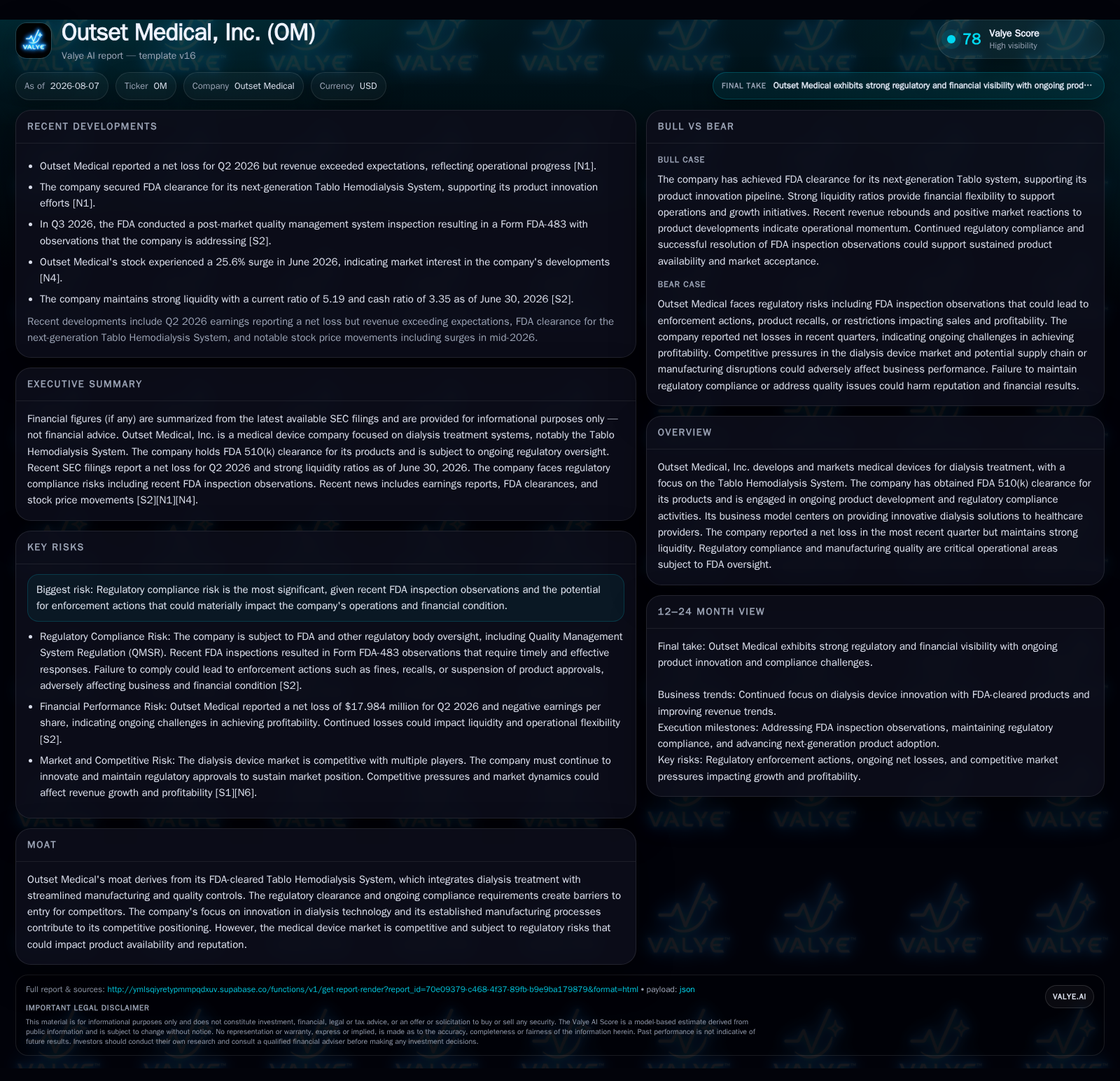
Outset Medical reported its Q2 2026 results alongside the announcement of a $40 million multi-year fleet refresh agreement with HCA, signaling solid demand visibility for its Tablo Hemodialysis System. However, recent FDA inspection observations underscore potential regulatory compliance risks that could affect manufacturing continuity and product availability. The company’s business model combines capital equipment sales to hospitals and clinics with recurring consumable revenue, a dynamic that depends heavily on installed base growth and customer renewals. Navigating these regulatory and operational factors while capitalizing on rising renal disease trends and adoption of home dialysis solutions will shape Outset’s path forward.
Contract Renewal Secures Multi-Year Visibility but Execution Remains Key Indicator
Outset Medical's latest quarterly filing reveals a strategic milestone: a June 2026 amendment to the existing purchasing agreement with HCA Management Services committing approximately $40 million in incremental capital sales over three years for fleet refreshes of the Tablo Hemodialysis System [S4]. This substantial order underscores strong confidence by a major hospital network in Outset’s technology to support hemodialysis in-sourcing initiatives. Such multi-year renewals not only signal durable demand for the Tablo platform but also create a framework for predictable revenue streams both from new console shipments and complementary consumable sales tied to system usage.
However, while the contract anchors capital sales outlook through 2028, the company notes uncertainty regarding the precise timing and ramp rate of delivery and installation across sites within this period—key variables that could affect near-term top-line performance reporting [S4]. The expected consoles also provide a basis for subsequent consumable purchases necessary for ongoing dialysis treatments, highlighting the interdependence between installed base growth and recurring revenue expansion crucial for sustaining margin improvement.
Impact of FDA Regulatory Inspections on Operating Risk Profile and Manufacturing Controls
Simultaneously, Outset faces intensifying regulatory scrutiny that clouds this promising demand outlook. The latest Form 10-Q details inspectional observations issued by the FDA following a third-quarter 2026 post-market quality management system (QMSR) inspection at its San Jose manufacturing site [S2], [S14]. These observations reflect deficiencies related to compliance with FDA's Quality Management System Regulation—a critical regulatory framework governing design controls, process validation, production oversight, labeling, packaging, storage, and post-market surveillance.
Given that QMSR adherence is integral to maintaining FDA 510(k) clearance status for Tablo devices—and thereby permits uninterrupted marketing and distribution—the stakes are high. Failure to address these observations expeditiously risks escalated enforcement actions ranging from warning letters to forced recalls or manufacturing shutdowns [S2], [S6], consequences that could severely disrupt product availability and erode customer trust in clinical settings.
The company's openness about these risks underscores the ongoing operational challenge of balancing rapid scale-up ambitions with rigorous quality controls expected in this highly regulated sector. Industry peers with longer-established manufacturing processes may face fewer such challenges; thus compliance outcomes represent an important near-term risk factor.
Business Model Anchored on Durable Capital Sales Complemented by Recurring Consumables Revenue Streams
Outset’s commercial approach centers on selling its flagship Tablo Hemodialysis System primarily to hospitals and outpatient centers seeking new or replacement dialysis platforms tailored for in-house treatment provision. Initial revenues derive from durable goods sales—Tablo consoles—recognized upon shipment or installation under relevant contracts such as the amended HCA deal. Crucially, however, these capital sales set up downstream recurring revenue opportunities stemming from consumables: single-use cartridges and other disposables required for each treatment session administered by the machine.
Recurring sales contribution dictates gross margin profile given their typically higher margin nature compared to hardware. Customer renewal rates and fleet upgrades thus serve as bellwethers for sustainable long-term financial health. Growth in installed base directly correlates with increased consumables usage volume over time. Service contracts further stabilize revenue while supporting device uptime—a critical concern for provider customers reliant on uninterrupted patient care.
This two-pronged monetization strategy is common within dialysis device manufacturers but execution quality around installed base expansion and renewal conversion varies considerably across firms [S1], [N1].
Competitive Positioning: Innovation, Regulatory Clearance, and Peer Benchmarking Within Dialysis Devices Market
Within the medical devices landscape serving renal care providers, Outset occupies a differentiated niche by offering an integrated hemodialysis system cleared via FDA’s streamlined 510(k) pathway. This compares favorably against competitors pursuing Premarket Approval (PMA)—a lengthier clearance route typical for novel technologies—allowing faster iteration cycles and potentially speedier market adoption.
Established market incumbents Fresenius Medical Care and Baxter International command dominant positions supplying both machines and consumables globally but often face slower innovation cycles due to legacy portfolio scale. Outset’s innovation claims center on ease-of-use features embedded in Tablo technology facilitating point-of-care dialysis deployments alongside digital integration capabilities enhancing clinical workflows [S1], [S3].
Smaller competitors targeting home or portable dialysis solutions represent a complementary competitive vector emphasizing patient mobility; however, their smaller scale contrasts with Outset’s positioning toward institutional customers reliant on robust service infrastructure.
Thus, Outset balances FDA-mandated regulatory rigor against opportunities fostered by nimble product development as an asset in gaining footholds within competitive hospital environments.
Market Growth Drivers Spotlight Rising Kidney Disease Prevalence and Home Dialysis Adoption Trends
Fundamentally supporting Outset’s addressable market is demographic-driven kidney disease prevalence growth globally—including increases in end-stage renal disease (ESRD) patients requiring lifelong dialysis therapy. Aging populations elevate incidence rates alongside improved diagnostic awareness broadening patient identification. These secular tailwinds underpin steady demand expansion for hemodialysis equipment irrespective of macroeconomic fluctuations.
Concurrently, evolving clinical paradigms promote home-based dialysis options supported by portable systems like Tablo aiming to enhance patient autonomy while reducing facility burdens. Adoption trajectories depend on reimbursement states across geographies plus provider willingness to integrate novel modalities into care protocols.
Technological innovations improving treatment safety profiles, reducing session times, or facilitating remote monitoring capabilities additionally drive demand uplift by promising better clinical efficacy outcomes—an evolving requirement increasingly embedded into purchasing decisions by providers aiming to balance cost containment with quality metrics.
Operational Constraints: Compliance Risks, Supply Chain Dependencies, and Pricing Dynamics in Focus
Operationally, Outset navigates multifaceted constraints primarily linked to meticulous regulatory adherence against FDA QMSR standards necessary to preserve market access. Any disruptions stemming from inspections could induce costly remediation expenses or production halts. Moreover, dependency on supplier quality stability adds supply chain risk especially when sourcing specialized medical-grade components whose qualification demands are stringent.
Competitive pricing pressures emerge amid reimbursement environment uncertainties where payors scrutinize capital investment returns tightly given healthcare cost containment priorities. This dynamic tempers pricing power attainable by manufacturers especially younger entrants needing to sustain R&D investments while attaining scale economies.
Capacity expansions require calibrated capital outlays balanced against forecast demand visibility influenced by macroeconomic cycles affecting hospital capital budgets—for example during periods of cautious spending triggered by inflationary pressures or policy reforms influencing Medicaid/Medicare reimbursement models.
What to Watch Next: Inspection Updates, Sales Ramp Timing, Consumables Penetration, Cash Burn Trajectory
Key monitoring points include developments surrounding resolution progress with FDA inspection observations—successful remediation would alleviate significant overhangs constraining operational continuity. Conversely any escalation portends risks warranting close scrutiny.
Execution pace for delivering new units under the HCA fleet refresh contract represents an upcoming demand indicator with direct implications for successive consumable consumption patterns historically linked closely with installed console base metrics 0 such data will validate persistent customer commitment beyond headline contract values.
Tracking consumables penetration rates alongside customer renewal behavior provides insight into recurring revenue momentum prospects vital for margin expansion.
Finally liquidity trajectory relative to burn rates remains important; managing cash reserves leveraged against funding needs entails fine balancing given ongoing operating losses characteristic of scaling phases within capital-intensive medtech arenas.
Financial Profile Discussion: Sustaining Liquidity Amid Continued Cash Burn And Capital Spending Needs
As of June 30, 2026, Outset reported cash and cash equivalents totaling $35 million and current assets of $228 million against current liabilities of $44 million, implying a current ratio near 5.19x, indicating ample short-term asset coverage over liabilities supporting working capital adequacy at present [F1]. Total debt stood near $96 million as of December 31, 2025, with an estimated net debt position of approximately $61 million calculated as debt less cash reserves [F1].
Notwithstanding healthy liquidity buffers providing runway cushioning near-term operational expenditure requirements including capex associated with manufacturing scale-up initiatives; persistent net losses captured previously (operating loss approximating $67 million as last recorded annually) underscore continued capital intensity challenging overall profitability timelines [F1]
Successful moderation of cash burn aligned with acceleration in recurring revenue scaling driven by installed base expansion constitutes critical financial inflection criteria pivotal toward sustainable margin improvement long term.
Disclaimer: This is research-only, informational analysis and not investment advice. It may include AI-generated interpretation and general industry context. Always verify important details using primary sources.

Comments