
C4 Therapeutics Advances Protein Degrader Pipeline with Robust Platform and Strategic Collaborations
Clinical progress on oncology candidates and expansion into neuroinflammation underscore C4 Therapeutics' differentiated approach in targeted protein degradation.
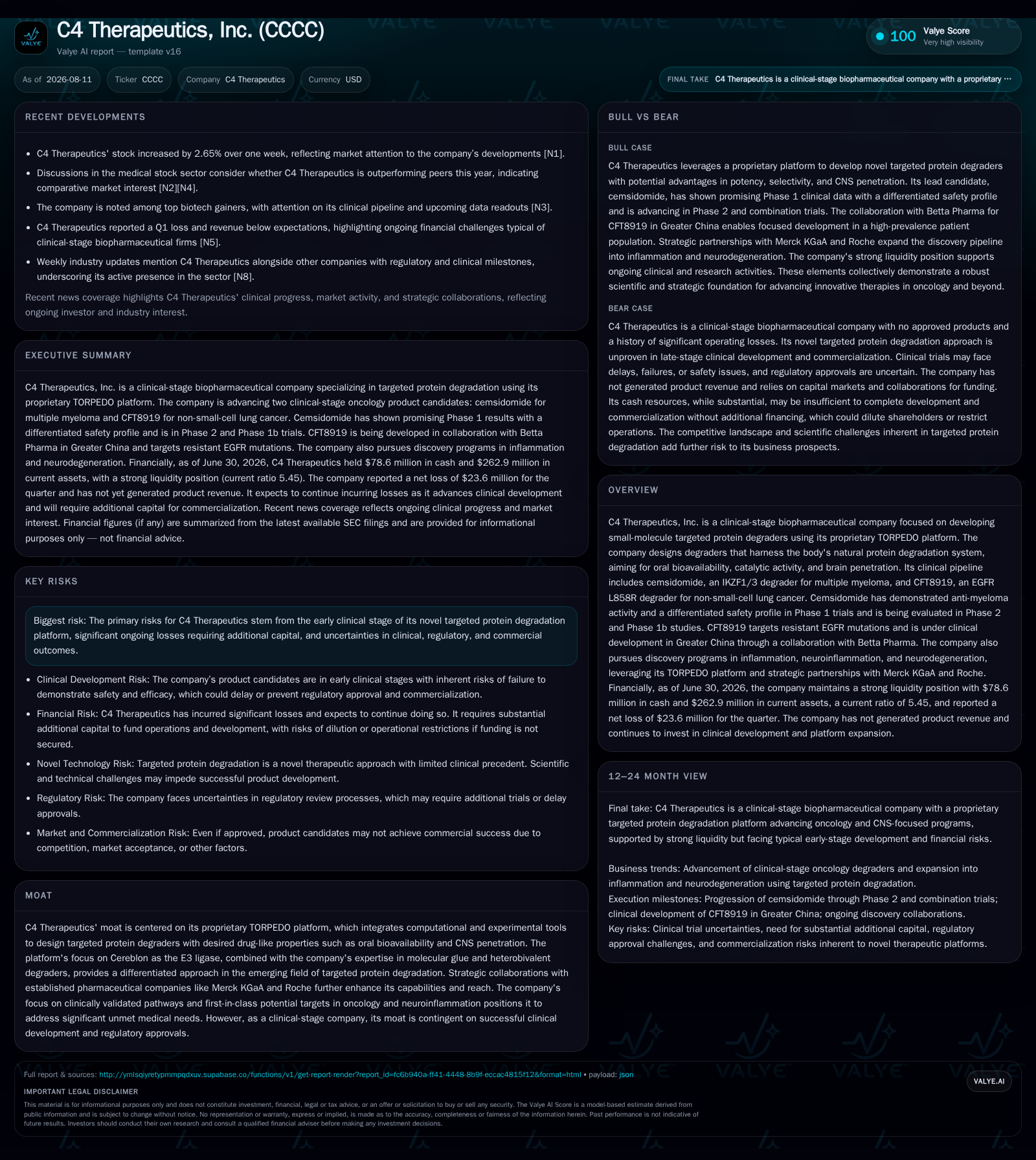
C4 Therapeutics reported Q2 2026 results highlighting continued R&D investment and clinical advancement of its lead oncology degraders, cemsidomide and CFT8919, leveraging its proprietary TORPEDO platform. The company's business model centers on developing orally bioavailable, brain-penetrant small-molecule degraders targeting validated disease pathways, supported by strategic partnerships with Merck KGaA and Roche. Despite no current product revenues, solid cash reserves and a strong current ratio provide runway to fund multiple clinical programs. Risks remain typical for clinical-stage biotechs, including regulatory uncertainties, capital needs, and competition, but the differentiated platform and pipeline breadth position C4 well within the emerging targeted protein degradation space.
Recent Operating Update
In its latest quarterly report for Q2 ended June 30, 2026, C4 Therapeutics reaffirmed the trajectory of its clinical-stage biopharmaceutical development strategy centered around its proprietary TORPEDO platform. The company recorded a net loss of $48.8 million for the first half of 2026 with an accumulated deficit approaching $788 million—a reflection of sustained investment typical for a firm in early-stage drug development without commercial products yet [S2], [F1]. Cash reserves stood at $78.6 million at quarter-end with a healthy current ratio of 5.45 indicating liquidity sufficient to fund ongoing R&D expenditures in the near term [F1].
Operationally, C4 continues to prioritize advancing its lead product candidates through clinical trials while expanding its discovery efforts across additional therapeutic areas. Notably, cemsidomide—a molecular glue type degrader targeting the IKZF1/3 transcription factors—is progressing beyond Phase 1 trials in multiple myeloma (MM) with encouraging safety profiles and anti-myeloma activity observed thus far [S1]. Concurrently, CFT8919 targets the EGFR L858R mutation in non-small cell lung cancer (NSCLC), addressing both primary oncogenic drivers and resistant mutations through an orally bioavailable BiDAC degrader format; this program is being advanced in Greater China via a collaboration with Betta Pharma to leverage geographic market expertise [S1].
Business Model Analysis
C4 Therapeutics operates in the cutting-edge niche of targeted protein degradation (TPD), developing small-molecule therapeutics designed to hijack the ubiquitin-proteasome system via recruitment of E3 ligase Cereblon to selectively degrade disease-driving proteins. Their monetization model revolves around internally discovering novel degrader compounds using their TORPEDO platform—which integrates computational chemistry with experimental validation—to create compounds exhibiting favorable pharmacokinetics such as oral bioavailability and brain permeability. These attributes are crucial given patient preference for oral therapies and the unmet need for CNS-penetrant drugs addressing neurodegeneration or metastatic cancers.
Revenue generation at this stage remains dependent on milestone payments from strategic collaborations as well as licensing revenues rather than product sales since none of the candidates have marketing approval yet [S1]. The company pursues partnerships that extend geographic reach or broaden indication areas—as exemplified by Betta Pharma's role in NSCLC trials within Asia—and collaborates with large pharma partners like Merck KGaA and Roche to share costs and access their expertise in inflammation-related drug discovery
Success metrics hinge on expanding the pipeline candidate count through TORPEDO-driven discovery programs, progressing active clinical trials efficiently from phase to phase (especially late stages), filing regulatory submissions that meet approval criteria, retaining patent protection robustness amidst IP challenges, enrolling patients at expected rates in trials, and demonstrating drug candidate safety and efficacy profiles that surpass existing therapies.
Industry Structure and Competitive Position
The biotechnology landscape focused on TPD remains nascent but rapidly evolving. Companies such as Arvinas Inc. and Nurix Therapeutics compete within this modality leveraging PROTACs or molecular glue mechanisms. However, C4 Therapeutics differentiates itself by emphasizing degraders optimized not only for target selectivity but also for oral dosing practicality and ability to penetrate the blood-brain barrier—features which address significant clinical gaps particularly in CNS disease.
The value chain positioning is strongly weighted toward discovery through early-clinical development phases; manufacturing scale-up capabilities are generally outsourced given typical biotech asset structures pre-approval. Partnerships serve both as risk mitigation tools against high R&D costs/clinical failure probabilities and as pathways for eventual commercialization leverage.
Competition extends beyond pure TPD platforms to include other innovative modalities such as gene therapies or monoclonal antibodies targeting similar disease pathways in oncology or neurodegeneration; pricing power post-launch will depend heavily on demonstrated differentiated efficacy/safety profiles versus these alternatives alongside regulators’ willingness to accommodate novel mechanisms.
Growth Drivers
Key growth is driven by:
- Advancing cemsidomide through later-phase trials informing pivotal studies that could trigger registrational pathways.
- Clinical progression of CFT8919 addressing resistant EGFR mutant populations underserved by first-generation tyrosine kinase inhibitors.
- Expansion into inflammation/neurodegeneration indications exploiting TORPEDO’s capability to engineer brain-penetrant degraders—a relatively underexplored frontier promising broad neurological impact.
- Leveraging strategic partnerships for co-development enhancing resource access across diverse therapeutic domains.
- Pipeline diversification enabling multiple shots on goal thereby spreading risk while increasing opportunity size.
- Successful intellectual property filings protecting novel degrader chemistries bolster competitive moat.
Progress on these fronts can be tracked by KPIs such as number of initiated clinical programs, milestone achievement dates (e.g., IND approvals), partnering/licensing deal frequency & terms disclosed publicly, patient enrollment velocity in trials reflecting market interest/feasibility, emerging safety/efficacy signals reported at scientific forums or publications.
Risks and Watchpoints
These risks require monitoring developments such as interim data readouts from ongoing trials (especially Phases 2/3), patent litigation news flow if any arises, cash burn rates relative to financing events ensuring runway continuity, regulatory guidance changes affecting TPD drugs specifically, plus updates on partnership statuses reflecting shared development risks.
What to Watch Next
Upcoming catalysts include:
- Completion timelines & data readouts from cemsidomide Phase 2 studies evaluating efficacy/safety endpoints critical for planning confirmatory trials.
- Progress reports from Betta Pharma regarding patient accrual rates or preliminary results on CFT8919’s activity against resistant EGFR mutations, potentially informing expansion plans or additional geographies beyond Greater China.
- Milestones related to CNS-targeting degrader discovery programs transitioning into IND-enabling studies indicating platform maturity across neurological indications.
- New partnership announcements or licensing deals reflecting external validation of TORPEDO capabilities across therapeutic areas beyond oncology/inflammation.
- Regulatory interactions providing clarity on approval pathway expectations specific to degrader technologies which could reduce timeline uncertainties.
Tracking these indicators provides insight into both operational execution fidelity and commercial trajectory potential impacting overall business durability.
Financial Profile Discussion
From a financial standpoint, C4 Therapeutics maintains $78.6 million in cash and equivalents at June 30, 2026 with a current ratio exceeding 5x—reflecting strong near-term liquidity supportive of ongoing high R&D spend typical for clinical-stage biopharma [F1]. This financial cushion supports technology platform expansion efforts alongside progression through costly multi-cohort human trials currently underway. Total debt remains minimal relative to cash reserves limiting leverage risks but continued capital raises may be necessary depending on trial progress pace and partner contributions [F1].
Operating losses continue predictably stemming from heavy research investment ahead of commercialization; net loss was approximately $48.8 million over six months indicating burn rate normalization consistent with prior periods [S2], [F1]. Future expenditure growth is anticipated aligned with trial intensification including pivotal studies initiation if interim data sustains positive outlooks reported previously [S2]. Close attention should be given to upcoming quarterly disclosures describing cash runway estimates versus planned milestones providing transparency into financing sufficiency or need for equity issuance dilutions which could influence shareholder positioning.
In conclusion, while still early-stage operationally without product revenues yet realized nor FDA approvals attained, C4 Therapeutics displays hallmark characteristics expected within innovative biotech sectors: intensive R&D spend weighted towards advancing pipeline quality underpinned by distinct science-driven platform advantages fostered through collaborations sharing risk/reward across geographies & indications. Success hinges largely upon navigating regulatory thresholds while maintaining capital discipline amid competitive pressures inherent in pioneering therapeutic classes like targeted protein degradation.
Disclaimer: This is research-only, informational analysis and not investment advice. It may include AI-generated interpretation and general industry context. Always verify important details using primary sources.

Comments