
Sagimet Biosciences Advances FASN Inhibitors Amid Strengthening Phase 2 Data and Capital Position
The clinical-stage biotech focuses on denifanstat for MASH and acne, leveraging precision medicine and strategic partnerships.
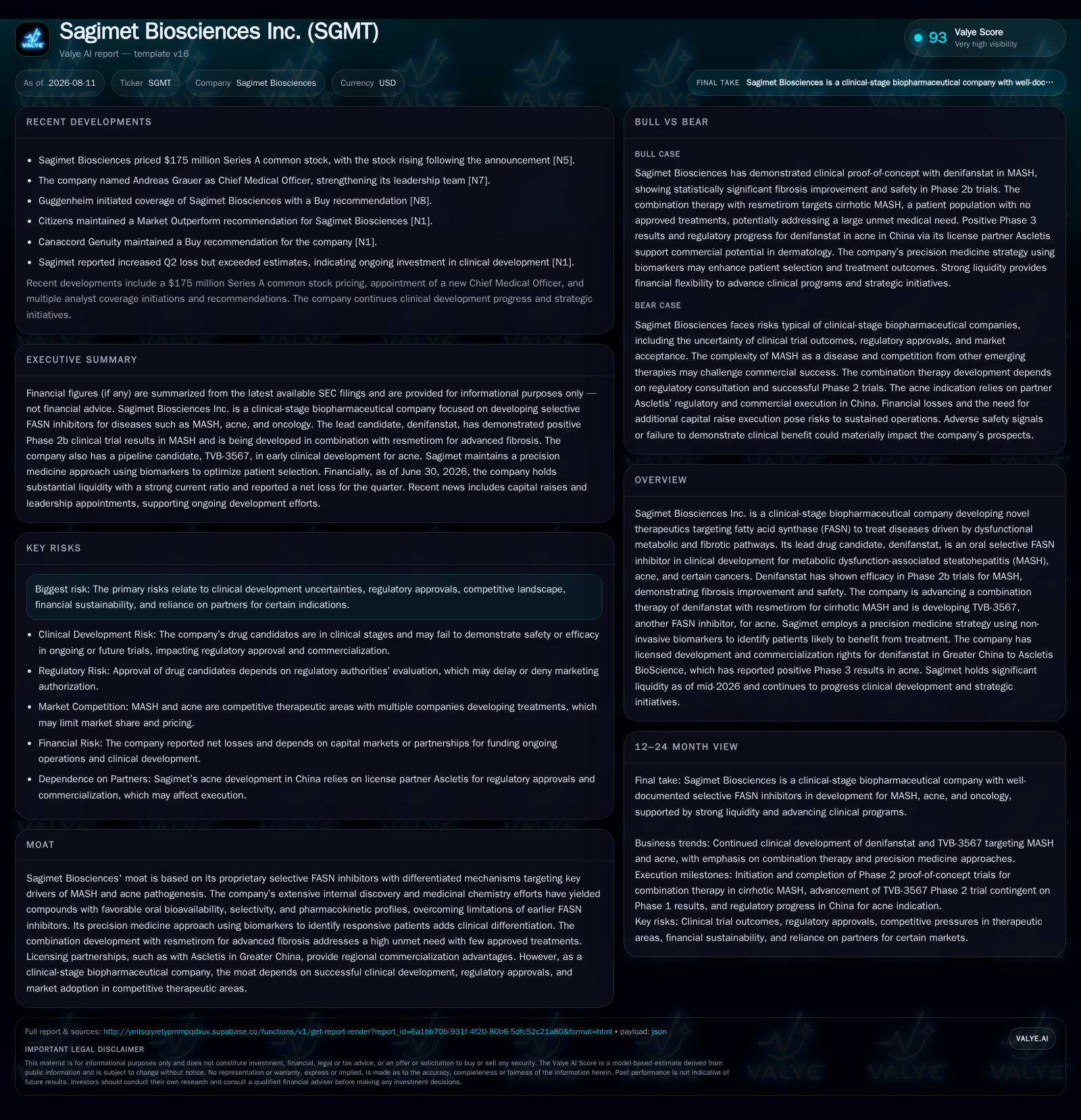
Sagimet Biosciences reported in its latest 10-Q filing that it maintains robust liquidity with $166 million in cash and equivalents and continues advancing its selective FASN inhibitors, primarily denifanstat, through Phase 2b studies targeting metabolic dysfunction-associated steatohepatitis (MASH) and acne. The company’s lead candidate showed statistically significant fibrosis improvement endpoints and safety in Phase 2b trials while progressing combination therapies addressing cirrhotic MASH. Sagimet's business model blends internal drug discovery, biomarker-driven patient selection, and regional licensing deals such as with Ascletis in Greater China. Risks remain chiefly around clinical outcomes, regulatory hurdles, competitive landscape, and funding sustainability.
Recent Operating Update
Business Model Overview
Sagimet operates as a clinical-stage biopharmaceutical company specializing in precision therapeutics targeting fatty acid synthase (FASN), an enzyme implicated in excessive palmitate production driving metabolic dysfunction-associated steatohepatitis (MASH), acne, and certain cancers. Its commercial pathway relies on successful clinical development of small-molecule FASN inhibitors followed by licensing agreements to accelerate regional market entries.
The lead candidate denifanstat is administered orally once daily and selectively inhibits FASN activity to address three major pathological domains of MASH: steatosis (fat accumulation), inflammation, and fibrosis (scarring). This multi-driver targeting offers a differentiated mechanism compared to mostly single-target agents in development [S1]. Sagimet generates value primarily through milestone payments under partnerships like the license granted to Ascletis for Greater China commercialization rights—leveraging local expertise while maintaining core R&D internally.
Patient selection employs a precision medicine approach using non-invasive biomarkers to enhance response rates and trial efficiency by identifying individuals most likely to benefit from treatment. This strategically mitigates heterogeneous disease population risks prevalent in MASH trials—a known challenge industry-wide where lack of patient stratification can dilute efficacy signals [S1]. Sagimet is also expanding its pipeline into dermatological disease (acne) via TVB-3567, broadening commercial potential beyond liver indications.
Revenue prospects for Sagimet remain contingent on successful trial readouts leading to regulatory approvals since it does not currently have commercial products generating sales. Instead, the company’s monetization hinges on negotiated licensing deal structures including upfront fees, milestone receipts upon clinical/regulatory progress, and eventual royalties post-commercial launch.
Industry Structure and Competitive Position
Sagimet lies within the biotechnology industry's discovery-to-clinic segment focused on novel molecular targets intersecting metabolic dysfunction and fibrotic diseases. This sector is marked by lengthy product development cycles often exceeding a decade with high failure rates at various clinical phases. Companies commonly partner later-stage programs to larger pharmaceutical entities due to commercialization scale requirements.
Within MASH therapeutics development—a field characterized by considerable unmet medical needs—few approved treatments exist for non-cirrhotic stages (F1-F3), while cirrhotic MASH lacks any approved pharmacotherapy entirely. Sagimet’s selective FASN inhibition mechanism places it among a relatively small number of players targeting this pathway with oral bioavailability suitable for chronic administration.
Differentiation arises chiefly via Sagimet’s demonstrated anti-fibrotic activity validated in Phase 2b trials showing statistically significant improvements in fibrosis stages and slowing progression to cirrhosis compared with placebo. Also noteworthy is the AI-enabled identification of advanced fibrosis patients using second harmonic generation technology that's novel within trial designs enhancing endpoint reliability [S1]. Competitors range from other biotechs pursuing metabolic modulation or anti-inflammatory pathways to large pharmaceutical companies exploring combination therapies.
Strategic alliances such as the licensing deal signed with Ascletis augment regional execution capabilities allowing Sagimet to focus internal resources on development innovation rather than downstream marketing complexities. This approach aligns with peer companies who similarly rely on geography-specific partners until late-phase validation or FDA approval is secured.
Growth Drivers
Key growth vectors include:
- Continued positive clinical developments for denifanstat as it advances through later-stage trials addressing both non-cirrhotic and cirrhotic MASH populations.
- Expansion of therapeutic indications supported by robust data for skin-related diseases such as acne via TVB-3567.
- Regulatory designations like Fast Track already granted for denifanstat’s use in selected fibrosis stages promise potential expedited review timelines facilitating faster market access [S1].
- Validation and deployment of biomarker-driven patient selection protocols which improve trial success probabilities - critical given MASH pathology diversity.
- Further licensing agreements leveraging Sagimet’s intellectual property portfolio could unlock revenue milestones while spreading geographic risk.
- Rising global prevalence of MASH fueled by growing obesity and type 2 diabetes incidence will enlarge the addressable market over time.
Risks and Constraints
The principal risks center around inherent biotechnology development uncertainties:
- Clinical risk persists as Phase 3 level trials are required for regulatory approvals; thus far most data derives from Phase 2b studies.
- Regulatory hurdles are compounded by evolving US CMS reimbursement frameworks incorporating international reference pricing models that may impact future drug pricing strategies negatively [S1].
- Competitive pressure includes alternative novel agents entering late-stage development potentially offering superior efficacy or safety profiles.
- Dependence on external capital markets remains given current lack of product revenues; unexpected adverse trial results could impair fundraising ability.
- Intellectual property challenges related to FASN inhibitor patents or biomarker validations could restrict freedom-to-operate or delay commercialization.
- Manufacturing scale-up readiness has not been disclosed but represents a typical bottleneck during transition from clinical supply to commercial-scale production.
- Commercial execution outside core US markets heavily reliant on third-party licensing partners increases operational complexity.
What to Watch Next
Investors should monitor several operational milestones: - Completion timelines for pivotal Phase 3 trials evaluating denifanstat’s efficacy across fibrosis spectrums including combination therapy outcomes with resmetirom targeting cirrhotic MASH patients. - Additional biomarker validation publications or presentations confirming predictive capabilities that underpin precision medicine strategy effectiveness. - Regulatory interactions reports particularly FDA feedback concerning Fast Track or breakthrough therapy status applications. - Updates regarding partnership expansions beyond Greater China territory potentially reflecting broader market adoption interest. - Quarterly disclosures indicating R&D spending trends as proxy indicators of trial progression intensity along with cash burn rates impacting capital planning scenarios [S3][S1]
Financial Profile Discussion
Sagimet’s financial position as of mid-2026 frames a stable runway amid early-stage biotech norms. Cash plus equivalents total roughly $166 million matching current assets near $244 million against minimal current liabilities under $6 million. This creates a current ratio surpassing forty-five times—exceptionally robust—indicating liquidity strength uncommon even among peers at similar stages [F1][S2]. The company reported operating losses consistent with sustained R&D expenditures imperative at this phase yet did not disclose material debt obligations minimizing leverage constraints affecting operational flexibility. While net negative income reflects ongoing investments rather than commercial revenues typical for a clinical-stage firm, capital adequacy reduces near-term refinancing pressures providing breathing room for advancing pivotal experiments.
Historically Sagimet has financed operations via equity offerings supplemented by licensing milestones such as those underpinning the collaboration with Ascletis. Regulatory-approved product sales remain distant pending successful trial completions; hence cash flow generation is largely unrealized [S2]
This analysis synthesizes public SEC filings up to August 2026 alongside industry-standard knowledge regarding biotechnology drug development frameworks focused on metabolic disease therapeutics. It does not constitute investment advice but aims to provide an informed internal perspective suitable for buy-side analysts tracking clinical-stage biopharmaceutical innovators specializing in precision medicine-enabled pipelines.
Disclaimer: This is research-only, informational analysis and not investment advice. It may include AI-generated interpretation and general industry context. Always verify important details using primary sources.

Comments