
Insight Digital Partners II Faces Critical Execution Timeline in SPAC Pursuit of Digital Infrastructure Deal
As a newly public SPAC focused on the digital economy, Insight Digital Partners II holds $172.5 million in trust but must complete a business combination within 24 months to avoid liquidation.
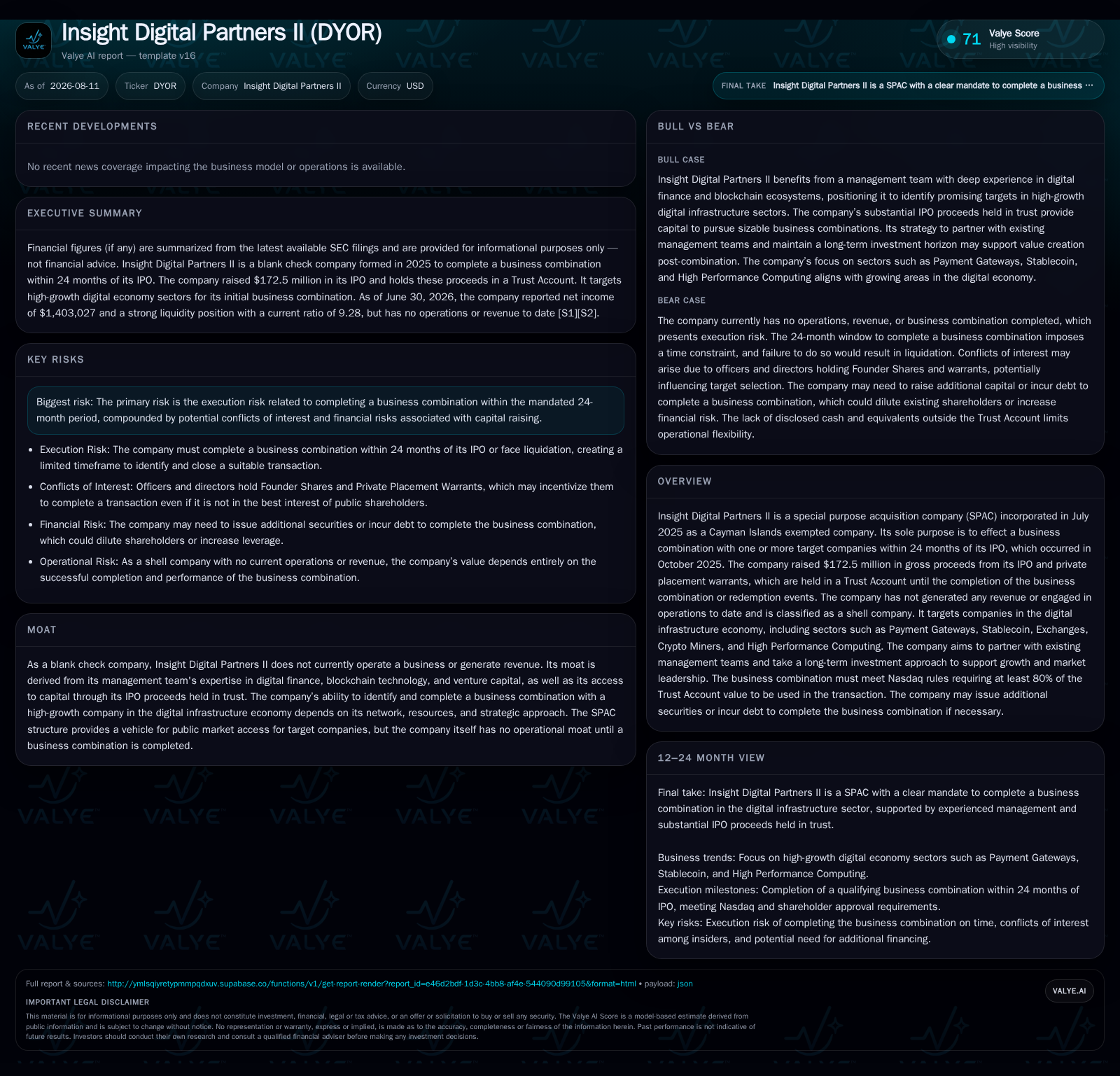
Insight Digital Partners II, a Cayman Islands-based blank check company, raised $172.5 million in an October 2025 IPO targeting acquisitions in digital infrastructure sectors like Payment Gateways and Crypto Mining [S1][S2]. With no operations or revenue to date, the company’s value proposition hinges entirely on completing a de-SPAC transaction by October 2027, leveraging its management team’s expertise in blockchain and Web3 [S1][S15]. The trust account preserves capital while operating expenses and redemption risk challenge execution. Key risks center on deal sourcing amid competitive SPAC activity and shareholder redemptions that could reduce acquisition capital [S1][S18]. Progress toward identifying a suitable target and managing transaction costs will be critical milestones to watch [S2].
Recent Operating Update: IPO Completion and Early Execution Status
Insight Digital Partners II successfully closed its initial public offering (IPO) on October 30, 2025, issuing 17.25 million units at $10 each to raise $172.5 million in gross proceeds [S1]. These proceeds were placed into a trust account invested in U.S. Treasury instruments maturing within six months or money market funds that invest primarily in government obligations. This structure safeguards capital for the eventual business combination while generating modest interest income; as of year-end 2025, the company earned $1.16 million in interest income on trust assets offset by approximately $266,000 in operating expenses related to compliance and due diligence activities [S1].
No operational revenues have been generated given the SPAC’s blank check nature; accordingly, Insight Digital Partners II is classified as a shell company under SEC definitions with nominal assets outside cash equivalents [S1][F1]. The company currently holds just under $900,000 in current assets separate from the trust with minimal liabilities, yielding a strong current ratio of over 9x for pre-combination working capital management [F1].
Business Model and Strategic Positioning
Operating as a Special Purpose Acquisition Company (SPAC), Insight Digital Partners II's business model fundamentally differs from traditional operating companies. It raised capital through an IPO solely to identify and effect one or more mergers or acquisitions—business combinations—with private companies that fit its sector focus. Until a successful de-SPAC transaction occurs, it does not earn commercial revenue but instead retains funds safeguarded in trust primarily invested conservatively to preserve principal while incurring regular public company expenses such as legal, accounting, and compliance costs for SEC reporting [S1][S15]
The company’s unique strategic edge lies in its targeted focus on high-growth digital infrastructure sectors underpinning the evolving digital economy. Its declared target areas encompass Payment Gateways facilitating digital payments, Stablecoin issuers stabilizing cryptocurrency valuations, Exchanges enabling asset trading, Crypto Miners for blockchain validation operations, High Performance Computing providers supporting complex computations often linked with blockchain technology, Energy sector participants supporting crypto operations' power needs, and Treasury Strategy operations around crypto asset holdings [S1][S15]. By concentrating on these interconnected verticals with anticipated rapid innovation and scaling potential driven by widespread fintech adoption and Web3 expansion, Insight Digital Positions II aligns itself with persistent secular growth themes.
Critical to execution is the management team's profile: professionals seasoned across blockchain technology innovation, digital finance ecosystems, and venture capital investing bring proprietary deal sourcing advantages and operational acumen beneficial during target identification and eventual governance post-business combination. The firm emphasizes partnering with incumbent management teams to maintain continuity while supporting accelerated growth through long-term investments rather than disruptive leadership changes typical of other transactions [S15].
Industry Structure: SPAC Dynamics Within Digital Finance
As a Cayman Islands-exempted blank check entity listed on Nasdaq under ticker DYOR (shares) and DYORW (warrants), Insight Digital Partners II exemplifies modern SPACs designed for niche sectors requiring rapid access to public markets by privately-held innovators that might otherwise face lengthy traditional IPO processes. This form provides an alternative listing route featuring distinct financial mechanics: unit offerings coupling shares with detachable warrants typically exercisable above $11 per share serve both as incentives for sponsor economics and potential dilution sources post-merger.
Crucial structural parameters include a strict two-year "completion window" during which the SPAC must consummate at least one qualifying business combination equivalent to at least 80% of funds held in trust excluding transaction expenses or face mandatory wind-up procedures returning most proceeds net of fees to shareholders [S1][S13]. Redemption rights allow shareholders dissenting from proposed deals to demand cash reimbursements pro-rata from trust assets thereby imposing dilution risk when high redemption rates reduce available acquisition war chest. Sponsors typically mitigate this risk via backstop agreements or forward purchase commitments though currently Insight Digital Partners II discloses no such arrangements nor additional fundraising efforts beyond initial sponsor loans potentially convertible into warrants if utilized pre-combination [S16][S24].
This puts Insight Digital Partners II amid an increasingly crowded SPAC landscape where strategic differentiation hinges on thematic focus (digital infrastructure here), management track record, sponsor incentives alignment with public investors’ interests, speed of execution relative to peers targeting similar sectors (e.g., fintech-focused SPACs), approval dynamics influenced by shareholder voting patterns or tender offers per Nasdaq rules, and cost discipline especially around underwriting fees which historically consume substantial portions of gross proceeds during IPO formation phase.
Growth Drivers
The appetite for alternative public listing vehicles remains robust particularly among fast-growing fintech-adjacent companies seeking ready access to scale capital while benefiting from sponsors’ network-driven deal sourcing capabilities alongside more flexible regulatory timelines than traditional IPOs impose. Continued adoption acceleration of cryptocurrencies exposing demand for supplementary digital finance infrastructure components fuels market opportunity expansion across Insight Digital Partners II’s targeted segments.
The emerging blockchain ecosystem creates persistent technology innovation waves compelling rapid adaptation by solution providers preserving market leadership positions. Strategic rationale for going public via SPAC includes access to liquid capital pools necessary for inorganic expansions (acquisitions) plus talent retention via equity incentives denominated in publicly tradable securities enhancing employee alignment post-business combination—factors explicitly noted by Insight’s management as evaluation criteria when selecting targets exceeding $500 million enterprise values featuring clear competitive advantages coupled with positive cash flow profiles supporting sustainable growth [S15][S26]
Risks and Constraints
Execution risk centered around completing an approved business combination within the mandated timeframe looms largest — failure triggers liquidation processes reducing investor outcomes to a likely return near IPO price net deductions leaving sponsor economics stranded and prior expenses unrecovered [S18]. The continued volatility in broader equity markets impacts investor sentiment toward available private targets’ valuations and public shareholder redemption decisions impacting financing efficiency.
Further complications arise around alignment conflicts since sponsors occasionally hold overlapping obligations toward other entities potentially competing for similar targets raising likelihood of competitive bidding or priority disputes limiting exclusivity periods; however Insight’s Articles acknowledge these constraints without foreseeing material conflicts impacting execution efficacy [S24].
Operationally sustained costs despite lack of revenue due to ongoing G&A expenses strain available cash outside trust requiring prudent expense management while sponsor loans provide limited short-term flexibility subject to conversion terms increasing long-term dilution but reducing immediate liquidity pressures pre-deal closure [F1][S1]. Lastly regulatory scrutiny has tightened around SPAC structures globally influencing disclosure requirements raising compliance burdens.
What To Watch Next
Key milestones include identification and announcement of prospective acquisition candidates fitting targeted sector profiles followed by completion agreement filings triggering proxy solicitations or tender offers informing shareholder votes/redeem elections — pivotal substantiation events illuminating timeline feasibility toward meeting October 2027 deadline maintaining listing eligibility under Nasdaq rules consistent with shareholder value preservation objectives.
Volume metrics like share redemption rates upon deal proposal provide early quantifiable indicators impacting transaction funding levels directly affecting deal economics and post-close runway. Monitoring legal filings around forward purchase agreements or backstop arrangements will clarify financing strategies if announced.
Management communications addressing pipeline robustness regarding screening quality targets within defined subsectors including Payment Gateways versus competing fintech-themed SPACs inform competitive positioning evolution ultimately driving both negotiation leverage and valuation defensibility post-combination.
Financial Profile Discussion
Although devoid of operating revenue streams characteristic of blank check companies prior to business combinations, Insight Digital Partners II exhibits disciplined liquidity stewardship managing approximately $900,000 outside its trust account as of mid-2026 against minimal current liabilities yielding an elevated current ratio exceeding nine times—a favorable indicator relative to immediate expense coverage capacity post-IPO formation phase [F1]. The bulk of capital remains protected at roughly $172.5 million within the trust account invested conservatively pending deployment toward acquisition consideration minimizing principal risk but constraining yield generation.
Operating losses arise exclusively from general administrative outlays including audit fees, legal counsel retainers related to due diligence on potential targets, transfer agent services intrinsic to maintaining SEC compliance as well as board compensation reflecting commitment intensity ahead of transaction closure—which totaled nearly $267,000 through year-end 2025 illustrating scale expenditures proportional to nascent execution stage [F1][S1]. Sponsor-originated promissory notes supplement working capital when necessary but functionally represent unsecured bridges convertible into equity-linked private placement warrants potentially dilutive but aligning interests given their contingent participation rights replacing hard cash repayment demands until completion [S1].
In conclusion, financial metrics reinforce Insight Digital Partners II’s reliance on timely strategic execution balanced against tight cost management within standard blank check operating constraints preceding de-SPAC transformation into an operating entity aimed at digitally oriented infrastructure innovations.
This analysis is based solely on publicly available regulatory filings as referenced. It does not constitute investment advice or solicitation. Investors should conduct their own comprehensive due diligence before engaging with securities related to special purpose acquisition companies.
Disclaimer: This is research-only, informational analysis and not investment advice. It may include AI-generated interpretation and general industry context. Always verify important details using primary sources.

Comments