
Adagio Medical Advances Ventricular Ablation Trials Amid Nasdaq Compliance Challenges
Adagio Medical progresses clinical development of its next-generation ventricular ablation system while navigating financial and listing hurdles.
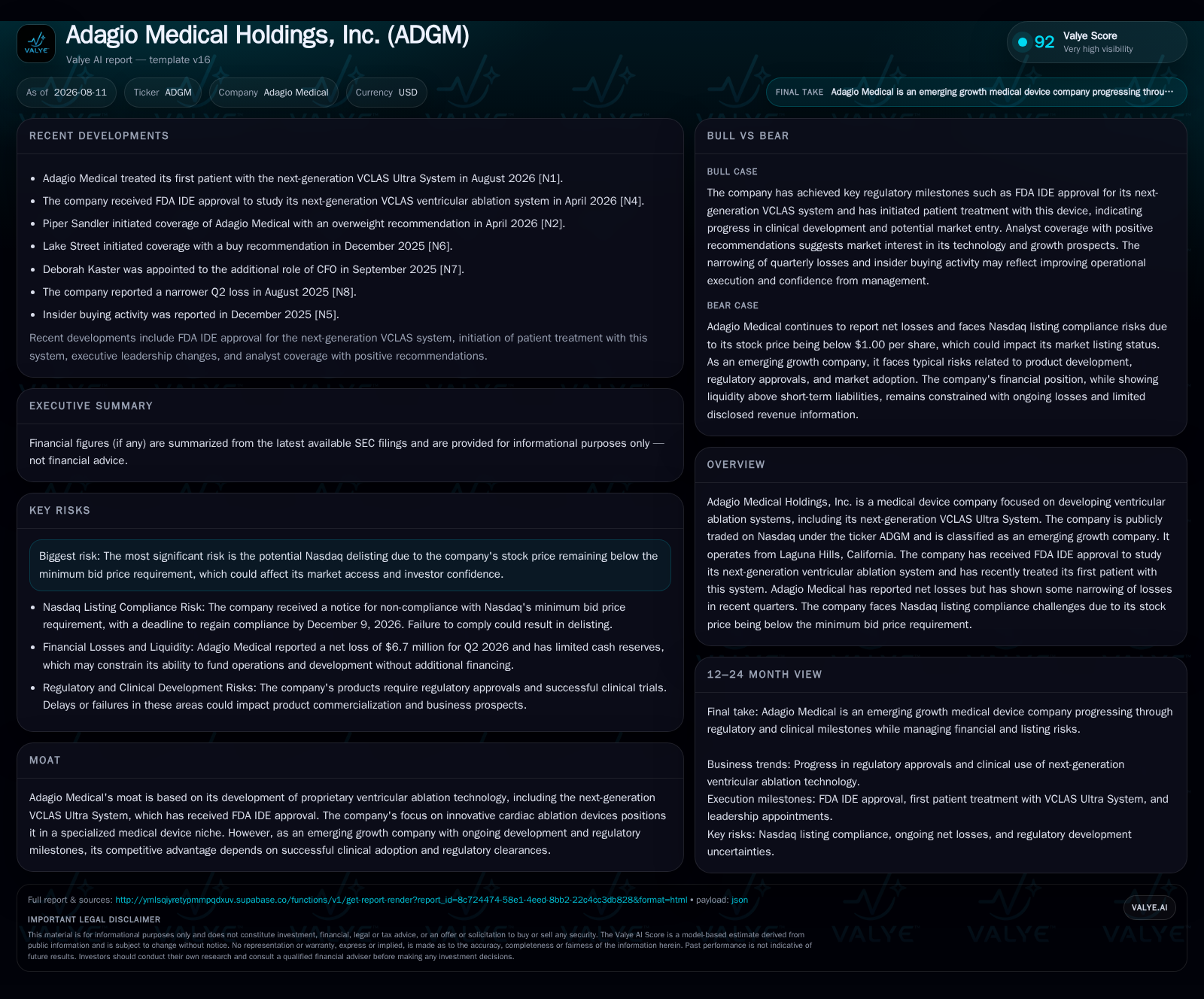
Adagio Medical Holdings, Inc. is enhancing its position in the cardiac electrophysiology medical device niche by advancing clinical testing of its next-generation ventricular ablation system, the VCLAS Ultra. The company received FDA investigational device exemption approval to conduct trials and treated its first patient with this system in 2026. Despite ongoing net losses and a tight cash runway, Adagio continues focused R&D investments but faces critical risks from Nasdaq’s minimum bid price compliance rules. The company’s commercial viability depends on successful trial enrollment, regulatory approvals, and ramping procedure adoption to build an installed base supporting recurring consumables revenue.
Recent Operating Update
Adagio Medical Holdings recently reported progress indicative of forward momentum in its core innovation efforts: FDA granted Investigational Device Exemption (IDE) approval allowing initiation of pivotal clinical trials for its next-generation VCLAS Ultra ventricular ablation system [S1], [S26]. Shortly thereafter, the company treated its first patient using this advanced energy delivery technology [N1]. This event confirms operational execution beyond regulatory permitting and is a fundamental test of both device safety and procedural efficacy essential for subsequent FDA Premarket Approval (PMA) review.
This IDE milestone represents a major near-term catalyst marking transition from developmental focus to data generation required for commercial clearance. It also aligns with industry-standard adoption pathways wherein medical device firms validate breakthrough catheter-based technologies by demonstrating arrhythmia treatment improvements over existing platforms. Notably, successful enrollment pace and positive interim findings will anchor future regulatory outcomes and underpin physician confidence — critical factors for hospital purchases reliant on evidence-based efficacy.
Business Model Overview
Adagio operates within the specialized medical device sub-sector focused on cardiac electrophysiology interventions targeting ventricular arrhythmias through catheter-based ablation. The company’s product suite concentrates on ventricular ablation systems designed to deliver controlled energy to myocardial tissue regions causing abnormal electrical signaling responsible for arrhythmias.
Revenue generation primarily involves upfront sales of proprietary ventricular ablation devices complemented by recurring sales of single-use consumable components employed during procedures. This consumables pull-through effect is vital to sustaining gross margins given that initial device sales commonly face pricing pressures typical to competitive medtech markets. Further monetization avenues potentially include service contracts or licensing arrangements tied to ongoing system support or software enhancements.
The customer base comprises hospitals equipped with electrophysiology labs and specialized cardiologists conducting arrhythmia treatment procedures. Revenue growth correlates strongly with increased procedure volumes driven by rising arrhythmia prevalence and expanded physician adoption. Pricing dynamics are influenced by reimbursement policies across diverse payor systems, meaning coverage expansion is necessary to drive sustainable uptake.
Industry Structure and Competitive Landscape
The cardiac ablation device industry is characterized by a few well-entrenched incumbents offering established technologies alongside emerging startups pursuing innovation differentiation. Leadership companies typically provide comprehensive suites covering atrial as well as ventricular arrhythmia treatment solutions widely adopted in major healthcare centers globally.
Adagio’s competitive advantage lies in its targeted development of a next-generation ventricular ablation platform incorporating proprietary energy delivery innovations intended to optimize ablation precision, safety profile, and procedural workflow efficiency. However, as an emerging growth company still undergoing pivotal clinical validation phases, commercial traction remains nascent compared to global scale peers possessing extensive installed bases.
Barriers include rigorous regulatory standards requiring multi-year clinical trials, complex reimbursement negotiations affecting hospital buy decisions, entrenched user preferences favoring incumbent products due to familiarity and training investments, plus capital-intensive salesforce deployment necessary to penetrate high-value electrophysiology accounts.
Growth Drivers
Several structural trends underpin growth potential:
- Increasing prevalence of cardiac arrhythmias globally due to aging populations boosts demand for effective treatment modalities such as catheter-based ablation.
- Rising procedural adoption supported by growing clinical evidence demonstrating improved outcomes over pharmacologic therapies encourages hospital investment into electrophysiology capabilities.
- Technological advances embedded in systems like VCLAS Ultra that aim to reduce procedural times, complications, and increase lesion durability could accelerate physician preference shifts.
- Regulatory milestones, especially anticipated PMA following ongoing IDE studies, would unlock commercial entry into key markets driving installation base expansion.
- Reimbursement landscape improvements through positive payer coverage decisions enhance financial incentives for providers adopting new devices.
- Installed base growth propels downstream recurring revenue from consumable disposables integral to each procedure performed using Adagio systems.
- Strategic partnerships or alliances with electrophysiology centers can expedite real-world utilization acceleration via targeted account engagement.
Risks and Constraints
The principal risks encompass:
- Nasdaq listing compliance risk: As disclosed by the company following a notice in June 2026, Adagio’s common stock has struggled below the $1 minimum bid price threshold required under Nasdaq Listing Rule 5550(a)(2), triggering an initial 180-day grace period ending December 9, 2026 [S28]. Failure to regain compliance risks delisting which would adversely affect liquidity, institutional investor accessibility, and valuation perceptions.
- Clinical trial uncertainties: Enrollment challenges or adverse safety or efficacy signals from IDE pivotal studies could delay PMA submissions or force design changes increasing costs and timelines.
- Reimbursement variability: Uneven insurance coverage can constrain hospital purchasing decisions limiting procedure volume ramp critical for scaling installed base.
- Competitive intensity: Well-funded incumbents may respond aggressively via pricing strategies or marketing initiatives deterring switching among electrophysiologists accustomed to legacy systems.
- Capital needs: Cash burn rates associated with ongoing R&D efforts—the latest filings indicate notable net losses—may necessitate dilutive equity raises or debt financing amid fragile investor sentiment [F1], [S2].
- Manufacturing scale/supply chain risks: Disruptions impacting availability of key catheter components or energy sources could delay delivery schedules affecting customer satisfaction.
Additionally, product liability claims inherent in novel invasive device usage pose latent legal exposures potentially impairing reputation or financial reserves if not adequately mitigated.
What to Watch Next
Key upcoming developments include:
- Pivotal clinical trial enrollment progress: Speed and completeness of patient recruitment will signal timeline credibility toward pivotal endpoints informing PMA readiness.
- Regulatory filings status updates: Submission acceptance timelines followed by FDA review benchmarks remain critical inflection points.
- Procedure volume indicators: Early post-market usage metrics once approved will provide evidence around physician adoption rates and penetration trajectory.
- Nasdaq compliance developments: Market reaction linked to stock price trajectory nearing end of current cure period December 2026 will be closely scrutinized for potential delisting risk mitigation actions including reverse stock split consideration.
- Cash runway guidance: Explicit management commentary on liquidity preservation strategies or financing plans will shape sustainability assessments amid continued operating losses.
Financial Profile Discussion
Adagio Medical’s financial snapshot as of June 30, 2026 reveals a constrained liquidity position with approximately $7.7 million cash balanced against roughly $24.8 million total debt resulting in a net debt level near $17.1 million [F1]. Current assets exceed liabilities moderately with a current ratio around 1.41 indicating some short-term solvency cushion yet limited room under standard working capital hedges [F1].
Operating losses remain substantial; reported net loss was approximately $25.1 million at year-end December 31, 2025 reflecting intensive expenditures predominantly within R&D invested toward product advancement and regulatory milestones [F1]. The absence of meaningful product revenue evidences the early-stage status where commercial scale economics have yet to materialize broadly.
The capital structure combined with external market pressures (i.e., Nasdaq bid price compliance risk) imply a pressing need for capital infusion either through equity issuance—likely dilutive—or debt refinancing with favorable terms posing execution risk amid volatile market sentiment toward small-cap medtech innovators [S2], [S28]. Managing burn rate effectively while delivering clinical milestone progress is thus essential to retain investor confidence and extend operational runway sufficiently for product commercialization efforts post-FDA approval.
Conclusion
Adagio Medical Holdings embodies many characteristics typical of emerging medtech companies striving to innovate within specialized cardiac electrophysiology niches. Its FDA IDE approval coupled with first-in-patient use of the VCLAS Ultra system marks critical inflection points advancing commercialization potential in a technologically rigorous environment demanding high safety-efficacy standards.
Nonetheless, the path remains fraught with execution challenges spanning regulatory timelines, reimbursement acceptance hurdles, competitive vigor from entrenched incumbents, financial resource limitations compounded by public-market listing risks. Achieving operational scale will depend heavily on maintaining disciplined R&D investment aligned with measurable trial progress while navigating Nasdaq compliance pressures transparently.
Close monitoring of trial enrollment data releases, FDA feedback loops on PMA filings, early customer usage patterns post-clearance, ongoing cash flow management tactics including capital raise success serve as key signposts delineating whether Adagio can translate technological promise into sustainable commercial viability within the cardiac ablation market ecosystem.
This analysis does not constitute investment advice or an investment research view. It is intended solely as an informative company and industry review based on publicly available SEC filings and news disclosures.
Disclaimer: This is research-only, informational analysis and not investment advice. It may include AI-generated interpretation and general industry context. Always verify important details using primary sources.

Comments