
908 Devices Advances Handheld Chemical Analysis with Strategic Portfolio Shift and Operational Milestones
Latest quarterly disclosures reveal 908 Devices’ sharpened focus on handheld chemical analysis platforms backed by portfolio realignment and evolving revenue recognition.
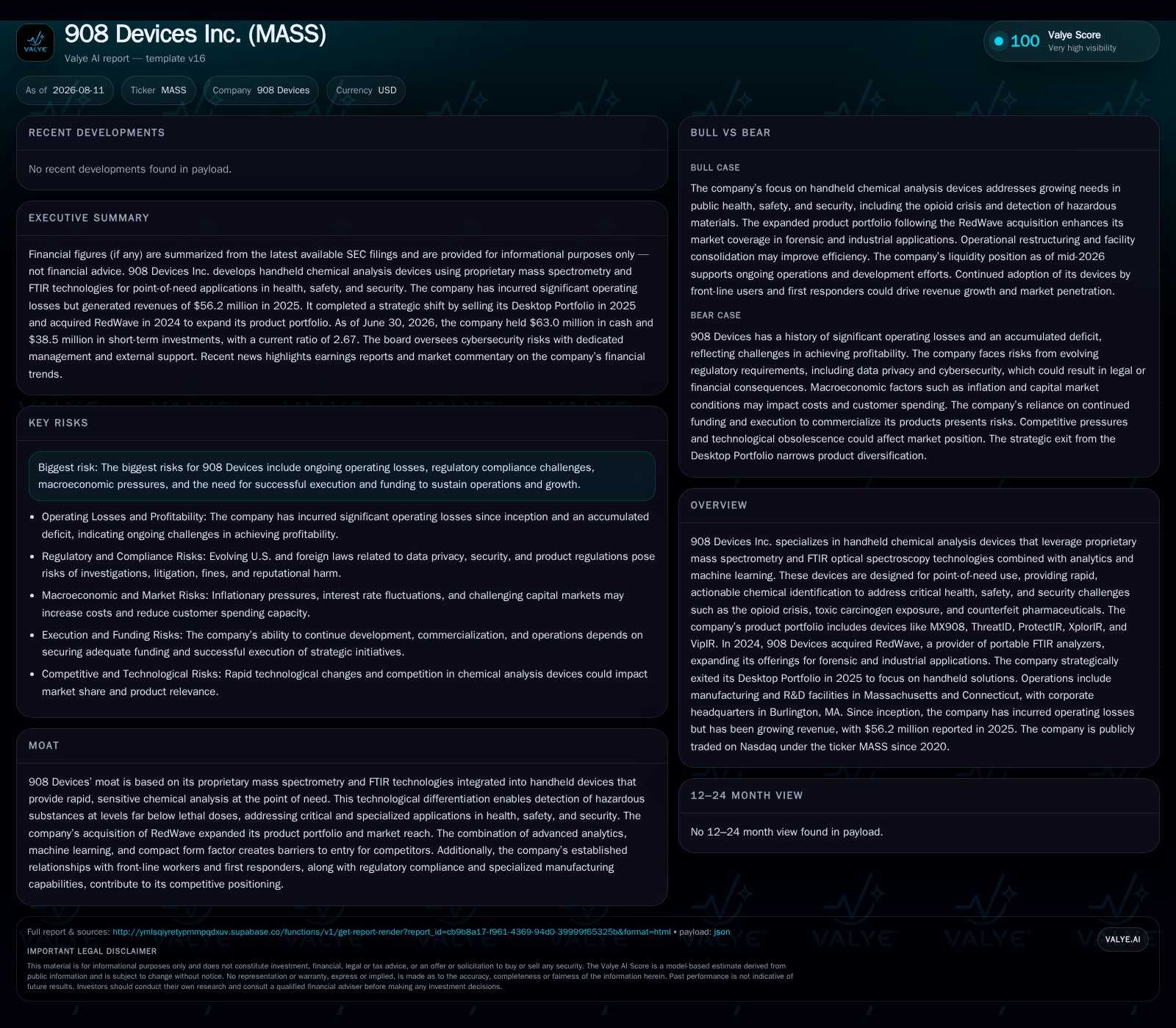
In its August 2026 10-Q filing, 908 Devices highlighted significant operational changes including the divestiture of non-core leased facilities and enhanced focus on handheld mass spectrometry and FTIR devices. The company derives revenue primarily through sales of these portable analyzers alongside consumables and software licenses, aiming to build recurring revenue streams critical for commercial scaling. Against a backdrop of ongoing operating losses, 908 Devices leverages proprietary technology integrations and machine learning to address specialized markets such as forensic labs and first responders. Key growth drivers include consumables attach rates and software adoption within its installed base, while risks remain around regulatory compliance, market adoption, and execution. The company’s current liquidity position supports near-term operations but underscores the importance of scaling recurring revenues moving forward.
Latest Quarterly Shift Reflects Strategic Focus on Handheld Solutions
In its most recent quarterly filing dated August 11, 2026, 908 Devices executed a Lease Assignment Assumption and Consent Agreement transferring rights and liabilities related to real property leases for its North Carolina facility to Repligen. This transaction also encompassed lease obligations tied to its German subsidiary's facility as part of the earlier sale of that unit [S2]. These moves signal an active retraction from non-core asset holdings consistent with the company's previously disclosed strategic emphasis on consolidating operations around its handheld chemical analyzer platforms headquartered in Massachusetts and Connecticut [S1].
The refinement in physical footprint corresponds with an evolved revenue recognition approach that treats contracts as multi-element arrangements allocating consideration upfront based on expected deliverables—spanning devices, consumables, accessories, software, and services. Revenue is acknowledged upon transfer of control of each component to customers under this framework [S2]. Such accounting reflects the complex nature of bundled analytical instrument offerings where consumables and software are integral to device functionality.
Reinventing Chemical Identification: Business Model Centered on Portability and Analytics
908 Devices' business model pivots around cutting-edge handheld analyzers that integrate proprietary mass spectrometry with Fourier transform infrared (FTIR) spectroscopy technologies augmented by advanced machine learning analytics. This combination targets rapid point-of-need chemical identification critical in domains confronting urgent health crises such as opioid detection, toxic carcinogen exposure assessments, counterfeit pharmaceutical screening, forensic investigations, and public safety interventions [S1].
Revenue generation arises firstly from direct sales of these compact devices designed for ease of deployment outside traditional laboratory settings [S1]. Notably, in 2024 the acquisition of RedWave complemented their portfolio by adding portable FTIR analyzers tailored for law enforcement and industrial use cases. Concurrently, management strategically exited desktop analyzer solutions in 2025 to sharpen focus exclusively on mobile technologies that better meet emergent field requirements
Crucially, the economics shift beyond one-time device sales toward establishing recurring revenue streams via consumable products—such as calibration materials or reagents—and software licenses for data processing and analytics platforms embedded within customer workflows. These recurring components provide predictable revenue complementing upfront device expenditures while increasing switching costs due to integration into customer operations [S1]. This blended monetization approach is indispensable given typical customer segments include forensic labs needing compliance-grade toxicology screening or first responders demanding rapid threat identification under field conditions.
Positioning Within Analytical Instruments: Competition, Technology, and Barriers to Entry
Within the broader analytical instruments industry—where firms like Agilent Technologies and Thermo Fisher Scientific dominate benchtop mass spectrometry—the niche for handheld integrated mass spectrometry/FTIR instruments remains narrowly contested due to substantial technical complexity and regulatory scrutiny [S1].
908 Devices’ competitive moat is anchored by its technology stack merging hardware miniaturization with sophisticated analytics software harnessing machine learning algorithms to enhance sensitivity, specificity, and speed of field chemical identifications. This hardware-software synergy raises switching barriers since alternative solutions often lack portability or require larger infrastructure investment [S1]. Additionally, stringent regulatory compliance regimes applicable to health, safety, security sectors further raise entry hurdles.
This positioning aligns well against peers like Bruker Corporation who target specialized spectroscopy solutions but often focus on larger-scale instruments. 908 Devices’ deliberate portfolio pruning away from desktop systems signals a commitment to deepening specialization rather than competing broadly with incumbents offering diverse analytical lines.
Growth Opportunities Anchored in Consumables Attach Rates and Software Adoption
A central lever underpinning scalable growth involves expanding recurrent consumption behaviors tied to an installed base of handheld analyzers. As customers deploy more devices across forensic or public safety units, proportional increases in consumables consumption become a durable revenue foundation given periodic recalibration needs or reagent replenishment. Closely related is boosting software license uptake which binds users deeper into proprietary analytic ecosystems.
Quarterly disclosures articulate that transaction prices are allocated at contract inception across multiple performance obligations including these recurring elements [S2]. While specific KPIs like exact device counts or attach rates were not quantified in recent filings, established industry dynamics underscore that improving consumable attach rate per device correlates strongly with margin enhancement due to higher gross profit contributions from reagents relative to hardware [S1]. Moreover, accelerating licensed analytics platform adoption translates into stickier customer relationships paired with less price elasticity.
Strategically integrating machine learning-based analytics differentiates product offerings by enabling faster time-to-result with enhanced chemical identification accuracy—critical parameters in end markets where minutes can impact health or security outcomes. This technology-driven differentiation enhances customer retention prospects amid competitive pressures.
Risks from Execution Challenges, Regulatory Hurdles, and Market Adoption Dynamics
Despite promising technology positioning, several risks temper near-term prospects. As detailed in the March 2026 annual risk disclosures, persistent operating losses underscore funding demands required to achieve commercial scale [S1]. Success hinges on continued access to capital coinciding with progressive ramping of recurring revenue streams offsetting upfront R&D investments.
Regulatory compliance remains a perpetual challenge especially given evolving U.S. and international requirements concerning medical device standards or chemical testing accuracy mandates. The company acknowledges potential revenue impacts arising from delays or failures in securing key approvals [S1]. Additionally, market adoption curves for handheld mass spectrometry involve educating end users accustomed to lab-based workflows; thus penetration speed could lag initial expectations.
Externally imposed macroeconomic headwinds affecting capital budgets among government entities or industrial users represent further demand-side restraints. Competition from conventional instrument suppliers expanding into portable solutions may intensify pricing pressure over time.
Key Milestones Ahead: Contract Timing, Product Rollouts, and Revenue Recognition Effects
Looking forward over upcoming quarters following the August filings, monitoring contract backlog fulfillment patterns will be important since transaction price allocation policies affect revenue timing significantly [S2]. Observers should watch for incremental disclosure on product launches particularly enhancements leveraging machine learning capabilities which may influence unit sales velocity.
Moreover, any commentary regarding trends in consumable sell-through metrics would serve as leading indicators for recurring revenue stabilization—a key threshold towards profitability scalability [S3]. Given continued leanings into point-of-need testing devices targeting first responders or forensic customers under heightened health-security protocols globally, sustained order intake from these verticals will be vital metrics for gauging progress.
Financial Profile Discussion: Maintaining Liquidity Amid Operating Losses
As of June 30, 2026 balance-sheet data indicate robust liquidity with cash & equivalents totaling approximately $63 million against current liabilities near $49 million yielding a current ratio around 2.67—a cushion supporting ongoing operations even amid reported negative net income trends [F1][S2]. This buffer was bolstered by divestitures transferring leasing obligations off company books consistent with strategic rationalization [S2].
Nonetheless operating results reflect ongoing net losses driven by elevated research & development expenses necessary for continued innovation plus costs related to scaling handset manufacturing capacity [F1]. The ability to convert device shipments combined with rising consumable attach rates into positive cash flows remains pivotal. Capital discipline alongside successful market penetration will influence adjustments in R&D intensity going forward.
Maintaining favorable working capital dynamics while managing supply chain complexities inherent in advanced analytical instrument manufacturing is essential given peer experiences within broader analytical instrumentation sectors frequently highlight protracted product development cycles impacting near-term margins.
This analysis integrates publicly filed quarterly updates alongside established industry context without providing investment advice or forecasts. Readers should interpret operational developments within the framework of typical market adoption challenges facing innovative handheld analytical instrumentation companies like 908 Devices Inc.
Disclaimer: This is research-only, informational analysis and not investment advice. It may include AI-generated interpretation and general industry context. Always verify important details using primary sources.

Comments