
Barnwell Industries Refocuses Upstream Operations Amid Revenue Pressures and Governance Challenges
Barnwell Industries continues restructuring upstream oil and gas assets, emphasizing drilling program progress and liquidity optimization while navigating governance disputes.
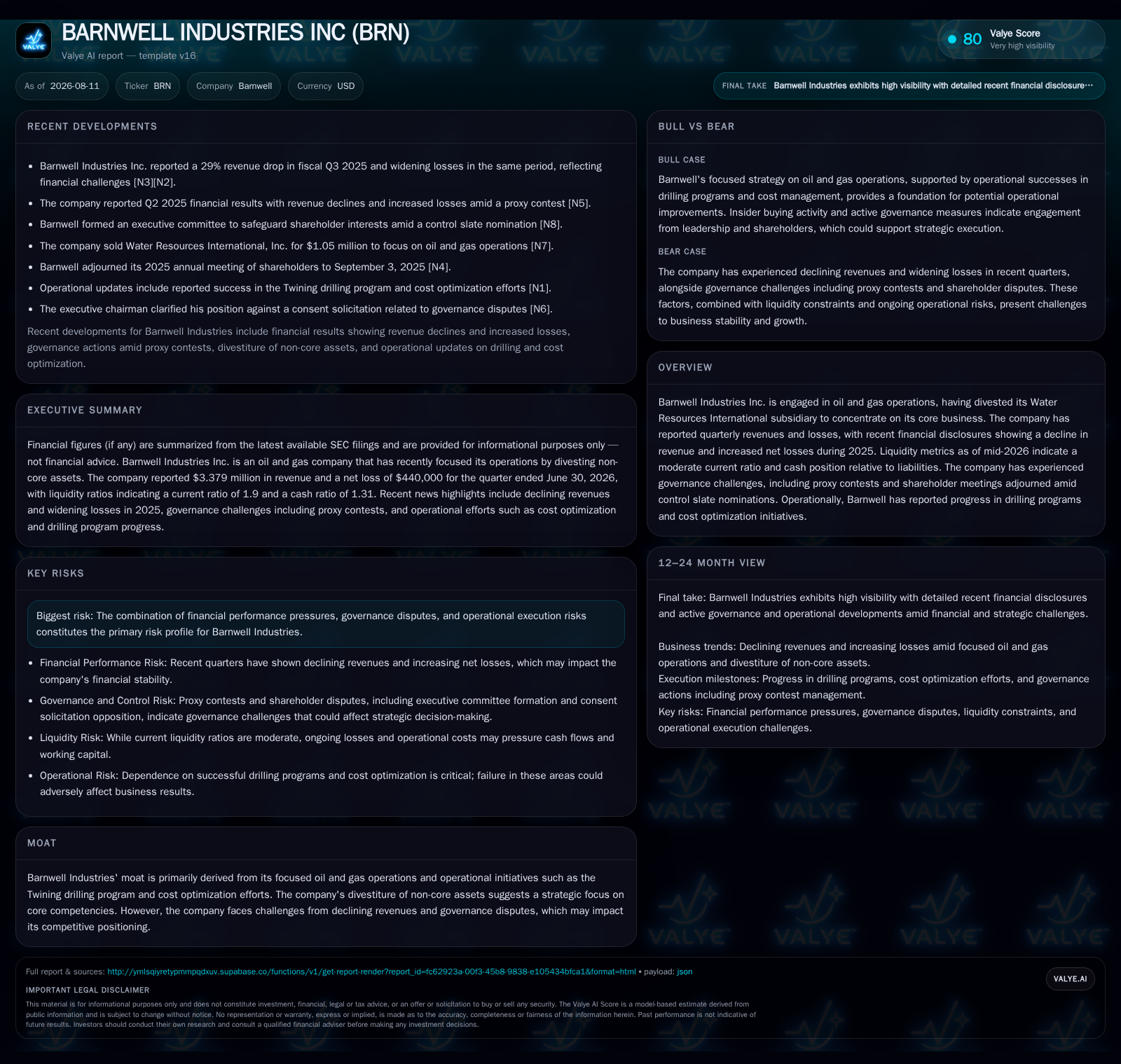
Barnwell Industries Inc. has recently advanced the divestiture of non-core real estate interests to sharpen focus on its core upstream oil and gas operations, as evidenced by a July 2026 purchase agreement targeting remaining Hawai’i real estate interests [S3][S26]. The company faces ongoing revenue declines and elevated net losses, alongside shareholder governance contests that threaten strategic execution stability. Operational updates highlight drilling program developments and cost optimization initiatives aimed at bolstering reserve replacement and margin recovery. Despite liquidity metrics reflecting moderate financial flexibility, continuity challenges persist due to volatile commodity prices and exposure to governance disruptions.
Recent Operating Update
This strategic divestiture marks a sharper focus on core upstream operations concentrated on hydrocarbon production and exploration. Meanwhile, reported revenues have declined to approximately $13.7 million as of September 30, 2025, reflecting softness in commodity markets or volume contractions relative to prior periods [F1]. Net losses widened sharply to $7.1 million over the same period during elevated operating expenses and corporate overhead burdens.
Governance issues surfaced prominently as proxy contests and adjourned shareholder meetings disrupted stable board oversight during the recent year [S1]. Such corporate governance uncertainty introduces execution risk for Barnwell’s restructuring efforts.
Business Model Analysis
Barnwell operates primarily in the upstream oil & gas sector through exploration, development, production of crude oil, natural gas, and NGLs. Monetization is chiefly through sales of these hydrocarbons to refiners or commodity traders under spot or contractual arrangements typical for small-scale producers.
Revenue is sensitive to production volumes (bopd equivalency), realized commodity prices (crude oil benchmarks or gas indices), contract structures (spot pricing versus hedging strategy), plus cost inputs including lifting costs per barrel and maintenance capex.
The company’s recent divestment of non-core assets indicates strategic prioritization of efficient upstream operations over diversified holdings in land or water services niche segments. This focus could enhance margin sustainability if operational execution improves drilling success rates and reserve replacement ratios — essential KPIs for proving long-term viability in this capital-intensive industry.
Capital expenditures have sharply diminished compared with prior periods ($28K in Q4 2025 versus $2.5 million the previous year), signaling either reduced drilling activity or postponement of development projects pending closer liquidity control [S20]. While managing operating expenses remains critical given reported cost pressures ($2.07 million O&G segment expenses in Q4 2025), degradation in depletion/amortization expense from reduced capital additions may signal some reserve aging.
Industry Structure and Competitive Position
Barnwell sits within the broader upstream oil & gas value chain as a smaller-scale producer primarily focused in North America (notably Canada) after winding down Hawaii holdings [S19]. Compared with majors like ConocoPhillips or Devon Energy—large-cap competitors with extensive portfolio diversification—Barnwell's scale limits economies of scale benefits and exposes it more acutely to commodity price swings.
Its operating cost structure likely commands closer monitoring than peers; cost optimization initiatives will be critical given narrow operating income margins (reported near break-even or mildly negative before G&A) [F1][S20]. Additionally, asset retirement obligations totaling roughly $7.4 million represent non-trivial legacy environmental liabilities that affect free cash flow availability for growth investments.
Sector-wide challenges such as regulatory compliance costs and geopolitical risks are compounded here by corporate governance strife which can delay decision-making or capital deployment.
Growth Drivers
Potential growth catalysts for Barnwell hinge predominantly on successful exploration results within ongoing drilling programs like Twining, which if effective could replenish reserves extending productive life and improving yield efficiencies.
Cost optimization initiatives aimed at reducing lifting costs per barrel—through technological upgrades or operational streamlining—could improve margins despite volatile commodity price environments.
Additional uplift could stem from completion of planned asset sales freeing up capital or reducing administrative overhead associated with non-core holdings [S3]. The refocused asset base might facilitate more targeted reinvestment strategies enhancing production volumes.
Broader sector tailwinds include sustained global oil & gas demand underpinning pricing power; however, volatility remains a constraint.
Risks and Watchpoints
The most immediate risks confronting Barnwell intertwine financial performance pressure from persistent losses with governance disruption that may inhibit timely execution of strategic plans or capital raises [S1].
Commodity price volatility remains an inherent threat impacting revenues directly—small producers often lack sophisticated hedging programs that larger peers deploy aggressively.
Operational risks around drilling failure rates or production interruptions could exacerbate negative financial trends given low margin buffers.
Asset retirement obligations necessitate robust future cash flow generation; failure here can impose unexpected liabilities impairing financial stability.
Moreover, the pending real estate transaction closing faces customary conditions precedent which introduces timing uncertainty affecting liquidity planning [S3][S26]. Lastly, adverse regulatory changes or increased compliance costs remain possible external shocks.
What to Watch Next
Key milestones include the imminent closing of the Hawai’i-related real estate asset sale expected by mid-September 2026 according to recent disclosures [S3][S26], which will help crystallize company focus but also test closure risk management.
Monitoring quarterly revenue trends post-divestiture will reveal whether strategic narrowing enhances upstream performance metrics such as production volumes or cost efficiencies.
Progress updates on the Twining drilling program and other exploration/development projects will be important leading indicators of reserve replacement success.
Shareholder activism resolution outcomes bear watching since board stability critically underpins confidence in longer-term execution plans.
Guidance on capital expenditure levels beyond current modest spending will indicate whether Barnwell is positioning for sustainable growth or maintaining conservative cash flow preservation stance.
Financial Profile Discussion
As of June 30, 2026, Barnwell maintained approximately $4.47 million in cash and equivalents versus about $3.42 million in current liabilities yielding a current ratio near 1.9 — suggesting reasonable short-term liquidity coverage though limited surplus cushion for aggressive expansion [F1]
Total debt approximates $3.44 million based on best-effort data points but net debt is negative when factoring current cash balances (-$1.03 million), highlighting manageable leverage at present [F1]
Operating income remained thin at roughly $30 thousand as of September 2025 with net income significantly negative ($-7.1 million), reflecting structural profitability challenges largely tied to revenue declines coupled with elevated general & administrative expenses exceeding $1.6 million per quarter [F1][S20]
Capital expenditures have contracted sharply compared with prior years’ levels indicative either of deliberate spending discipline amid uncertain market conditions or deferment of potentially productive investments jeopardizing reserve replacement rate over time [S20].
Asset retirement obligations remain sizable at above $7 million requiring ongoing accruals reflecting environmental remediation commitments that will continue burdening cash flow allocations over forecast horizons [S19][S6]
Overall financial posture suggests adequate near-term operational backing but highlights need for improved profitability and stable governance environment to enable value-enhancing deployment of capital amid challenging upstream market dynamics.
Disclaimer: This analysis is based solely on public SEC filings dated through August 11, 2026. It incorporates supported company-specific data blended with industry-standard frameworks without providing investment advice or forecasts.
Disclaimer: This is research-only, informational analysis and not investment advice. It may include AI-generated interpretation and general industry context. Always verify important details using primary sources.

Comments