
Arteris Advances NoC IP Leadership Amid Expansion in SoC Integration Software and Persistent Profitability Challenges
The company’s latest quarter reveals strong revenue execution and strategic leadership changes, underscoring the complexity of sustaining growth in semiconductor IP licensing and integration software.
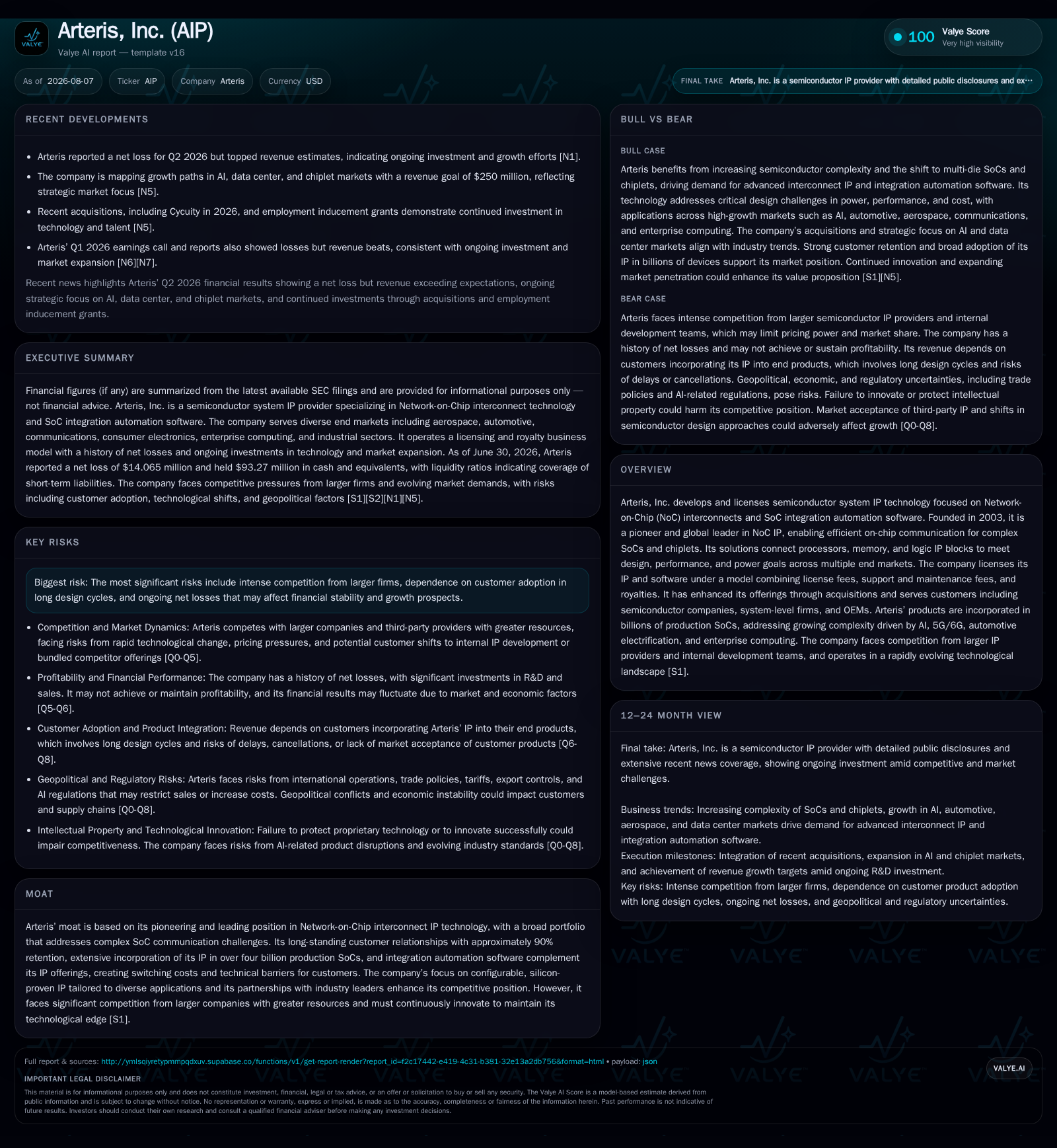
Arteris, Inc. reported Q2 2026 results that beat revenue expectations despite continuing operating losses, reflecting ongoing investments in Network-on-Chip (NoC) interconnect IP and System-on-Chip (SoC) integration automation software. The firm faces a competitive landscape dominated by larger peers with deeper resources while navigating prolonged design cycles, geopolitical risks, and evolving end-market demands in automotive, AI, and communications. Strategic acquisitions have broadened Arteris’ product offering into chip-level security verification, supporting growth in complex SoC environments. A recent CFO transition adds leadership dynamics as the company balances innovation with path-to-profitability challenges.
Recent Operating Update
In its latest 10-Q filing for Q2 ended June 30, 2026, Arteris delivered revenue above consensus estimates despite continued net losses typical of semiconductor IP licensors pursuing market expansion through R&D investments [S2], [N1]. The company's financial results reflect the prolonged nature of design wins translating into royalty streams only after chips reach mass production—a structural feature of the business model prevalent across semiconductor IP firms.
Concurrent with earnings disclosure, Arteris announced a leadership change appointing Saurabh Sinha as CFO effective September 8, 2026 [S3]. This transition is occurring against the backdrop of an aggressive strategic push including integrating recent acquisitions like Cycuity to enhance security capabilities within its SoC integration automation portfolio
Business Model Analysis
Arteris operates primarily as a technology licensor specializing in Network-on-Chip (NoC) interconnect intellectual property (IP) crucial for efficient on-chip data communication within System-on-Chip designs. Its offerings extend into SoC integration automation software which streamlines customers' configuration processes for these interconnects and overall SoC assembly.
Revenue is generated through a hybrid licensing model combining upfront license fees that are recognized relatively early in the product cycle; recurring support and maintenance fees; and royalties that scale with semiconductor production volumes embedding their IP [S1]. This model aligns incentives where early-stage sales funnel investments lead to longer-term royalty income contingent on end-customer chip success
The need for configurable, silicon-proven IP customized for diverse architectures—ranging from Arm to RISC-V—is critical given increasing SoC complexity involving multiple heterogeneous processors, memory blocks, I/O subsystems, and now chiplets. Arteris leverages decades of NoC expertise to serve fabless semiconductor designers as well as systems companies and OEMs who increasingly outsource these crucial integration elements rather than developing them in-house due to escalating cost and complexity barriers.
The company's recent acquisitions—Magillem (2020), Semifore (2022), and notably Cycuity (2026)—have expanded its technological scope into security verification alongside interconnects [S1]. This broadens total addressable market opportunities since cybersecurity vulnerabilities at the hardware level have become paramount concerns for automotive ADAS systems, aerospace defense applications, and secure enterprise computing platforms
Industry Structure & Competitive Position
Arteris resides upstream in the semiconductor design value chain supplying reusable IP blocks embedded within customer SoCs rather than fabricating physical devices. The sector is characterized by high barriers to entry including extensive R&D intensity due to rapid technology evolution around chip-scale integration protocols (e.g., UCIe), rigorous silicon validation requirements to ensure reliability under diverse conditions, and long multi-year design cycles leading up to mass chip production.
Key competitors include large scale third-party IP providers such as Arm Holdings (renowned for processor cores but also expanding interconnect offerings), Cadence Design Systems, and Synopsys which together provide vertically integrated suites blending Electronic Design Automation (EDA) software with broad IP portfolios. Moreover, integrated device manufacturers increasingly develop proprietary internal IP solutions posing entrenched competition especially when well-funded.
Arteris’ moat stems from pioneering NoC IP technology since 2003 combined with strong customer relationships reflected in approximately 90% retention rates and over four billion production chips incorporating its IP worldwide—metrics signaling durable trust albeit in a fiercely competitive landscape requiring perpetual innovation [S1]
Competitive pressures manifest not only on price but also on pace-of-innovation demands ensuring compatibility across evolving ecosystems of chiplets, standards compliance (like BoW or XSR protocols), power-performance optimizations specific to application domains such as automotive or AI inference chips.
Growth Drivers
Fundamental structural demand stems from rising SoC sophistication which amplifies communication bottlenecks internally at scale sizes beyond conventional bus/crossbar topologies. As AI workloads proliferate across edge-to-cloud devices demanding heterogeneous compute elements at low latency/power budgets—and as automotive applications surge toward fully autonomous capabilities requiring robust sensor fusion processing—the role of configurable high-performance NoCs coupled with streamlined integration software grows substantially.
The recent Cycuity acquisition targets semiconductor security at the hardware level—a nascent but rapidly growing imperative given risks around data privacy breaches or malicious hardware exploits that could compromise entire systems post-deployment.
Additional growth catalysts include expanding usage of chiplet architectures using advanced packaging technologies where seamless on-die or multi-die interconnects are critical; regulatory mandates especially in automotive/aerospace for safety certification standards enforcing stringent reliability; partnerships with global industry leaders enhancing go-to-market reach; plus geographic diversification tied to higher penetration outside the U.S., notwithstanding geopolitical risks affecting China-related revenues currently composing about one-quarter of sales but expected to contract due to U.S. export restrictions [S16], [S21].
Risks & Watchpoints
Despite its technology leadership niche, Arteris confronts significant execution risk inherent in its sector: intensely competitive environment with rivals often wielding deeper financial resources; reliance on extended design win cycles where delays or reduced end-product acceptance can materially defer royalty inflows; ongoing erosion pressure on average selling prices common across semiconductor IP markets as customers seek cost efficiencies;
Regulatory complexities especially surrounding export controls exacerbate uncertainty given substantial revenue exposure to Chinese customers impacted by U.S. government restrictions potentially limiting market access or increasing compliance overheads.
Financially consequential risks persist including a consistent history of net losses driven by high R&D expenses essential for maintaining technological advantage yet posing sustainability challenges absent accelerated commercial traction. Intellectual property litigation risks remain due to complex overlap domains within semiconductor innovations potentially involving multiple parties.
Leadership changes such as the CFO transition introduce short-term managerial discontinuities though may also bring fresh financial discipline aligned with scaling ambitions [S2], [S3], [S19].
What To Watch Next
Near-term indicators worth monitoring include sequential quarterly updates on license fee growth signaling new design wins; early signals from royalty revenues reflecting downstream production ramp-ups; support contract renewal trends pointing to sustained customer satisfaction;
Progress integrating Cycuity’s security verification tools will be pivotal for expanding total addressable market relevance amidst increasing cybersecurity demands.
Any commentary on China revenue trajectory amid shifting geopolitical currents remains material given its current sizable contribution.
Capital allocation decisions around further acquisitions or partnerships will reveal management’s approach balancing inorganic growth versus internal product development efforts.
Finally, any shifts in gross margin profiles or guidance revisions would shed light on pricing environment dynamics relative to competitors.
Financial Profile Discussion
As of Q2 2026 ended June 30, Arteris held roughly $93 million in cash and equivalents against current liabilities of about $93 million providing a healthy liquidity cushion reflected by a current ratio near 1.57 [F1]. This liquidity supports ongoing investment into R&D while enabling absorption of acquisition-related expenses without immediate external capital raises.
Operating losses persist consistent with prior periods (operating income was negative around $33 million at FY end December 31, 2025), highlighting that path to profitability remains contingent on unlocking higher royalty streams over time from existing design wins converting into volume production plus sustained new business generation [F1]
Given industry norms of significant upfront expense before stable royalties mature due to multi-year chip development cycles combined with competitive reinvestment imperatives, this profile is typical for mid-size specialized semiconductor IP players striving toward scale.
In summary, Arteris currently balances robust technology portfolio expansion through organic innovation and acquisitions with measured financial discipline anchored by solid liquidity—but faces critical operational execution hurdles inherent within an evolving competitive semiconductor IP ecosystem.
Disclaimer: This is research-only, informational analysis and not investment advice. It may include AI-generated interpretation and general industry context. Always verify important details using primary sources.

Comments