
Ouster Advances Physical AI Platform with Scalable Digital Lidar Amid Profitability Challenges
Ouster's 2026 Q2 results highlight growth in digital lidar deployments across industrial, automotive, robotics, and infrastructure sectors alongside ongoing investment to scale manufacturing and software capabilities.
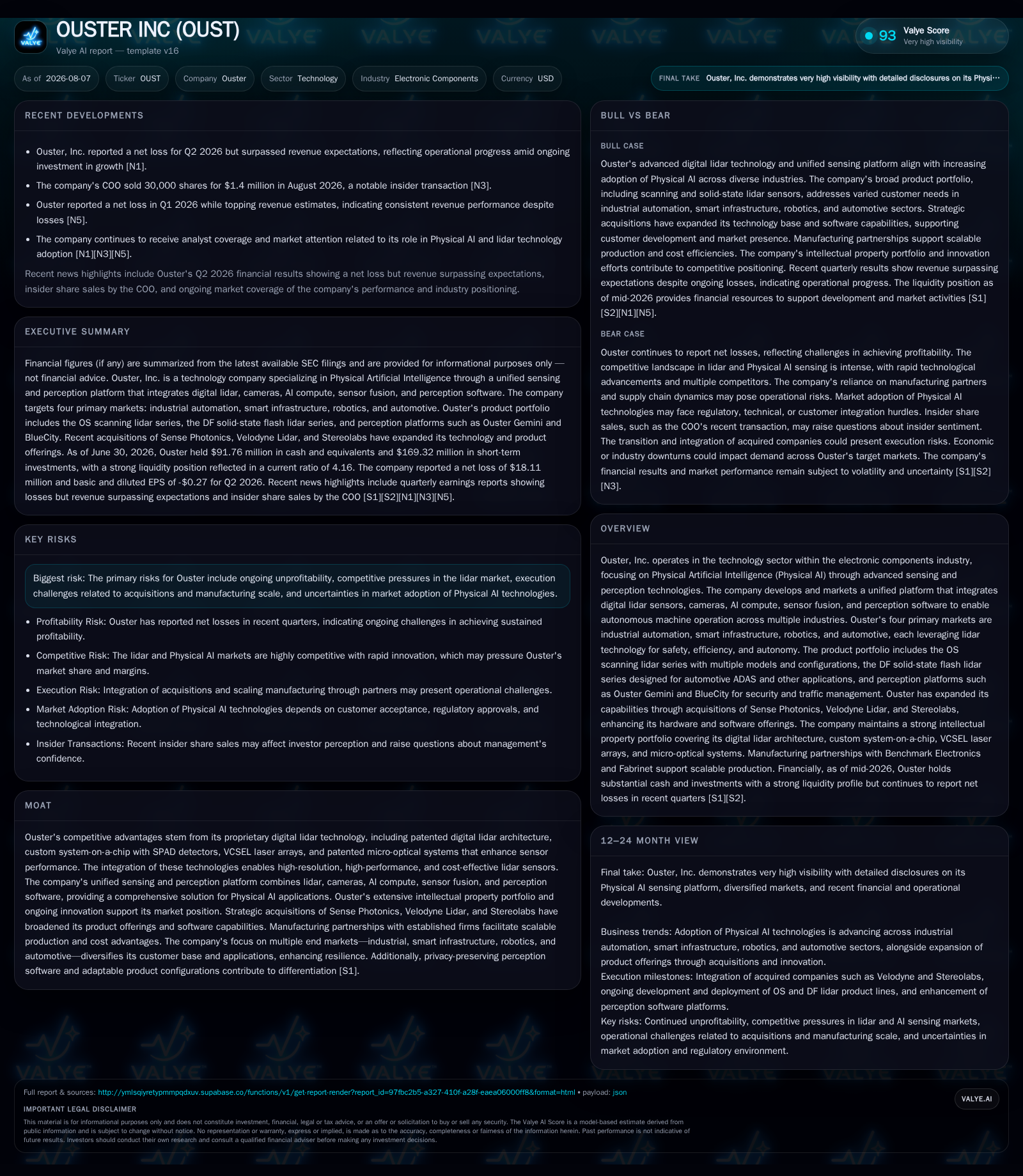
In its latest quarterly filing ending June 30, 2026, Ouster, Inc. reinforced its position as a Physical Artificial Intelligence (Physical AI) innovator through incremental product enhancements and a broadening market footprint. While revenue growth continues, the company remains unprofitable as it invests heavily in R&D, manufacturing scale-up, and commercial execution. Its unified sensing and perception platform combining digital lidar hardware with AI compute and perception software underpins competitive differentiation but also requires continued capital deployment to support expanding customer adoption and OEM integration cycles. Key risks include sustained losses, supply chain dependencies, competitor dynamics, and evolving regulatory landscapes for AI technologies. Monitoring sensor unit shipments, sales pipeline progression, and time-to-market for next-generation sensors will be critical to gauge Ouster’s transition toward profitability.
Recent Operating Update: Revenue Growth during Losses
Business Model: Integrated Hardware-Software Platform Driving Physical AI
Ouster generates revenue primarily through the design, manufacturing, and sale of advanced lidar sensing products alongside integrated perception platforms combining hardware sensors with AI compute modules and perception software stacks capable of sensor fusion [S1][S9]. Customers span original equipment manufacturers (OEMs), Tier 1 suppliers in automotive ADAS markets, industrial equipment vendors employing automation technologies, robotics firms deploying autonomous systems, and smart infrastructure operators seeking improved safety and operational efficiency
The core hardware offerings include:
- OS Product Line: A suite of scanning digital lidar sensors powered by proprietary silicon CMOS system-on-a-chip architectures producing high-resolution spatial data across varying fields of view and ranges. The recently launched REV7 generation doubles detection range while improving accuracy without significantly raising costs or altering form factors [S1][S16].
- DF Series: Solid-state flash lidar sensors designed for automotive ADAS use cases meeting stringent performance and reliability standards. These modular sensors provide flexible configurations tailored for vehicle OEM integration where full 360° coverage may not be necessary [S1].
The business model extends beyond hardware into recurring revenue analogues via bundled perception software platforms (e.g., Ouster Gemini) that reduce development complexity for customers lacking deep engineering resources. Software adoption is both additive to sensor sales volume and strategically important for creating long-term switching costs through ecosystem lock-in [S9]. This unified platform approach is a differentiator relative to peers focused solely on hardware or standalone software.
Sales mechanics combine direct enterprise engagements—particularly with larger OEMs involved in pilot-to-production project lifecycles—and indirect distribution channels which were expanded following the Velodyne acquisition enabling broader geographic reach especially in Asia-Pacific regions [S25]. These relationships require long integration cycles often spanning multiple years before large production orders materialize.
Industry Structure and Competitive Position
Operating within the electronic components industry segment focused on Physical AI-enabled sensing solutions places Ouster among relatively few pure-play lidar hardware/software specialists pursuing cross-industry autonomy applications. This market is capital-intensive with rapid innovation driven by semiconductor advances (e.g., VCSEL laser arrays and SPAD detector chips), software algorithms for perception accuracy, and cost-effective scalable manufacturing.
Ouster’s moat lies notably in its proprietary digital lidar architecture representing a patent-protected blend of micro-optics combined with custom SoCs optimizing resolution-per-cost efficiency—a technical hallmark underpinning lower field failure rates typical in rugged environments compared to competitors relying on traditional analog or MEMS-based approaches [S1][S24]. Strategic acquisitions such as Sense Photonics (before Velodyne) and most recently camera vision firm Stereolabs have expanded product breadth from pure lidar devices into fully integrated sensing platforms—reflecting industry consolidation trends aimed at building end-to-end Physical AI suites rather than component sales only [S9][S16].
Competitors include Velodyne Lidar (now part of Ouster), Luminar Technologies specializing in automotive-grade lidar solutions focused on long-range autonomous driving requirements, Quanergy offering solid-state sensors targeting cost-sensitive applications, and Innoviz Technologies emphasizing perception software layers. Ouster’s dual focus on developing both high-performance customizable hardware coupled with advanced AI compute capability places it competitively but also demands ongoing substantial investment to maintain technology leadership.
Growth Drivers: Expanding Application Footprint Across Four Markets
Key underlying demand drivers are rooted in accelerating adoption of autonomy-enhancing technologies:
- Automotive ADAS: Regulatory mandates worldwide requiring advanced driver-assistance features support projected volume growth in solid-state lidar sensors designed for OEM integration. Ouster’s DF series aims to capture these opportunities leveraging reliability certifications demanded by auto manufacturers [S18].
- Industrial Automation & Robotics: Increasing operational automation in warehouses, ports, mines, agriculture farms leverages Ouster’s rugged scanning lidars providing safety monitoring and efficient autonomous vehicle guidance within complex physical environments [S1].
- Smart Infrastructure: Growing smart city initiatives enhance road safety through traffic management systems employing lidar-based spatial tracking augmenting legacy CCTV surveillance. Security system integrators deploying intrusion detection also represent meaningful new customer segments adopting Ouster’s spatial perception platforms [S1].
- Software Perception Expansion: Software solutions like Gemini foster conversion of raw spatial data into actionable insights reducing customer engineering burden thereby catalyzing broader adoption beyond traditional lidar users. Stereolabs’ camera vision addition further enriches multi-modal sensor fusion capabilities unlocking new use cases such as humanoid robotics or visual inspection tasks previously difficult to scale commercially [S9][S16].
Continued sensor shipments growth combined with higher software platform utilization will be crucial KPIs evidencing sustainable scaling.
Risks and Growth Constraints
Ouster operates amidst tight technological competition where rivals vie aggressively on price-performance trade-offs driven by chip advancements yet face slow customer adoption cycles necessitating pilot validation before volume contracts [F1][S1]. This elongates revenue visibility horizons increasing working capital needs during upfront heavy R&D investment phases—a pattern reflected in consistent multi-year net losses despite revenue traction.
Supply chain dependencies pose risks especially since complex components like VCSEL arrays or SoCs require specialized fabrication capacity potentially impacted by geopolitical tensions or raw material shortages [S18]. Contract manufacturing partnerships mitigate but do not eliminate these vulnerabilities.
Failure to obtain or sustain key safety certifications needed for automotive OEM acceptance can delay production launches; similarly changes in regulatory regimes governing AI usage or electronic product radiation could impose compliance costs or constrain product deployment scope [S11][S21][S22]. Legal proceedings inherent in patent-heavy industries also carry potential cost impacts.
Execution risks exist around integrating recent acquisitions effectively without diluting management focus or incurring goodwill impairments adversely affecting financials. Cost discipline balancing accelerated commercial hiring alongside production scale-up will influence path-to-profitability timelines.
What to Watch Next
Key milestones tied to validating Ouster’s strategic trajectory include:
- Sequential increases in sensor unit shipments evidencing successful customer migration from pilot projects to mass production.
- Stabilization or improvement of average selling prices (ASP) per sensor signals competitive pricing power amid industry commoditization risks.
- Adoption rates of bundled perception software offerings reflecting expanding platform ecosystem value beyond hardware sales.
- Manufacturing yield improvements demonstrating operational scalability at Benchmark/Fabrinet facilities offsetting cost pressures.
- New major OEM design wins particularly within the automotive ADAS segment applying DF series sensors critical for future sales conversion forecasts.
- Quarterly cash burn rate trends relative to liquidity reserves indicating runway sufficiency amid planned R&D expenditure levels.
Financial Profile Discussion
As of June 30, 2026, Ouster reported cash and equivalents of approximately $91.8 million against current liabilities of about $83 million, resulting in a strong current ratio near 4.16, indicative of ample near-term liquidity available for operations including manufacturing expansions during growth phases [F1]. Total debt was approximately $40 million as of September 30, 2023, with no more recent disclosures suggesting significant changes in leverage exposure [F1].
Profitability remains elusive consistent with prior years’ operating losses primarily driven by elevated R&D expenses essential for sustaining leadership in this innovation-driven sector [S1]. Capital expenditures remain focused mainly on product development initiatives rather than asset-heavy investments, minimizing fixed cost base ramp risks.
The financial strategy prioritizes securing scalability through partnerships rather than internal capacity buildup while investing heavily in engineering talent, clouding breakeven trajectory clarity but supporting medium-term competitiveness in a fast-evolving ecosystem.
This analysis synthesizes publicly filed documents including Ouster’s latest quarterly (10-Q) report dated August 6, 2026 ([S2]), supplemented by their annual report (10-K) from March 2, 2026 ([S1]) plus recent event filings ([S3]) alongside available third-party news summaries ([N1]). No forward-looking investment advice is provided here; readers should consider company filings directly alongside market developments when forming views.
Disclaimer: This is research-only, informational analysis and not investment advice. It may include AI-generated interpretation and general industry context. Always verify important details using primary sources.

Comments