
Century Casinos Confronts Economic Sensitivity and Competitive Pressures While Expanding Geographic Footprint
Recent quarterly results reveal challenges in profitability amid economic headwinds and intense market competition across North America and Poland.
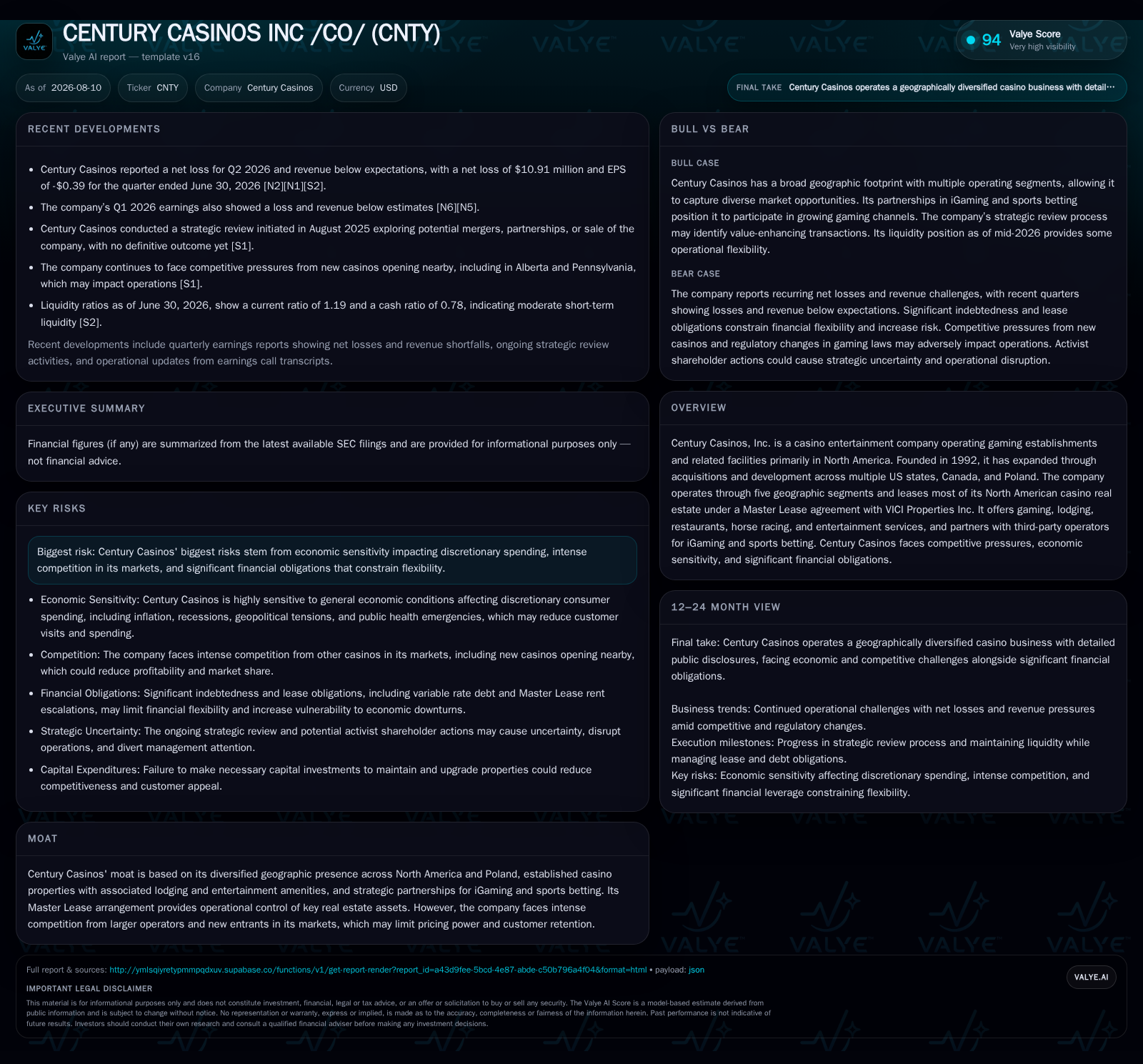
Century Casinos Inc. reported a Q2 2026 loss, reflecting pressures from macroeconomic factors dampening discretionary spending and fierce competition within its geographically diversified casino portfolio. The company operates under a Master Lease agreement for most North American properties, balancing operational control with significant fixed financial obligations. Growth initiatives focus on expanding iGaming and sports betting partnerships alongside hospitality enhancements. However, Century faces risks from economic downturns, competitive market saturation, and leverage constraints that may limit near-term margin improvement.
Recent Operating Update
Century Casinos disclosed its Q2 2026 results on August 7, revealing continued challenges as the company posted a net loss with revenues trailing estimates [S2][N2]. This reflects broader macroeconomic headwinds impacting household discretionary spending—a core driver of casino visitation and gambling spend. The company highlighted intensified competition across its markets and ongoing pressure on margins despite efforts to optimize operational efficiencies. Notably, activist shareholder activity has prompted governance attention with a new director appointed via a nomination agreement that aims to stabilize board composition over the coming nine months [S2].
Business Model Analysis
Century Casinos operates a multi-jurisdictional portfolio comprising casinos in the United States (segmented into East, Midwest, West), Canada, and Poland [S1]. Its core revenue stems from gaming operations including slot machines and table games — supplemented by lodging accommodations, food and beverage outlets, entertainment shows, and horse racing venues. Monetization hinges on customer visitation rates and per-visitor spend across these channels. A distinctive aspect of Century's business model is its triple net lease Master Lease with VICI Properties covering most North American casino real estate [S1], enabling operational control but introducing substantial fixed lease obligations.
Revenue is predominantly generated from gaming operations in physical locations; ancillary services provide diversification but are also subject to demand variability influenced by seasonal trends and consumer confidence. Strategic partnerships in iGaming and sports betting represent growth avenues aligning with shifting customer behavior toward online platforms. However, third-party involvement in these ventures limits Century's direct control over digital revenues yet broadens market access.
Industry and Competitive Positioning
The casino gaming sector is characterized by sensitivity to economic cycles due to reliance on discretionary income for entertainment spending. Century's geographically diverse footprint offers some buffer against localized downturns or regulatory shifts but also requires navigating varied competitive intensities—particularly against larger regional operators such as MGM Resorts International or Caesars Entertainment.
Competition is multifaceted: operators vie for limited consumer spending through marketing promotions like players’ clubs and superior hospitality offerings. Century acknowledges its smaller scale relative to peers with greater resources for brand recognition and advertising. This dynamic constrains pricing power and retention capabilities while necessitating continuous investment in property quality and guest experience.
Strategic leasing arrangements distinguish Century's asset-light approach compared to integrated resort operators owning their real estate outright but impose inflexible cost structures that dampen margin expansion during revenue softening phases. Additionally, regulatory environments across jurisdictions dictate gaming formats allowed (e.g., table games vs slots), taxation levels, and licensing renewals—adding complexity to operating segment profitability.
Growth Drivers
Century’s growth strategy emphasizes acquisition of new gaming opportunities combined with reinvestment in existing facilities to enhance amenities such as lodging capacity, entertainment content, and dining experiences—factors proven effective in bolstering customer visitation counts.
Importantly, partnerships for iGaming and sports betting platforms aim to address evolving consumer preferences favoring digital channels while complementing brick-and-mortar revenue streams. This integration can increase player engagement year-round beyond seasonal foot traffic fluctuations.
Market expansion into untapped geographic regions remains constrained by regulatory approvals but represents an avenue for future portfolio diversification once licensure hurdles are cleared. Effectiveness of loyalty programs to drive repeat visitation constitutes an additional lever influencing volume trajectory.
Economic cycles remain pivotal: as consumer confidence improves post any downturns or inflationary pressures ease, discretionary spending on casino entertainment typically rebounds favorably impacting gross gaming revenue (GGR) [S1]. Hotel occupancy rates and food & beverage spend per customer provide supplementary growth signals in integrated properties.
Risks and Constraints
The foremost risk factor is the heavy dependence on discretionary spending vulnerable to macroeconomic stressors including inflationary pressures or recessionary conditions that reduce consumer leisure budgets [S1]. The high fixed-cost base driven by leased property expenses exacerbates earnings sensitivity when top-line growth stalls.
Intense competition within many of Century’s markets—some experiencing oversupply of casino options—limits pricing elasticity and retention success despite marketing efforts such as players’ club promotions. Regulatory environments add uncertainty regarding permissible gaming expansions or changes in tax regimes possibly affecting profitability.
Financially, Century’s leverage profile is elevated with net debt around $276 million as of mid-2026; servicing this debt requires sustained cash flow generation amid volatile economic conditions [F1]. Interest expense amplifies earnings pressure especially given variable-rate borrowings exposed to interest rate fluctuations. Liquidity metrics indicate ability to meet near-term obligations but long-term flexibility hinges on deleveraging progress or asset monetization potential.
Moreover, the presence of activist shareholders introduces governance instability risks that could distract management focus or precipitate strategic shifts not aligned with long-term value creation goals despite current standstill agreements aiming at short-term peace [S2].
What To Watch Next
Monitoring Century’s upcoming quarterly segment disclosures will be critical to assess how each geographic unit navigates persistent economic challenges and competitive pressures. Trending KPIs such as segment-level gross gaming revenue (GGR), lodging occupancy rates, average daily theoretical (ADT) revenue per player, and players’ club engagement will provide early signals on operational traction.
Progress in expanding iGaming offerings alongside sports betting partnerships warrants close attention for contribution toward offsetting slower physical visitation trends. Management commentary on capital allocation priorities including possible asset divestitures or reinvestment plans will illuminate efforts toward improving leverage ratios.
Additionally, resolution or evolution of activist shareholder actions may affect strategic initiatives or capital structure decisions influencing investor sentiment dynamics.
Financial Profile Discussion
The company’s sizable indebtedness includes a term loan under Goldman Sachs Credit Agreement bearing variable interest generally above prevailing SOFR rates plus a margin approximating 5-6%, magnifying exposure to interest rate shifts [S11][S12][S20]. Century maintains regular rent payments under its Master Lease arrangement which represent significant fixed obligations irrespective of operating performance thus requiring disciplined operating cost management to preserve earnings margins especially during demand softness phases.
In summary, Century Casinos faces a capital-intensive operating environment marked by elevated leverage requiring caution around liquidity management amidst uncertain economic conditions impacting end-consumer discretionary expenditures.
This analysis synthesizes available public filings from Century Casinos as of August 2026 without forming any investment research views or price forecasts.
Disclaimer: This is research-only, informational analysis and not investment advice. It may include AI-generated interpretation and general industry context. Always verify important details using primary sources.

Comments