
Trulieve’s U.S. Cannabis Retail Scale and Vertical Integration Strengthen Market Leadership
Trulieve Cannabis Corp. reported solid operational scale and ongoing investments in technology-driven customer engagement alongside navigating regulatory complexity in key U.S. states.
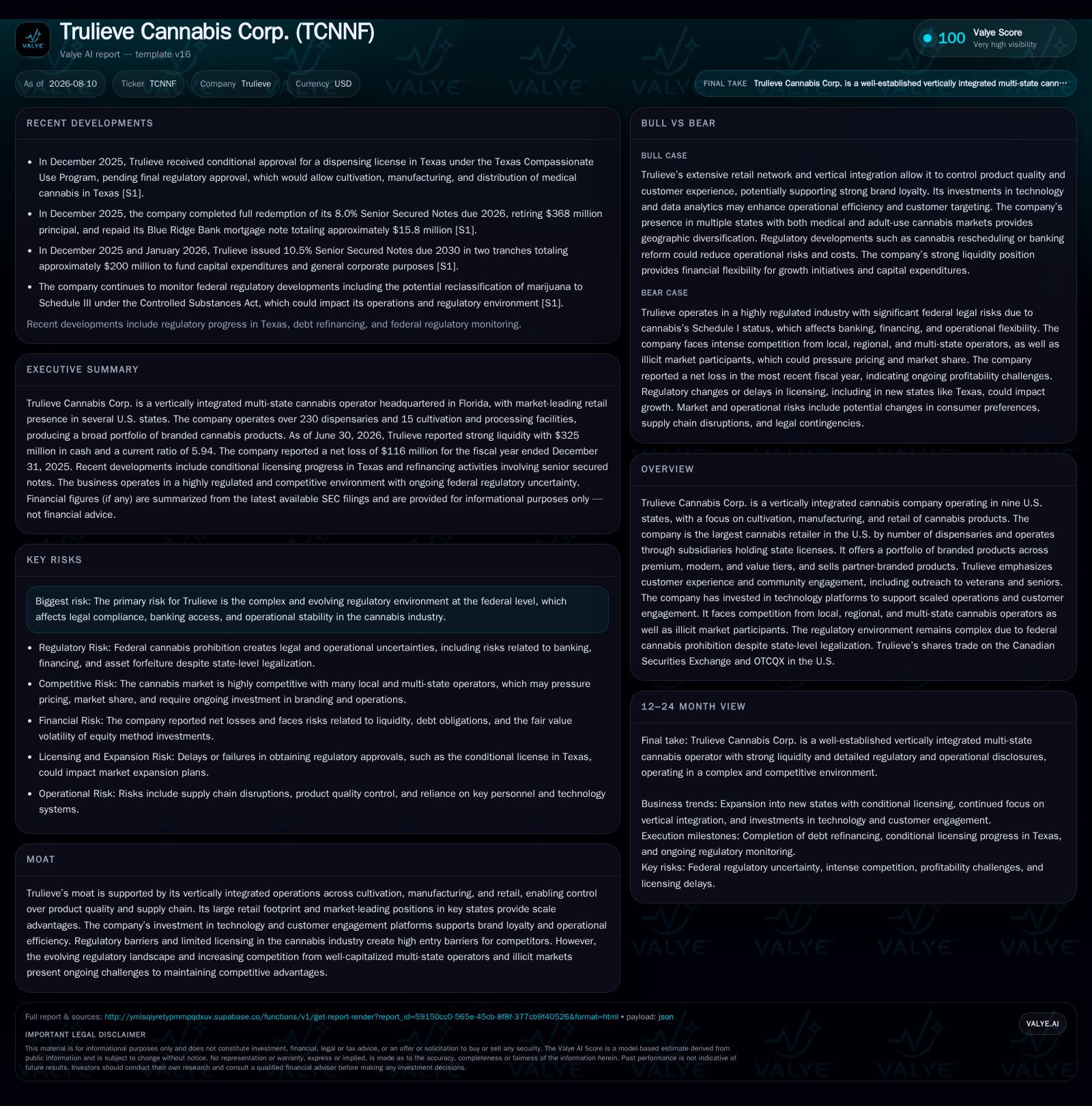
Trulieve Cannabis Corp., the largest cannabis retailer in the U.S. by dispensary count, continues to consolidate its multi-state presence with a focus on vertical integration across cultivation, manufacturing, and retail. Its Q2 2026 update highlights disciplined expansion within nine states, supported by robust liquidity and manageable debt levels. The company leverages technology platforms to enhance operational efficiencies and customer loyalty amid increasing competition from multi-state operators and the illicit market. However, federal cannabis prohibition and evolving regulatory risks remain key challenges. Near-term growth will hinge on new market entries and adult-use program developments where licensed.
Latest Operating Update Highlights
Trulieve Cannabis Corp.'s latest quarterly filing for Q2 ended June 30, 2026 confirms the company's continued leadership as the largest cannabis retailer in the United States by dispensary count [S2][F1]. Operating through subsidiaries licensed in nine states—including cornerstone markets Florida (162 dispensaries), Arizona (22), Pennsylvania (21), West Virginia (10), Ohio (8), Georgia (6), Maryland (3), Connecticut (1), and Colorado (no dispensaries but cultivation) —Trulieve maintains a total of 233 retail dispensaries paired with 15 cultivation and processing facilities as of late 2025 [S1]. This substantial physical footprint underpins scale advantages particularly in retail operations.
From a financial liquidity standpoint, Trulieve's balance sheet as of June 30 shows $325 million of cash and equivalents against $200 million of total debt, resulting in an impressive net cash position near $125 million [F1]. This liquidity profile facilitates ongoing capital expenditures targeted at maintaining cultivation capacity, expanding dispensary count where permitted, and funding technology initiatives [S1][S19].
Business Model: Vertical Integration Anchors Quality and Control
Trulieve’s vertically integrated business model is a critical competitive advantage in the cannabis sector known for complex supply chains. The company controls multiple stages of the value chain: cultivation of cannabis plants in proprietary facilities; manufacturing of derivative products such as oils, edibles, and concentrates; followed by distribution through its extensive network of retail dispensaries fully licensed by state regulators [S1][S21].
This integration enables tighter quality assurance and supply reliability versus pure-play retailers or those that source wholesale products externally. Controlling production also allows optimization of product mix toward higher-margin categories like concentrates or edibles—a key lever as consumer preferences evolve beyond flower-centric purchases prevalent historically. The model also supports compliance rigor vital in highly regulated states.
Monetization flows mainly through retail sales directly to registered medical patients or adult-use consumers aged 21+, with state-specific regulatory environments dictating licensing scope and customer access rules [S19]. Trulieve’s branded portfolio spans premium to value tiers combined with partner-branded product offerings—a diversification that aids market penetration across demographics while leveraging brand loyalty initiatives incentivized via a customer rewards program integrated within their technology platform
Industry Structure & Competitive Position
The U.S. cannabis industry remains characterized by fragmented state markets regulated independently amid an ongoing federal prohibition that creates significant operational complexity. Multi-state operators (MSOs) like Trulieve compete not only with local or regional firms but also face indirect pressure from unregulated illicit market players who can undercut prices due to lower compliance costs.
Among peer MSOs such as Curaleaf Holdings—known for its broad U.S. footprint—and Green Thumb Industries—focusing on branded merchandising plus retail conglomeration—Trulieve distinguishes itself by leading in retail density within its core states and emphasizing vertical integration more extensively than some peers who rely more heavily on third-party sourcing [Industry Knowledge Layer context; S13][S21].
Market entry barriers are high due to limited licensing availability enforced by state regulators coupled with expensive compliance demands including track-and-trace systems preventing illegal diversion. These barriers protect incumbents but mean competition intensifies primarily around consumer experience delivery, product innovation breadth, pricing models responsive to illicit competition, and geographic expansion within permitted jurisdictions.
Growth Drivers
Several factors underpin Trulieve’s prospects for expansion:
- State-Level Legalization Expansion: Adult-use legalization programs active in Arizona, Colorado, Connecticut, Maryland, Ohio represent immediate growth arenas with potential increases in consumer base size relative to medical-only states such as Florida [S1][S21].
- New License Opportunities: Conditional approval received for Texas medical cannabis operations marks a strategic geographic advancement pending final regulatory clearance—potentially adding a sizable new revenue stream once operations commence [S13].
- Retail Footprint Expansion: Opening new dispensaries where allowed drives incremental same-store-sales growth while extending brand reach.
- Product Innovation & Portfolio Diversification: Shifting mix toward higher-margin concentrate products and edibles aligns with changing consumer preferences enhancing profitability.
- Technology Platforms: Investments in enterprise-grade data analytics enable personalized marketing campaigns across email, SMS, mobile app channels enhancing repeat purchase rates and average ticket size [S19]. These platforms also streamline inventory allocation optimizing supply-demand matching.
- Demographic-Focused Outreach: Community engagement targeting veterans and seniors helps cultivate brand loyalty within specialized consumer segments often underserved elsewhere [S19].
Risks & Constraints
The foremost risk continues to be federal cannabis illegality that restricts banking access forcing reliance on cash operations which constrains scalability [S14][S18]. The rescheduling process has seen fits-and-starts despite executive orders favoring reclassification to Schedule III intended to legitimize medical use; however administrative delays create uncertainty over when federal relief might materialize or what scope it might cover
Furthermore:
- Competition intensifies not only among MSOs but from illicit market operators whose lower cost structures pressure pricing especially at commodity flower segments [S13].
- Regulatory regimes vary considerably from state to state requiring costly compliance processes monitored continuously.
- Exposure to valuation fluctuations related to Trulieve's equity method investment in Harvest Health adds financial volatility risk [S27].
- Market saturation risks arise particularly where dispensary densities approach limits set by authorities or cannibalization occurs without sustained volume growth.
- Supply chain disruptions or quality control lapses could materially impact reputation or lead to enforcement actions.
What To Watch Next
Near-term milestones reflecting execution clarity include:
- Final regulatory approval and commencement schedules for Texas Compassionate Use Program participation.
- Performance indicators from adult-use programs such as same-store sales growth rates coupled with ticket size trends revealing customer spend dynamics.
- Progression of federal marijuana rescheduling processes signaling potential easing of banking/finance obstacles if moved forward.
- Updates on integration efforts or capital deployment related to technology platform development impacting operational leverage.
- Developments regarding Trulieve’s equity method interest valuation adjustments tied to Harvest Health's performance.
- Dispensary openings or expansions announced across multistate hub clusters bolstering regional dominance.
Financial Profile Discussion
As of mid-2026 quarter-end, Trulieve reports robust liquidity with $325 million cash versus $200 million debt outstanding reflecting net cash position near $125 million providing financial flexibility for capital expenditure funding including cultivation expansion projects or M&A activity if pursued [F1]
Operating income was reported at $143 million for full-year 2025 illustrating operating scale though profitability margins must be interpreted tightly given industry capital intensity alongside compliance cost pressures [F1]. The company retired previous higher-cost notes fully by year-end 2025 while replacing some debt with senior secured notes at elevated interest rates around 10.5% maturing in 2030 reflecting sector credit risk profiles offset by predictable cash flow generation potentials under regulated framework commitments [S4][S24].
In summary, Trulieve demonstrates disciplined financial management consistent with sustaining a leadership position amid evolving legislative landscapes while investing strategically in infrastructure required for long-term viable growth within the U.S. cannabis ecosystem.
This analysis is informational only. It does not constitute investment advice or research views.
Disclaimer: This is research-only, informational analysis and not investment advice. It may include AI-generated interpretation and general industry context. Always verify important details using primary sources.

Comments