
Avenue Therapeutics Maintains Clinical Focus Amid Transition to OTC Market
Avenue Therapeutics continues advancing its IV Tramadol development and manages liquidity following Nasdaq delisting.
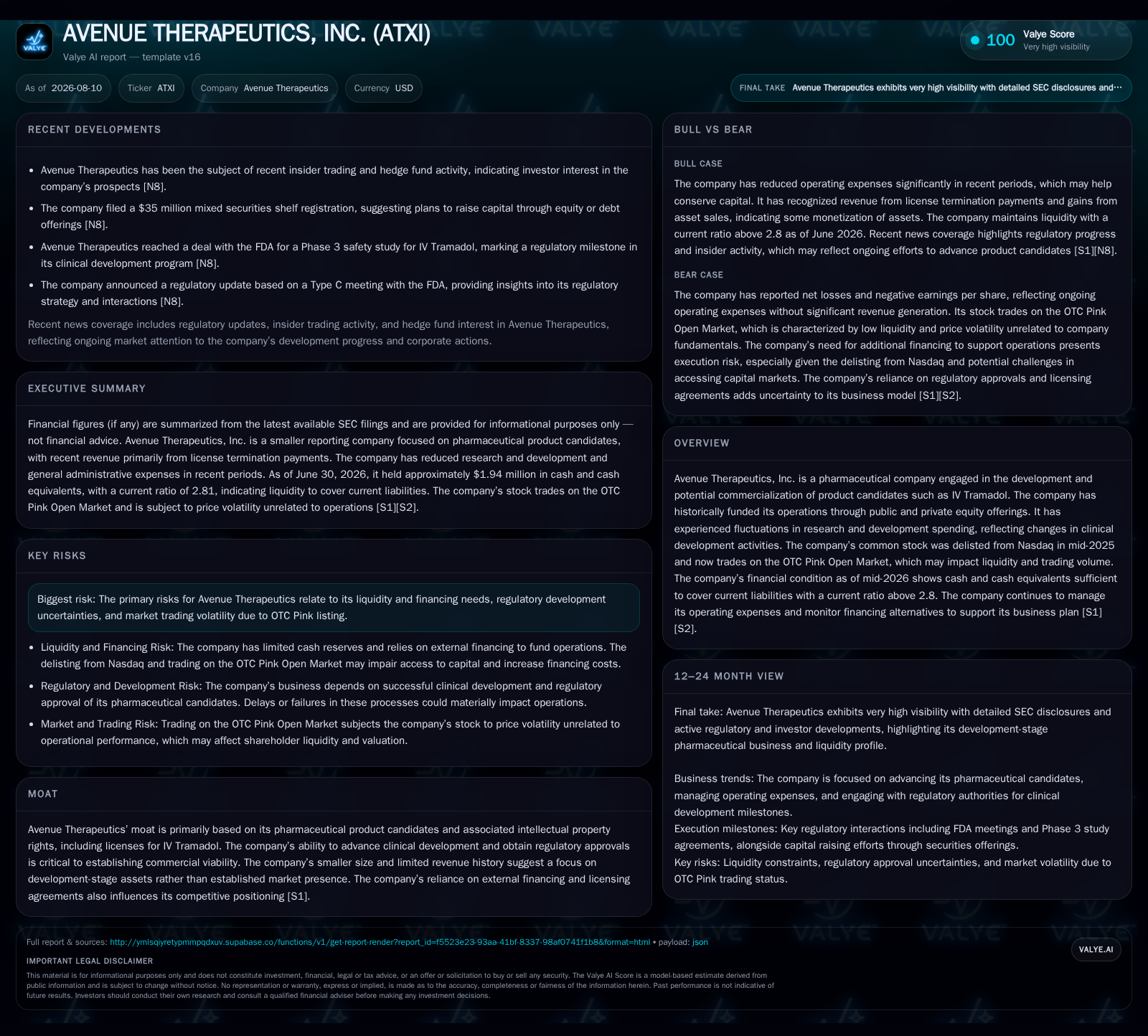
Avenue Therapeutics is a clinical-stage pharmaceutical company centered on IV Tramadol and related drug candidates, navigating liquidity and regulatory challenges after its Nasdaq delisting in mid-2025. Its latest quarterly filing reveals extended supply agreements, milestone payment obligations totaling $15.6 million for pipeline assets, and a cash position sufficient to cover short-term liabilities. The firm's primary value lies in licensing intellectual property and advancing clinical milestones, with growth contingent on successful FDA approvals and strategic partnerships. Trading on the OTC Pink market introduces heightened stock volatility and liquidity risks that could impact financing options.
Recent Operating Update
In its latest quarterly report filed August 7, 2026, Avenue Therapeutics disclosed a significant amendment to its exclusive supply agreement with Zaklady Farmaceutyczne Polpharma for the drug product of intravenous (IV) tramadol. The contract now extends the term to eight years following product launch [S2]. This deal structure includes contingent payments: Polpharma is due a $2 million milestone upon FDA approval plus low single-digit royalties on net sales over five years post-launch. This extension signals confidence in the clinical development path towards potential commercialization but also commits Avenue to ongoing licensing expenses tied to regulatory success.
Further financial obligations arise from Avenue's ATX-04 license agreement with Duke University. Aside from small upfront fees (~$19,000), the company carries potential development, regulatory, and commercial milestone payments aggregating approximately $15.6 million contingent upon achieving defined corporate milestones. Royalties on net sales of ATX-04 are also payable at tiered low single-digit rates [S2]. These structured deals reflect typical biotech industry mechanisms where early-stage innovators bear upfront R&D costs but are liable for stepped payments upon specific progress triggers.
On liquidity, Avenue reported cash and cash equivalents of roughly $1.94 million at June 30, 2026 versus current liabilities of about $1.41 million — producing a healthy current ratio of 2.81 [F1]. While this cushion supports operational needs near term, the absence of commercial revenue necessitates further financing to fund clinical programs and milestone payments over time.
Importantly, Avenue’s shares were delisted from Nasdaq during mid-2025 and now trade on the OTC Pink Open Market [S1]. This transition reduces public market liquidity significantly and exposes shareholders to high price volatility unrelated directly to operating performance. Such market status can hinder capital raising efforts or prompt share price swings independent of milestones or news flow.
Business Model Analysis
Avenue Therapeutics fits within the specialty pharmaceutical subset of biotechnology firms focused on developing innovative pain management therapies through novel formulations like IV Tramadol (ATX-03) alongside pipeline candidates such as ATX-04 [S1]. This business archetype typically operates with minimal or no direct product sales prior to obtaining FDA approvals due to the extensive multi-year clinical trial process.
Revenue predominantly derives from milestone payments triggered by regulatory achievements or licensing deals rather than recurring sales at this stage [S2]. Upon successful FDA approval and commercialization, royalties from partners like Polpharma provide ongoing revenue streams pegged to net sales volumes. Until then, capital inflows largely rely on equity financings paired with strategic collaborations that mitigate upfront R&D cost burdens.
Licensing agreements grant access to intellectual property essential for proprietary formulations but embed contingent liabilities that scale with developmental success [S2]. As such, managing valuation-sensitive milestones while conserving cash becomes a core balancing act. The extended supply agreement with Polpharma reflects an effort to secure manufacturing continuity critical for eventual market entry — an important component given manufacturing scale-up complexity in specialty pharmaceuticals.
Market timing depends heavily on achieving clinical progression milestones within FDA timelines; delays or setbacks can significantly impact liquidity and valuation. The firm's ability to manage contract research organizations (CROs), oversee trial sites efficiently, and navigate regulatory submissions will materially influence operational leverage.
Industry Structure and Competitive Position
Operating within the biotechnology sector specializing in pharmaceutical development for pain therapies aligns Avenue with peers such as Cara Therapeutics and Collegium Pharmaceutical — companies advancing specialty analgesic candidates often underpinned by patent portfolios protecting novel formulations. Like these peers, Avenue lacks commercial revenue presently but seeks validation through progressive clinical trial phases culminating in regulatory approval.
Differentiation rests primarily on proprietary intellectual property rights licensed from research institutions (e.g., Duke University) combined with in-house formulation expertise targeting unmet medical needs via novel IV administration routes [S2]. Competitive dynamics revolve around speed of clinical development execution, patent life management amid looming expirations common in pharma IP portfolios, and securing effective partnerships for manufacturing and commercialization.
Market entry barriers include stringent FDA regulations mandating extensive evidentiary clinical trials that lengthen timelines while ratcheting R&D costs higher. Counterbalancing these are expedited review pathways potentially available for novel analgesics addressing significant unmet needs in opioid-sparing pain management frameworks.
OTC Pink listing status detracts somewhat from peer comparability by increasing stock volatility risk relative to Nasdaq-listed peers who benefit from tighter spreads and greater institutional investor presence [S1]. This factor can indirectly constrain future equity capital access critical for sustaining prolonged drug development cycles.
Growth Drivers
Avenue’s key growth drivers remain enclosed within clinical trial milestones tied directly to FDA submissions and anticipated approvals for IV Tramadol (ATX-03) as well as other pipeline products like ATX-04 [S2]. Successful completion of late-stage clinical trials or favorable regulatory feedback would unlock milestone payments (e.g., the $2 million payment due Polpharma), catalyze royalty stream initiation post-commercial launch, and enhance licensing negotiation leverage.
Strategic partnerships around manufacturing scale-up (the amended Polpharma agreement exemplifies this) are vital precursors enabling smooth transition from trials to commercial supply chains — any disruption here could delay launches or inflate costs substantially.
Intellectual property protection extending patent life or securing formulation exclusivity serves as another lever enhancing long-term competitive positioning in specialty pain markets. Expansion of the product pipeline through potential in-licensing deals or acquisitions could diversify risk otherwise concentrated in a small number of candidates.
Finally, improving access to capital markets underpins sustained funding for costly R&D expenditures whose expense recognition dominates operating losses pre-commercialization.
Risks and Watchpoints
Principal risks facing Avenue Therapeutics stem from regulatory uncertainties surrounding FDA approval timelines or potential negative trial outcomes that can stall milestone realizations or force costly program reevaluations [S1][S2]. High operating losses driven by R&D expense necessitate continuous external financing; failure or delay in securing funds could disrupt development continuity.
Stock trading on the OTC Pink Open Market heightens risk of illiquidity-driven price swings unrelated to fundamentals — this can impair investor confidence or complicate secondary offerings required for capital raises [S1]. The limited public float may exacerbate share volatility further.
Intellectual property challenges persist including risks that licensed patents fail to protect competitive advantages fully or face invalidation/patent cliffs limiting commercial exclusivity horizons.
Competition from other pharmaceutical firms seeking approvals for alternative pain management therapies could compress future market opportunities or pricing power.
Lastly, manufacturing scale-up agreements pose operational vulnerabilities; reliance on third-party suppliers requires robust contract management amidst potential supply chain disruptions affecting product availability post-launch.
What To Watch Next
Near-term milestones include monitoring FDA feedback on ongoing IV Tramadol clinical programs alongside any newly announced development progress with ATX-04 [S2]. Verification of triggering milestone payments tied to FDA approvals will serve as tangible markers confirming advancement towards commercialization.
Financially, tracking cash burn rate relative to quarterly cash balances will indicate runway sufficiency — new financings or partnership announcements would be significant events mitigating funding risk.
Changes in trading volume patterns or bid/ask spreads on OTC Pink may signal shifts in investor sentiment reflecting either optimism tied to data releases or broader macro factors impacting biotech equities listed off major exchanges.
Finally, management commentary accompanying subsequent SEC filings may clarify strategic posture regarding pipeline expansion plans or commercialization preparations including marketing collaboration talks or manufacturing partner identification beyond Polpharma.
Financial Profile Discussion
As of June 30, 2026, Avenue Therapeutics reported cash and cash equivalents totaling approximately $1.94 million against current liabilities around $1.41 million — resulting in a strong current ratio near 2.81 that implies near-term liquidity adequacy [F1]. However, this level remains modest given the typical quarterly research expense demands characteristic of early-stage biopharmaceuticals relying heavily on outsourced contract research organizations (CROs) and licensing obligations including milestone commitments totaling estimated tens of millions over time [S2].
Operating income remains negative consistent with pre-commercial phase status; no revenues beyond licensing-related gains were noted recently [F1]. This pattern aligns with industry norms where protracted R&D investment cycles precede potential revenue generation arising only post-market approval when royalties commence or direct sales begin.
Management’s financing strategy appears focused on conserving cash while progressing key pipeline milestones essential to unlocking milestone payment inflows or attracting new partners capable of supplementing capital needs through equity or debt facilities. Nonetheless, heightened execution risk persists until commercial viability is firmly established.
Disclaimer: This analysis is provided solely for informational purposes based on publicly available SEC filings as cited; it does not constitute investment advice or research views.
Disclaimer: This is research-only, informational analysis and not investment advice. It may include AI-generated interpretation and general industry context. Always verify important details using primary sources.

Comments