
Oscar Health’s Q2 Growth: Technology Drive and Member Scale in Individual Insurance
Oscar Health’s latest quarter underscores its expanding effectuated membership, technology integration, and ICHRA brokerage growth amid regulatory and capital considerations.
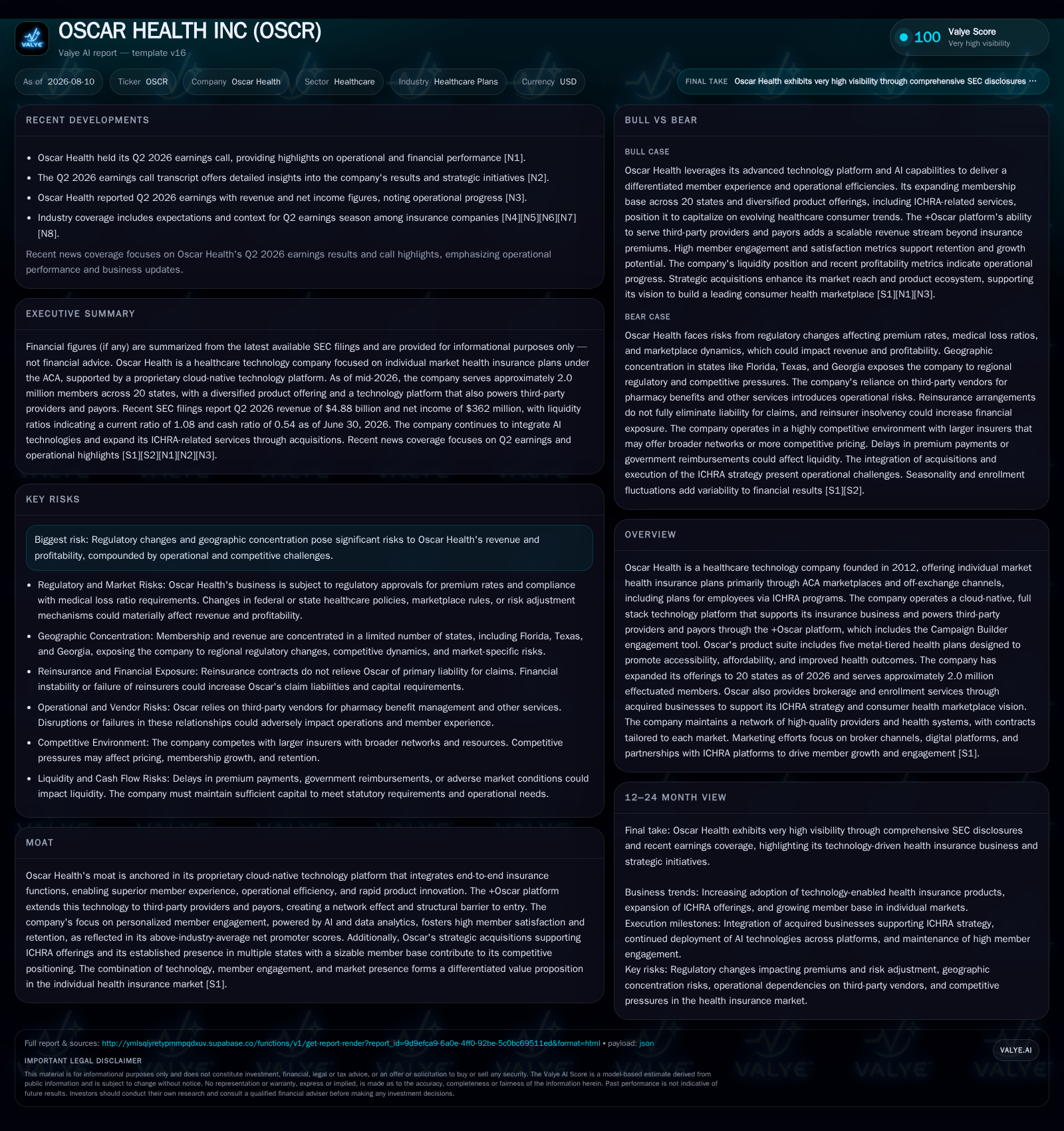
In Q2 2026, Oscar Health reported effectuated membership approaching 2 million, leveraging its cloud-native platform to support both insurance operations and a growing third-party client base. The company continues expanding geographically with offerings across 20 states and diversifies distribution via brokerage acquisitions supporting Individual Coverage Health Reimbursement Arrangements (ICHRA). Operating metrics reveal stable medical loss ratios and strong member engagement, while capital requirements linked to rapid growth remain a key factor to monitor. Oscar Health navigates the complex ACA individual insurance landscape anchored by proprietary technology, differentiating itself from peers through member experience and platform scalability.
Quarterly Update: Membership Momentum Anchored by ACA Expansion
Oscar Health's Q2 2026 results highlight continued execution on membership growth with effectuated members approaching 2 million — a material scale that reflects both organic ACA marketplace growth and expansion into off-exchange distribution through ICHRA channels. The company offers individual market health plans across five established ACA metal tiers: Catastrophic through Platinum, designed to promote accessibility and affordability. By mid-2026, Oscar covered individuals in approximately 20 states [S2][S1]. This broad footprint is critical in today's health insurance plans industry where geographic diversification supports volume stability amid state-specific regulatory uncertainties.
Premium revenue streams primarily derive from monthly premiums collected from members who have either paid or are within grace periods, reflecting well-managed risk pools typical of individual market insurers. Oscar's emphasis on effectuated members as a key metric signals focus on quality of enrollment beyond mere sign-ups—a vital distinction given churn risks prevalent in ACA markets [S1]. Recent filings confirm stable risk-adjusted premiums maintaining normalized underwriting exposure despite ongoing market challenges [S2].
Cloud-Native Platform Powering Innovation: +Oscar’s Dual Role
A distinctive component of Oscar Health’s business model is its fully integrated cloud-native technology platform known as +Oscar. This platform underpins all core insurance administrative functions—policy management, claims adjudication, member communication—and extends services to external payors and providers through tools like Campaign Builder. This engagement engine leverages AI-driven data analytics to enhance personalized member outreach, improve care quality, and reduce wasteful utilization [S1]
The dual function—both as an insurer relying on +Oscar internally and as a technology provider powering other healthcare entities—builds a structural moat by generating network effects. The platform supports near real-time reporting for key outcomes, providing actionable insights that strengthen member retention and satisfaction metrics [N2][S1]. Oscar reports net promoter scores (NPS) exceeding industry averages, suggesting high member engagement attributable to this technological advantage
Market Context: Differentiation Among ACA Peers via Tech & Product Breadth
Within the broader health insurance landscape, Oscar competes amid national carriers like UnitedHealth Group with extensive government-sponsored product lines and regional insurers such as Anthem or Centene focusing on Medicaid or Medicare. Oscar’s niche centers on the individual market with technologically enabled product delivery—a positioning shared partially by peers like Bright Health but differentiated by Oscar's proprietary cloud-native infrastructure and AI capabilities embedded end-to-end.
This tech focus allows Oscar to innovate plan designs tailored for specific demographics (e.g., programs for diabetes or asthma) while maintaining cost efficiency through predictive underwriting and utilization management [S26][S29]. Such differentiation supports negotiating favorable provider reimbursement agreements relative to competitors lacking data-driven engagement strategies.
Scaling Through ICHRA Brokerage Integration and Consumer Access Channels
To bolster growth beyond direct ACA marketplace participation, Oscar has strategically expanded into the Individual Coverage Health Reimbursement Arrangement (ICHRA) segment via recent acquisitions—including Lucie Inc., IHC Specialty Benefits Inc., and Healthinsurance.org LLC—integrating brokerage services with digital enrollment platforms [S1][S3]
These acquisitions enable Oscar to tap employer-funded individual insurance reimbursements off-exchange, broadening distribution while deepening broker relationships. Brokers represent a majority source of membership acquisition due to ease of accessing diverse plan offerings through platforms compliant with federal marketplaces’ EDE standards. Increasing broker commission structures highlight competitive tension in these channels but also underscore their critical role in building effectuated membership at scale [S26].
Operational Performance: Claims Efficiency, Medical Loss Ratio Trends, Engagement Metrics
Operational data reveals that Oscar maintains disciplined underwriting reflected in stable medical loss ratios (MLR), a core KPI measuring proportion of premiums spent on claims versus administrative costs [N2][S2]. Technology-enhanced claims processing reduces cycle times and enhances accuracy, contributing to expense control despite rising healthcare cost inflation pressures common industry-wide
Member engagement fueled by +Oscar facilitates higher retention rates vis-à-vis peers by providing more personalized care pathways and transparency into covered benefits. Such engagement reduces adverse selection risks and promotes preventive care usage patterns positively influencing long-term financial performance.
Growth Outlook: State Expansion, Regulatory Hurdles, and Capital Demands
Oscar continues seeking new marketplaces for product launches but faces significant barriers due to capital requirements mandated by state regulators who enforce elevated risk-based capital (RBC) thresholds especially during initial seasoning periods after entering new states [S1]. These requirements affect cash flow dynamics since increased enrollment triggers higher mandatory surplus contributions that may surpass near-term underwriting income.
Regulatory approval processes also impose timing uncertainty for benefit designs and premium rate filings; regulators may demand modifications negatively impacting profitability [S22]. Managing this capital intensity while scaling effectuated membership remains a strategic balancing act shaping deployment speed going forward
Risk Factors: Regulatory Exposure, Capital Requirement Volatility, Competitive Pressures
The major risks confronting Oscar include potential adverse regulatory changes that could restrict plan design flexibility or alter subsidy calculations impacting demand elasticity. Escalating capital demands tied to expanding risk pools combined with increasing broker compensation driven by competitive pressures strain financial resources further [S27][S28].
Operational risks around cybersecurity in handling sensitive health information also increase with platform expansion along with emerging legal exposures arising from ongoing audits or litigation tied to fraud or abuse laws common in government-sponsored programs.
What To Watch Next: Enrollment Trends, Regulatory Guidance Updates, Technology Enhancements
Key near-term indicators include tracking Q3/Q4 effectuated membership changes reflective of enrollment season performance plus any shifts in regulatory guidance around marketplace operations or advanced premium tax credits potentially reshaping consumer behavior [N1][S3]
Additionally, continued rollout of enhancements within the +Oscar platform—particularly expanding AI-driven personalized research views—will serve as evidence points validating the sustainability of member engagement advantages underpinning retention economics.
Financial Profile Discussion: Capital Position Supports Controlled Expansion Amid Investment Needs
As of June 30, 2026, Oscar held approximately $4.08 billion in cash and equivalents against roughly $432 million in total debt resulting in a strong net cash position supportive of operational liquidity needs during aggressive growth phases [F1]
However, sustained investment in technology development coupled with capital requirements associated with new markets contributes to operating losses reported historically (notably a net loss exceeding $443 million for 2025), consistent with early-stage disruptive insurer dynamics relying on scale build-out before achieving profitability thresholds [F1]. Prudent capital stewardship under revolving credit covenants remains essential as expansion progresses.
Disclaimer: This analysis is based solely on information publicly available via SEC filings and related earnings disclosures up to August 10, 2026. It does not constitute investment advice or any research view regarding securities of OSCAR HEALTH INC.
Disclaimer: This is research-only, informational analysis and not investment advice. It may include AI-generated interpretation and general industry context. Always verify important details using primary sources.

Comments