
QuidelOrtho Navigates Seasonality and Debt While Expanding Diagnostic Portfolio
Q2 2026 results reflect operational optimization, acquisition integration, and geographic diversification amid respiratory product seasonality.
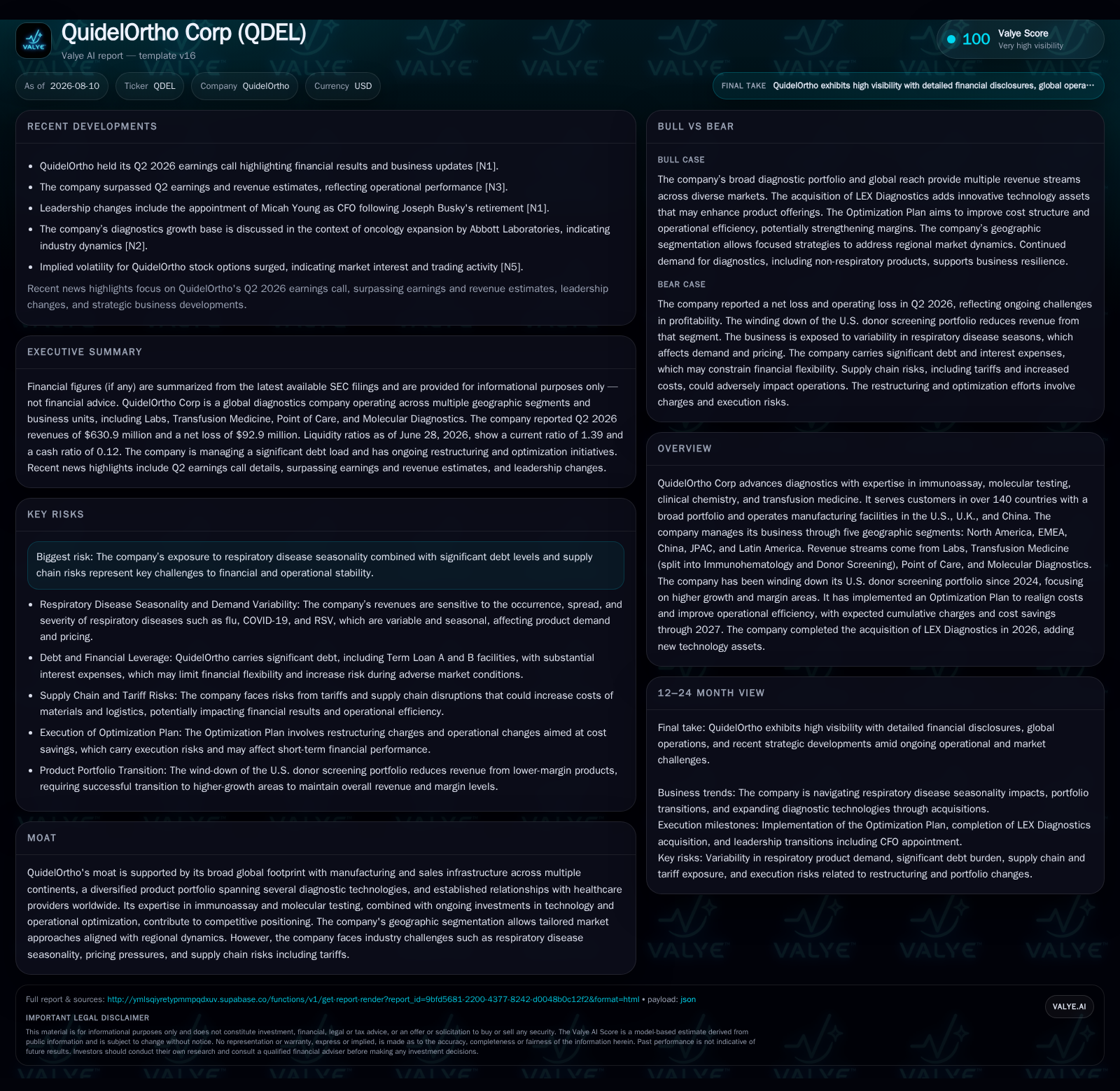
QuidelOrtho Corp’s latest quarterly filing shows continued focus on streamlining costs through its Optimization Plan while integrating the recent LEX Diagnostics acquisition to broaden its molecular testing capabilities. Revenue was supported by geographic diversification across five segments despite seasonal softness in respiratory-related diagnostics. The company sustains a high debt load used to fund strategic expansion, with interest rate hedging in place. Key near-term indicators include progress on cost reduction targets, test kit volume recovery post-seasonality, and successful integration of new product lines.
Recent Operating Update
QuidelOrtho’s Q2 2026 Form 10-Q filing reveals a business balancing short-term respiratory product seasonality with strategic repositioning through portfolio expansion and cost management [S2]. Total revenues in the quarter reached approximately $630.9 million across five global segments. Despite a typical seasonal dip in respiratory test demand—which accounted for roughly 8% of total revenues—the company offset softness with sustained growth in molecular diagnostics and point-of-care testing domains [S2]. The acquisition of LEX Diagnostics earlier in 2026 is highlighted as a material step toward expanding molecular assay capabilities, strategically aimed at capturing rising demand for rapid infectious disease testing [S3].
This quarter also reflects ongoing execution of a comprehensive Optimization Plan initiated in 2024 to realize long-term operational efficiencies. Restructuring and integration charges continue through 2027, aiming to streamline manufacturing footprint and reduce overhead costs across global functions [S2]. Notably, these initiatives coincide with an active winding down of the legacy U.S. donor screening portfolio begun in 2024 to sharpen focus on higher-growth areas such as transfusion medicine immunohematology [S2].
Business Model Insights
QuidelOrtho operates as an integrated manufacturer and distributor of diagnostic instruments and consumable test kits serving clinical laboratories, hospitals, blood banks, and point-of-care customers worldwide. Its revenue streams are diversified by both technology platform—immunoassay, molecular diagnostics, clinical chemistry—and geography through distinct regional segments: North America, EMEA (Europe/Middle East/Africa), China, JPAC (Japan/Pacific Asia/Canada), and Latin America [S2][S18]. This segmentation enables tailored marketing approaches aligning with regional healthcare reimbursement systems and regulatory frameworks.
Revenue mechanics hinge on consumable sales volume (i.e., number of tests sold) driven by epidemiological factors such as respiratory illness seasonality alongside contract renewals for instrument placements supporting ongoing test kit utilization. Pricing power is moderated by competitive dynamics including peer firms like Abbott Laboratories and Roche Diagnostics offering overlapping products. Margins depend heavily on product mix shifts toward higher-margin molecular or transfusion medicine assays versus lower-margin point-of-care respiratory tests.
The recent LEX Diagnostics acquisition expands presence in molecular platforms recognized for growth due to increased demand for rapid pathogen identification beyond traditional respiratory panels [S3]. This bolsters QuidelOrtho’s value proposition among clinical labs seeking multiplexed automated solutions.
Industry Structure and Competitive Position
The medical diagnostics sector is characterized by rapid technological innovation coupled with complex regulatory oversight requiring substantial R&D investment. QuidelOrtho sits among diversified diagnostics providers competing on breadth of test menu, accuracy/speed of results, ease-of-use at point-of-care settings, and extensive global manufacturing capacities. Its widespread manufacturing footprint in the U.S., U.K., and China supports resilient supply chains though geopolitical tensions including tariffs impose layered risks to component sourcing and cost structure [S27].
Financially disciplined peers balance innovation-driven R&D spending—typically high relative to sales—with strategic acquisitions to maintain competitive edge. QuidelOrtho’s effort to optimize corporate overhead while integrating new product lines illustrates this balancing act amidst intensifying competition from Roche, BD, Siemens Healthineers, among others.
Growth Drivers
Key growth drivers include rising global demand for rapid infectious disease detection amplified by evolving pandemics and antimicrobial stewardship protocols that increase molecular testing adoption. Expansion into emerging markets within JPAC and Latin America offers further upside given increasing healthcare infrastructure investments.
Product innovation through LEX Diagnostics acquisition complements existing immunoassay offerings by enhancing the molecular diagnostic pipeline targeting multiplex viral panels and potentially oncology biomarkers over time [S3]. Additionally, improvement in test kit utilization rates linked to installed instrument base expansion remains an important metric for sustainable top-line growth.
Operationally, the Optimization Plan aims to reduce manufacturing complexity and streamline SG&A expenses measured via segment adjusted EBITDA improvements observed in recent quarters [S26]. Efficient cost structure gains enhance profitability over cyclical revenue fluctuations driven by respiratory seasonality.
Risks and Watchpoints
Seasonal demand volatility for respiratory diagnostics constrains near-term revenue visibility—approximately 8% contribution from these products—posing challenges for capacity planning and inventory management [S2]. Supply chain constraints related to tariffs implemented since mid-2025 continue elevating production costs despite partial offsets through operational efficiencies [S27].
High leverage remains a critical watchpoint with total debt around $2.54 billion as of Q2-end against modest cash reserves ($123 million) resulting in net debt near $2.41 billion [F1][S2]. Interest expense is significant ($54 million quarterly) even after employing interest rate swaps to hedge variable rate exposures on term loans and revolving credit facilities [S2].
Concentration risk appears controlled; the largest customer accounts for about 11% of revenues without excessive accounts receivable concentration [S2][S18]. Nonetheless, competitive innovations from peers or reimbursement changes could pressure pricing power. The discontinuation of the SAVANNA platform development announced previously adds uncertainty around molecular segment contribution timing [S27].
What To Watch Next
Key upcoming milestones include progress updates on Integration of LEX Diagnostics’ technologies measured by product launches or FDA approvals relevant to multiplex assays. Monitoring the trajectory of cost savings under the Optimization Plan—targeting cumulative charges through 2027—will reveal structural margin improvement sustainability.
Tracking the seasonal recovery pattern post-Q2 in respiratory test volumes will inform revenue stability ahead of winter influenza seasons. Quarterly disclosures regarding geographic segment performance will shed light on emerging market penetration success particularly within JPAC and Latin America where diagnostic infrastructure investments vary widely.
Financial Profile Discussion
As of June 28, 2026, QuidelOrtho reported cash and equivalents totaling approximately $123 million juxtaposed against total debt near $2.54 billion yielding a net debt level around $2.41 billion with a current ratio of 1.39 indicating adequate short-term liquidity coverage [F1][S2]. The company actively manages interest rate risk employing multiple interest rate swap agreements designated as cash flow hedges aligned with variable-rate borrowings under revolving credit facilities and term loans [S2].
Operating activities reflected net losses partly offset by non-cash adjustments such as depreciation/amortization ($230 million over six months) and stock-based compensation ($23 million) with cash flow generation critically reliant on inventory turnover efficiency given inventories exceeded $600 million recently [S2]. Capital allocation remains focused on funding acquisitions like LEX Diagnostics alongside restructuring-related investments embedded within the Optimization Plan.
This analysis draws exclusively from QuidelOrtho’s recently filed SEC documents supplemented by external industry insight patterns typical within diversified medical diagnostics companies. It refrains from speculative forward-looking statements absent direct disclosures or explicit guidance.
Disclaimer: This is research-only, informational analysis and not investment advice. It may include AI-generated interpretation and general industry context. Always verify important details using primary sources.

Comments