
Alto Ingredients Leverages Specialty Alcohols and Carbon Initiatives Amid Commodity Volatility
Latest quarterly results highlight recovery in margins and strategic focus on specialty alcohols and sustainability.
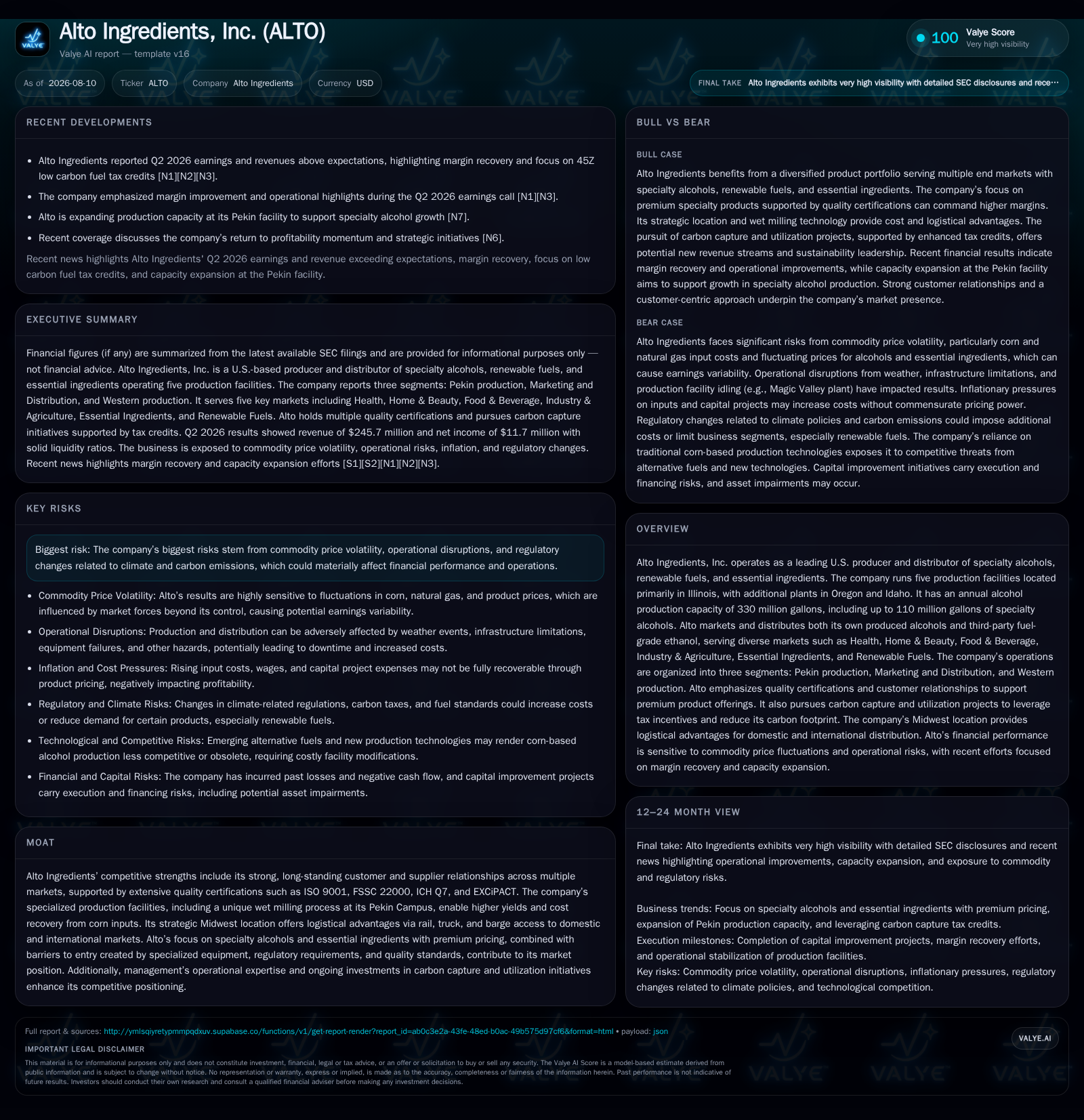
Alto Ingredients, Inc., a midstream producer of specialty alcohols, renewable fuels, and essential ingredients, reported a margin recovery in Q2 2026 driven by improved product mix and operational discipline. The company's diversified business model combines production at five facilities and marketing/distribution of third-party ethanol, serving multiple markets with specialty alcohols commanding premium pricing. Despite exposure to corn and natural gas price volatility, the firm's quality certifications and strategic Midwest footprint underpin its competitive position. Ongoing investments in carbon capture/utilization and selective facility idling address sustainability and economics. Leverage remains significant, posing financial flexibility risks amid historically variable commodity prices.
Recent Operating Update: Margin Recovery Drives Momentum
In its latest quarterly filing ending June 30, 2026, Alto Ingredients reported operating improvements highlighted by margin recovery across segments. This was driven primarily by an emphasis on selling higher-margin specialty alcohols over lower-margin fuel-grade ethanol during challenging commodity input costs [S2][N1]. The company’s strategy to optimize product mix towards premium-quality beverage-grade and pharmaceutical-grade alcohols is starting to show through in operational results, reflecting management's pivot away from predominantly fuel-grade ethanol commoditization.
Additionally, Alto entered into an At-The-Market Issuance Sales Agreement in August 2026 to facilitate equity capital raising flexibility for ongoing investments [S3], signaling proactive financial management alongside operational progress.
Business Model: Integrated Production and Distribution of Specialty Alcohols and Renewable Fuels
Alto’s business model integrates midstream production with downstream marketing/distribution activities [S1]. It operates five production facilities—primarily clustered in Illinois with important Western plants in Oregon and Idaho—yielding a combined annual alcohol production capacity of approximately 330 million gallons. Notably, the company can produce up to 110 million gallons of specialty alcohols annually depending on product mix decisions that balance between industrial-, pharmaceutical-, food- and beverage-grade specifications versus renewable fuel ethanol volumes
The firm's three reportable segments include:
- Pekin Production: Focused on producing specialty alcohols and essential ingredients like distillers grains mostly at three Illinois plants;
- Marketing & Distribution: Encompasses merchant trading and resale of both company-produced alcohols/ingredients as well as third-party fuel-grade ethanol sourced to meet customer demand;
- Western Production: Aggregates output from Western facilities including the liquid CO₂ plant adjacent to Oregon operations.
This integrated structure creates multiple points along the value chain from raw agricultural inputs (primarily corn) through value-added processing (wet milling process yields higher corn oil and protein co-products) to diversified customer end-markets spanning Health & Beauty products, Food & Beverage industries, industrial use cases, agriculture feed essentials (WDGS/DDGS), and Renewable Fuels blending [S1][N1]. Wholesale fuel-grade ethanol distribution includes both direct sales from owned production and merchant sourcing to satisfy volume commitments.
Revenues are generated primarily through sales contracts that vary between fixed-price specialty alcohol agreements for consumer product customers—where pricing power can be sustained—and more volatile spot or indexed pricing for fuel ethanol marketing activities [S2]. Managing inventory levels of purchased third-party ethanol is essential given the lag between purchase commitments at a current market price versus later-sale index-based pricing that can create margin pressure or losses during declining price environments
Industry Structure and Competitive Position
Alto Ingredients operates within the specialized niche of U.S. alcohol producers differentiated by an emphasis on higher-quality specialty products beyond commodity fuels. The industry is capital-intensive with high exposure to commodity input cost volatility—principally corn kernels as feedstock and natural gas for process energy. This volatility impacts margins significantly due to fluctuating spread dynamics between raw material costs and finished product prices.
Peers generally include vertically integrated ethanol producers who also have specialty capabilities such as Green Plains Inc. or Darling Ingredients; however, Alto’s strategic focus on certified quality standards (ISO 9001 for quality management systems; FSSC 22000 targeting food safety; ICH Q7 compliant for pharmaceutical quality; EXCiPACT for excipient GMP compliance) fortifies barriers to entry by offering trusted ingredient profiles essential for health-related applications [S1].
The company’s Pekin campus benefits from geographic advantage: proximate rail lines with connections enabling transport via truck or barge support broader U.S. distribution channels including export potential. Such multi-modal logistics infrastructure helps control delivery costs and enhances service reliability relative to competitors with less flexible routes or fewer certified production assets.
Facility operational status is dynamic due to economic factors—most notably the Magic Valley plant in Idaho has been subject to cyclical hot-idle followed by a cold-idle since end-2024 because market spreads didn’t justify continued production despite investments made to optimize corn oil extraction systems there [S1][S2]. This demonstrates responsiveness to market signals but also highlights risk of sunk-cost asset idling under adverse commodity conditions.
Growth Drivers
Key growth opportunities include:
- Expansion of Specialty Alcohol Applications: Heightened demand in Health & Home Beauty sectors fuels need for purer grade alcohols suitable for pharmaceuticals, cosmetics, sanitizers—a trend strengthened post-pandemic which favors differentiated Alto products with certified quality controls [N1].
- Renewable Fuel Adoption Dynamics: Broader acceptance of E15 fuel blends under evolving U.S. energy policies could incrementally increase ethanol consumption volumes beyond current mandates; Alto participates through both production uplift possibilities (if economics improve) and via third-party marketing volume growth [N9].
- Carbon Capture & Utilization: Investment in proprietary CO₂ liquefaction adjacent to Oregon operations opens new revenue avenues by commercializing biogenic CO₂ streams otherwise emitted; this positions Alto advantageously as carbon regulation tightens while enabling partial offsetting of environmental liabilities [N8][S1].
- Debottlenecking Initiatives: Operational enhancements aiming to squeeze incremental capacity out of existing assets without heavy capital expenditure could drive incremental volume gains while improving fixed-cost absorption metrics [N11].
- Geographic & International Market Expansion: Targeted distribution network extending reach beyond Midwest heartland into other U.S. regions or exporting essential ingredients leveraging logistical advantages offers incremental scale economies.
Risks and Constraints
Several risks temper Alto’s performance outlook:
- Commodity Price Volatility: Corn prices remain highly variable due to weather patterns, global grain markets, inflationary pressures; natural gas costs further add input complexity causing periodic margin compression leading to facility idling decisions that disrupt cash flow predictability [S2][S13].
- Regulatory Environment: Changes affecting renewable fuel credits such as Section 45Z tax credits for low-carbon fuels impose revenue uncertainty given legislative timelines (current credit available only through 2030 with transferability ceasing earlier); failure to meet carbon intensity thresholds or prevailing wage rules could materially impact credit eligibility or amounts received [S12].
- Operational Disruptions: Plant downtime risks include maintenance issues given complex wet milling equipment; supply chain bottlenecks can affect timely input availability or shipment reliability; insurance coverage gaps exist for certain environmental hazards creating potential loss exposure [S13].[
- Counterparty Risks: Fixed-price contracts coupled with customer payment delays or renegotiation requests during falling price environments elevate receivables risk.
- Leverage Constraints: High outstanding indebtedness limits financial maneuverability amid volatile earnings periods; debt covenant breaches pose refinancing risk especially if operating conditions deteriorate sharply [F1][S10][S12].
What To Watch Next
Investors should monitor:
- Quarterly margins segmented between specialty alcohol products vs renewable fuels reflecting sustained premium penetration or reversion toward commoditized fuels.
- Utilization rates at idled or partially operated facilities such as Magic Valley for restart signals aligned with improving spread economics.
- Progress reports on carbon capture project commercialization outcomes coupled with any announced sustainability certifications that may bolster long-term competitiveness.
- Developments regarding Section 45Z tax credit policy extension or replacement influencing low-carbon fuel profitability.
- Inventory levels of third-party sourced ethanol against market price trends as an early indicator of merchant trading margin risk.
- Debt servicing capacity measured against free cash flow amid capital expenditure schedules tied to debottlenecking plans or facility upgrades.
Financial Profile Discussion
At June 30, 2026, Alto held around $24 million in cash & equivalents against $149 million in total debt resulting in a net debt position north of $125 million—a sizable leverage level typical in this capital-intensive sector but one that demands careful cash flow management especially given earnings cyclicality driven by commodity price swings [F1]. The company's current ratio stood robustly at approximately 3.19 suggesting sufficient near-term liquidity coverage of current liabilities including working capital needs [F1].
Recent equity raise capability evidenced by the At-The-Market Sales Agreement filed August 2026 further supplements financial flexibility for ongoing projects though timing remains contingent on market conditions [S3]
Capital expenditures continue focused on scaling specialty alcohol infrastructure while selectively limiting investment in lower-margin fuel-oriented assets until market fundamentals stabilize. Operating income has rebounded modestly but still reflects the challenging input cost environment extending from late 2024 into early 2026 periods [F1].[ Maintaining adherence to covenants is critical—any adverse shock impacting spreads or regulatory frameworks could strain the balance sheet necessitating defensive liquidity actions.
This analysis is based solely on publicly filed documents from Alto Ingredients Inc., recent news coverage through August 2026, and established industry knowledge within specialty alcohols and renewable fuels production sectors. It does not constitute investment advice but serves as an informed synthesis integrating operational updates with strategic context.
Disclaimer: This is research-only, informational analysis and not investment advice. It may include AI-generated interpretation and general industry context. Always verify important details using primary sources.

Comments