
ICF International Expands Contract Backlog and Leverages AI to Enhance Government Consulting
Q2 2026 results reveal growing backlog alongside AI and cloud integration fueling competitive advantage in complex government services.
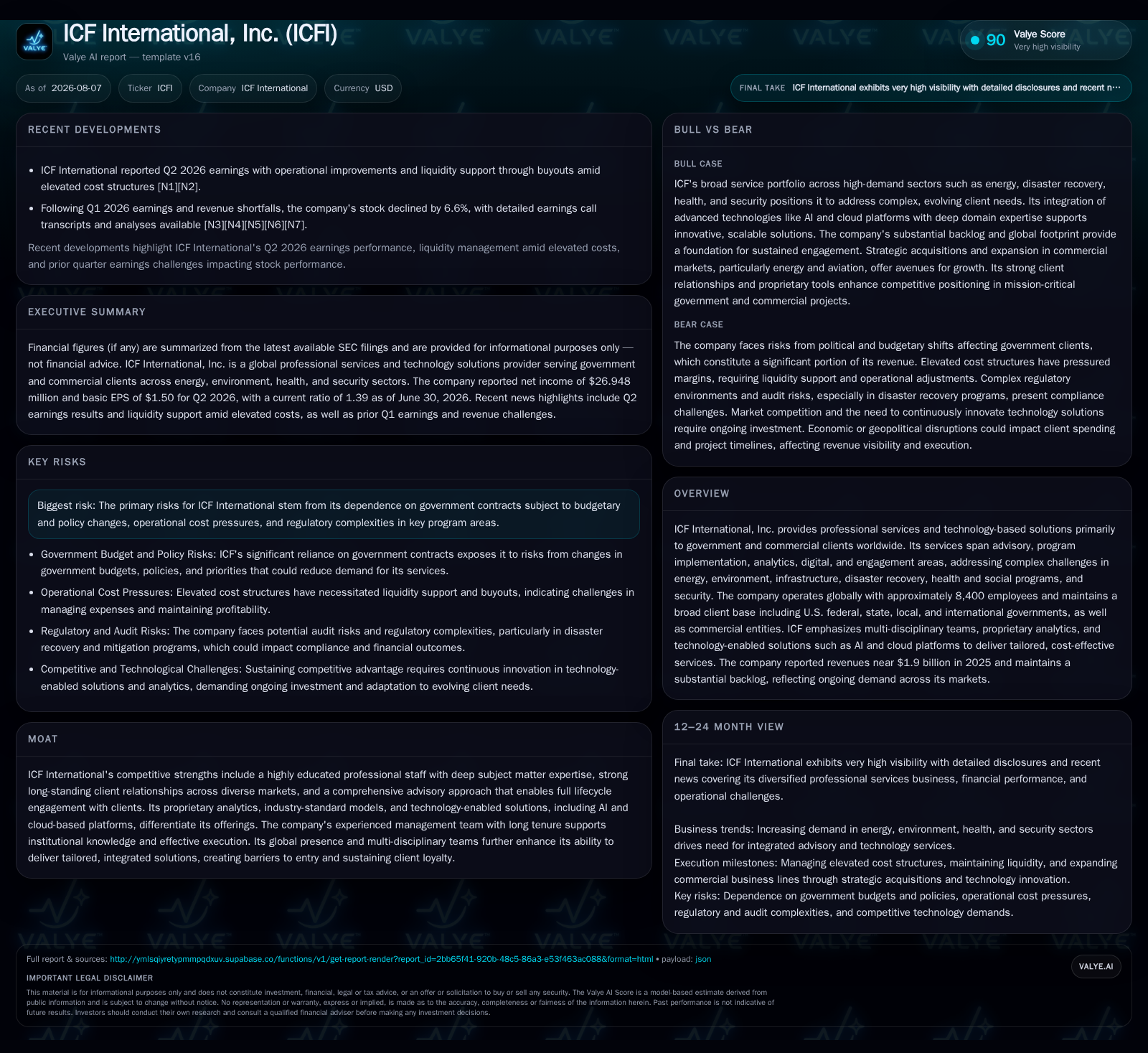
ICF International reported a notable increase in contract backlog in Q2 2026, signaling sustained demand for its multi-disciplinary advisory and implementation services amid an evolving government contracting landscape. The company’s embedding of AI and cloud platforms into analytics and digital transformation offerings reinforces its differentiation in professional services tailored to government and regulated industries. While political and budgetary uncertainty remain risks, ICF's diversified client base, expanding technology-enabled capabilities, and sizeable backlog underpin its growth resilience.
Second Quarter Operating Update: Backlog Expansion Strengthens Growth Visibility
In the latest quarterly filing dated August 6, 2026, ICF International disclosed an increase in its contract backlog that underscores ongoing strength across its government and commercial service lines [S2],[S3]. This expanded backlog operates as a critical leading indicator of future revenue streams given the time-and-materials or fixed-fee contract structures that dominate ICF's business model. The company’s backlog size improvement is particularly meaningful within the context of prevailing government budget uncertainties where appropriations cycles can compress short-term demand but backlog buffers create revenue visibility lasting multiple quarters to years. Confirmation of this trend will depend on sustained or further growth in backlog combined with stable utilization rates of ICF’s highly skilled professional staff.
The market response reflected positively to this update, consistent with industry dynamics where large consulting firms serving public sector clients leverage backlog expansion as a proxy for durable pipeline health [N1]. This suggests that despite federal budgetary pressures that have contracted some peers' pipelines recently, ICF’s multi-disciplinary approach enables resilience by addressing a broad array of client needs from energy infrastructure to social program modernization.
Integrated Service Delivery Model Combines Expertise with Next-Gen Technologies
ICF operates a comprehensive service delivery footprint: Advisory Services provide strategic insights; Program Implementation turns those strategies into effective actions; Analytics Services use advanced modeling enriched by AI; Digital Services modernize IT infrastructure including cloud migrations; while Engagement Services drive communication goals with client stakeholders [S1]. This end-to-end lifecycle engagement model creates stickiness by allowing ICF to follow clients from initial strategy through deployment and evaluation.
Particularly notable is the firm's recent focus on deploying proprietary AI capabilities through its ICF Fathom platform introduced in 2025. This technology enhances data analytics offerings by automating complex data transformations and enabling predictive insights that fuel more cost-effective policymaking and program management [S1],. Integration of cloud platforms further enables scalable service delivery with improved security and agility. The fusion of domain expertise with these technology-enabled solutions supports differentiated pricing power unlike standard consulting engagements reliant solely on billable hours.
Operating leverage derived from this tech infusion is expected to manifest through enhanced project margins as automation accelerates delivery cycles without proportionate increases in headcount.
Market Position Amid Government Contracting Dynamics
Within the broader professional services landscape focused on government markets, ICF holds competitive positioning alongside peers such as Booz Allen Hamilton (noted for broad consulting capabilities), AECOM (strong environmental/infrastructure focus), Accenture (digital transformation leader), SAIC, and Leidos Holdings (government IT/security specialists). While public sector procurement is naturally price-sensitive due to regulatory oversight and tight budgets, ICF mitigates this by securing niche specialization across energy/environmental policy consulting as well as health/social programs which face expanding compliance demands.
Long-standing client relationships developed over decades imbue the company with favorable renewal prospects despite political shifts. Strategic diversification across federal (approx. 43% revenue share), state/local (17%), international governments (7%), and commercial clients (33%) provides resilience against any single market’s downturns [S24]. Nonetheless, sensitivity remains around annual contract rebidding cycles requiring persistent investment in business development.
Regulatory complexity inherent in energy transitions or disaster recovery programs also creates barriers to entry favoring established firms like ICF with deep subject matter experts capable of navigating compliance challenges efficiently.
Key Growth Levers: Backlog, AI Integration, and Diversified Client Base
Government emphasis on infrastructure modernization, climate-related programs, cybersecurity enhancement, disaster recovery planning, along with accelerated demand for digital transformation collectively drive ICF’s growth runway. The company’s Q2 backlog expansion reflects wins related to energy resilience projects aligned with increasing electrification initiatives fueled by data center expansions supporting AI workloads highlighted in their annual reports [S1]
Utilization metrics—though not explicitly disclosed quarterly—are typically pivotal KPIs indicating efficiency gains or margin pressure; stable to improving utilization would confirm successful absorption of higher tech-enabled project mixes without productivity dilution.
Global presence beyond U.S., including offices in the UK, Belgium, Spain, India, and Canada supports access to growing European markets focused on climate change regulation compliance where cutting-edge advisory services are critical. This multiregional footprint combined with multi-sector diversification reduces client concentration risk while enlarging total addressable market scope.
Operational Risks: Revenue Concentration, Cost Pressures, and Regulatory Complexity
ICF identifies several key risk vectors impacting growth durability including budgetary constraints at government levels which can delay or reduce contracting opportunities [S1]. Labor cost inflation remains a structural challenge given the need to recruit highly educated subject matter experts skilled in emerging technologies such as AI. Failure to retain top talent could undermine project quality or delivery timeliness.
Regulatory risk looms large particularly in environmental or health program areas where changing policies necessitate rapid adaptation. Further cyber threats constitute operational hazards despite robust enterprise risk management processes incorporating NIST standards and frequent penetration testing routines reported by management [S1]. Successful risk mitigation will hinge on continued investment in cybersecurity governance alongside proactive scenario planning.
Project execution complexity inherent in long-cycle contracts presents risks of margin erosion if unforeseen delays or scope changes occur. While diversified clients offer insulation against downturns at any one agency or sector segment, concentration among federal contracts (~43% revenue) requires close monitoring.
What to Monitor Next: Backlog Trends, Contract Awards, Utilization Metrics
Upcoming quarters will be telling regarding whether the Q2 backlog rise marks a sustainable inflection or transient reorder effect connected to specific contract awards. Investors should track sequential backlog changes alongside billable hours or utilization rate disclosures when available as leading indicators of operational execution quality.
Additionally, significant new contract awards particularly within AI-enabled analytics or energy resilience verticals would validate technological adoption momentum supporting margin improvement narratives.
Changes in client composition or geographic mix could signal shifting strategic priorities responding to regional policy initiatives or geopolitical trends affecting funding availability.
Financial Profile Discussion: Liquidity, Debt Structure, and Margin Support
At quarter-end June 30, 2026, ICF held approximately $4.62 million in cash against total debt near $408 million yielding net debt around $403 million; current assets balance was $579 million versus current liabilities of $418 million resulting in a healthy current ratio of about 1.39 evidencing adequate short-term liquidity to fund ongoing investments in workforce expansion and technology platforms [F1]
Manageable leverage supported by amended credit facilities extending maturities into 2031 provides capital structure flexibility important for absorbing acquisition opportunities or financing incremental R&D for proprietary tools enhancing competitive positioning.
This analysis synthesizes SEC filings from Q2 2026 alongside prior annual disclosures augmented by professional services industry context highlighting how ICF International strategically manages multi-sector expertise blended with technology solutions to sustain growth amid evolving government demand patterns. Readers should watch incremental backlog developments and operational cadence metrics such as utilization rates as concrete markers confirming durable momentum versus cyclical variability inherent to public sector consulting engagement cycles.
This article is intended solely for informational purposes without research view toward any investment action.
Disclaimer: This is research-only, informational analysis and not investment advice. It may include AI-generated interpretation and general industry context. Always verify important details using primary sources.

Comments