
Cable One Advances Broadband Expansion and Debt Refinancing with Strategic Infrastructure Investment
Q2 2026 results reveal targeted capital investments aimed at network quality alongside active debt refinancing efforts shaping Cable One’s operational and financial trajectory.
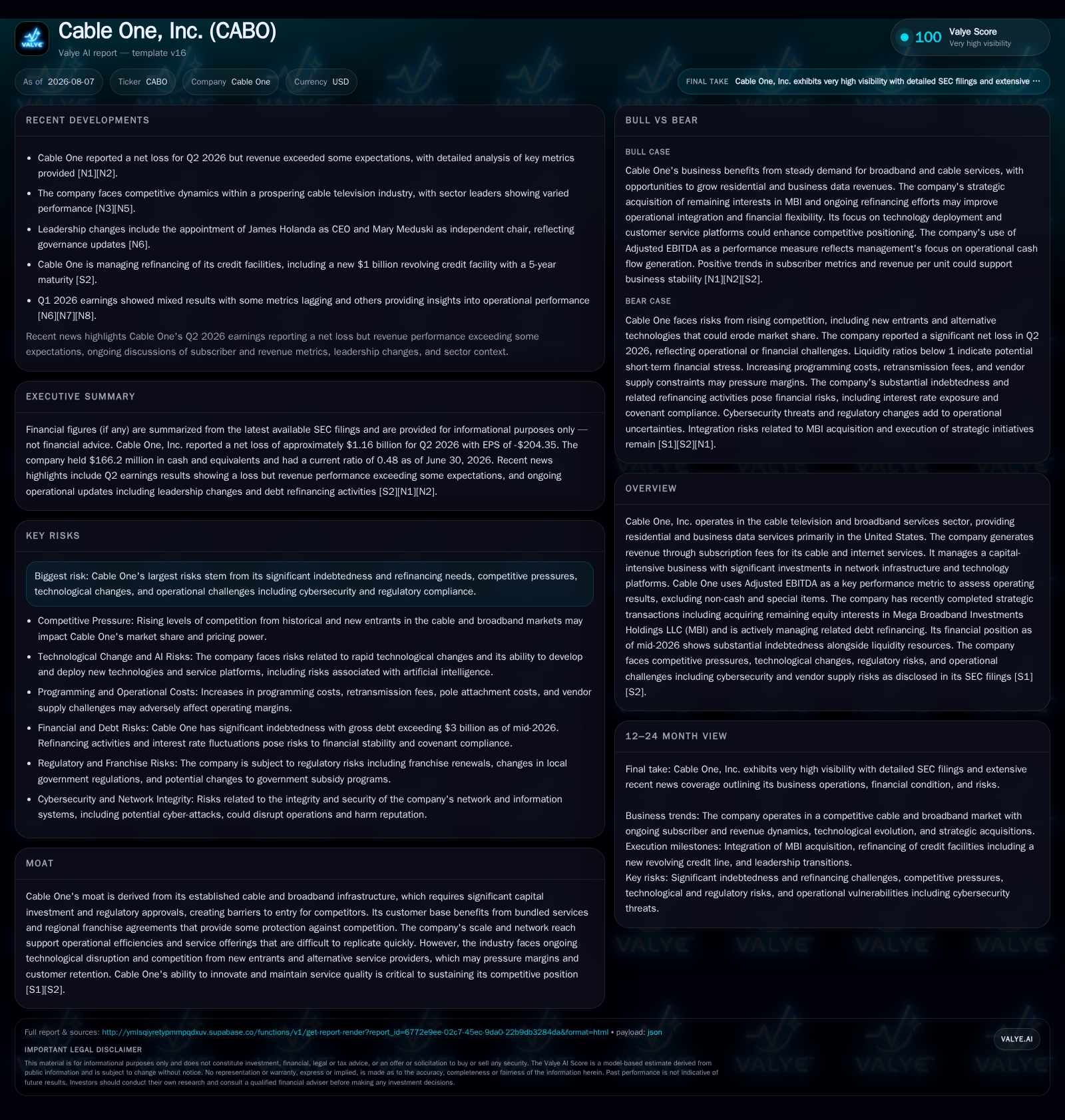
Cable One's Q2 2026 filing highlights deliberate capital expenditure on broadband infrastructure to sustain competitive service tiers amid ongoing subscriber dynamics. The company is engaged in managing significant leverage through refinancing transactions while maintaining a focus on subscription revenue streams from bundled residential and business broadband services. Competitive pressures and regulatory factors underscore the importance of sustaining network quality and customer retention, with future milestones centered on subscriber trends, capex execution, and debt restructuring developments.
Q2 Operational Metrics Highlight Capital Deployment Choices
Cable One's second quarter fiscal update filed August 6, 2026 [S2][S3] confirms a focus on deploying capital expenditures targeting network infrastructure enhancement critical for broadband service quality. The company continues investing in physical network assets required to meet growing demand for high-speed data while managing legacy cable television services. Though net residential data subscriber losses were expected in the range of 16,000 to 18,000 units [S16], these dynamics reflect broader industry churn trends rather than abrupt market share shifts. Average Revenue Per Unit (ARPU) for residential data was guided to about $80 to $81 monthly, illustrating stable monetization despite pricing pressures [S16]. Adjusted EBITDA performance remains a key indicator for Cable One as it excludes non-cash charges such as depreciation arising from substantial capital assets [S8], reinforcing focus on underlying operational profitability.
This capex emphasis underpins Cable One’s strategy to uphold network uptime and service tier competitiveness. CapEx is inherently lumpy but essential for reducing churn by sustaining high-quality broadband availability. The interplay between subscriber metrics, ARPU stability, and capex deployment will be pivotal in validating demand strength going forward.
Subscription Revenue Model Shaped by Bundled Broadband Services
Cable One’s revenue model centers on recurring subscription fees derived from tiered packages that bundle broadband internet with cable television options targeting both residential consumers and business clients [S1]. Residential broadband subscriptions provide the bulk of revenue, complemented by business data services tailored for local enterprises requiring reliable connectivity. Bundling video with internet access offers a natural churn mitigation tool enabling higher lifetime customer values through multi-service contracts.
The company’s ability to upsell customers into higher priced service tiers supports ARPU growth, albeit tempered by competitive offerings from telecommunications providers [S1]. Franchise agreements provide regional exclusivity that constrains new entrants but do not eliminate competition risks entirely. Interactions among pricing power, retransmission fees paid for video content rights, and customer acquisition costs shape margin structure crucially.
Competitive Landscape and Industry Economics Within Cable Broadband Sector
Cable One operates within an intensely capital-intensive market characterized by entrenched players such as Charter Communications and Comcast Corporation offering scale advantages in network reach. Competition arises not only from fellow cable operators but increasingly from satellite providers and telecom companies deploying fiber networks; streaming platforms indirectly affect demand by shifting consumer video consumption preferences.
Ownership of robust physical network infrastructure undergirds Cable One’s moat due to high barriers for competitors seeking comparable scale without extensive capital outlays or regulatory approvals [S1]. Franchise agreements furnish geographic protection that complements bundling strategies against substitution risks. Nonetheless, rising programming costs and retransmission fees represent ongoing cost pressures limiting margin expansion potential [S19].
Capital Expenditure Focus Supports Infrastructure Amid Demand Growth
Repeated emphasis throughout recent filings places Cable One’s capex plans at the core of maintaining a viable competitive posture [S2][S1]. Capital expenditures are primarily directed toward augmenting hybrid fiber-coaxial networks to elevate bandwidth capacity while consolidating service reliability. This investment cycle seeks to preempt customer turnover induced by inferior network performance relative to fiber-focused competitors.
Given the structural importance of capex in sustaining ARPU levels through upgraded service tiers, shifts in spending can presage changes in achievable operating income margins over subsequent quarters. Furthermore, some spending is channeled toward integrating acquired assets — notably the recent full consolidation of Mega Broadband Investments Holdings LLC (MBI) — which adds complexity but also incremental scale [S3]. Monitoring capex intensity relative to free cash flow generation will provide insight into balance sheet strain versus growth investment trade-offs.
Debt Refinancing Activities Reshape Financial Flexibility Profile
With total gross debt exceeding $3 billion as of June 30, 2026, net of approximately $166 million cash balances [F1][S16], Cable One operates under significant leverage typical for cable broadband operators managing infrastructure-heavy businesses. Recent disclosures detail active refinancing arrangements involving exchange offers tied to MBI-related senior secured term loans aiming to optimize maturity distribution and reduce interest costs [S6][S15]. The company contemplates whether to consummate certain exchange offers or leave existing secured term loans intact with limited additional credit support from the parent entity [S16].
Successfully optimizing debt structure impacts weighted average cost of capital favorably and influences discretionary free cash flow availability for reinvestment or shareholder returns. This backdrop underscores that financial engineering forms a vital component of operating flexibility alongside demand-side initiatives.
Key Risks from Intensifying Competition and Balance Sheet Leverage
Cable One’s risk profile embodies classic themes faced by cable broadband providers: elevated indebtedness coupled with potentially volatile refinancing environments may restrict strategic maneuvering during industry headwinds [S19][S2]. Competition remains intense as alternative connectivity options proliferate including mobile wireless advanced networks competing for consumer data budgets.
Technological innovation demands continual adaptation in service offerings and infrastructure upgrades or risk customer attrition. Rising content programming fees add cost pressures while regulatory scrutiny over franchise obligations persists. Cybersecurity exposures heighten operational risk given growing threats targeting network integrity [S19]. Customer churn velocity combined with ARPU compression can undermine revenue growth unless offset by effective bundled product differentiation.
What to Watch: Subscriber Growth, CapEx Execution, and Refinancing Milestones Ahead
Upcoming quarters should spotlight shifts in net subscriber counts indicating Cable One’s retention efficacy amidst evolving competitive alternatives. Incremental ARPU movements tied to successful upselling or pricing adjustments warrant close monitoring reflective of market tolerance. Execution tempo on capital projects upgrading broadband infrastructure will serve as leading indicators for sustained platform competitiveness.
On the financial front, updates regarding completion timing and terms of refinancing transactions — particularly concerning MBI-related debt instruments — will materially affect balance sheet durability benchmarks.
Regulatory developments impacting franchise agreement terms or retransmission fee frameworks bear watching as indirect modulations on profit margins. Finally, tracking integration progress post-MBI acquisition provides insight into anticipated synergies realization timelines versus execution risks.
Financial Profile Discussion: Leverage, Liquidity, and Cash Flow Context
As of quarter-end June 30, 2026, Cable One held approximately $166 million in cash against total debt near $3.03 billion yielding net debt around $2.86 billion with a current ratio underscoring liquidity constraints at about 0.48 [F1][S16]. This gearing level aligns with sector norms where substantial borrowing supports capital expenditures essential for network maintenance.
Adjusted EBITDA remains the preferred metric referenced internally and externally for assessing operating health excluding non-cash expenses associated with asset base depreciation [S8]. FCF generation balanced against sizeable CapEx requirements determines the net available resources for deleveraging or incremental growth investments.
This financial profile encapsulates the tension within cable operators balancing growth funding needs against leverage tolerance amid dynamic competitive forces.
This analysis synthesizes publicly filed disclosures up through August 6, 2026 ([S1]-[S3], primarily) complemented by recent news ([N1],[N2]) without explicit extrapolation beyond verified data points. No investment research views are made herein; this report aims solely to elucidate Cable One’s latest operational context within its sector dynamics respecting valuation implications indirectly through performance metrics discussion.
Disclaimer: This is research-only, informational analysis and not investment advice. It may include AI-generated interpretation and general industry context. Always verify important details using primary sources.

Comments